
How LinkedIn Works Like a Recruiter Search Engine
Many experienced professionals treat LinkedIn as a digital business card. Recruiters usually do not. They often use it like a search engine: they search by job title, skill, industry, location, and filters, then review the profiles that look relevant first.
That is why LinkedIn profile SEO matters. Your profile does not need clever wording. It needs clear positioning, recognizable terminology, and easy-to-scan evidence that matches the searches recruiters actually run.
In practice, recruiters often look for three things early:
- A recognizable job title
- Relevant keywords tied to the role
- A profile that confirms credibility quickly
If your headline is vague, your experience section is generic, and your skills are random, you become harder to find and harder to trust. If your profile uses clear role language and consistent terms, you improve discoverability and make it easier for a recruiter to understand your fit.
A strong profile also increases the impact of your summary. If you need to sharpen that message, learn how to write a strong LinkedIn bio .
Profile Photo and Banner: Professional, Simple, and Corporate-Safe
Your photo and banner are not the core of profile SEO, but they influence whether someone stays on your profile after finding you.
For your photo, use a current professional image with:
- Good lighting
- A simple background
- Clear visibility of your face
- Business or business-casual clothing that fits your field
Avoid heavy filters, casual social photos, strong edits, or distracting poses. The goal is not to look artistic. The goal is to look credible and easy to place in a professional context.
Your banner should support your brand without creating visual noise. A clean design, subtle brand colors, or a simple industry cue can work well. Avoid banners with too much text, too many icons, or slogan-heavy designs.
For most experienced professionals, simple and corporate-safe performs better than flashy.
Location and Open-to-Work Settings That Support Search
Location affects visibility because recruiters often filter by geography early in the search process. This matters when roles require local presence, regional understanding, or a clear target market.
Use the location that best reflects your real professional target. If you are focused on roles in Saudi Arabia, your profile should not create confusion about where you want to work.
Your Open-to-Work settings also affect how your profile is interpreted. A controlled setup is often better than a very broad public signal, especially for experienced professionals in senior, client-facing, or leadership roles.
A practical approach is to:
- Keep target job titles focused
- Choose locations carefully
- Avoid signaling interest in too many unrelated roles
- Review visibility settings before sharing your profile
The aim is to improve matching, not to look available for everything.
Contact Info and a Clean Custom URL
This section is small, but it helps trust and professionalism.
First, claim a clean custom LinkedIn URL. It should ideally use your real name or a consistent professional name format. Avoid long number strings or inconsistent spelling.
Second, keep contact details selective. Email is usually enough. Phone number is optional. If you add external links, make sure they support your professional case, such as:
- A portfolio
- A personal website
- A project page
- A speaking or publication profile
Do not add weak or outdated links just to fill the section. A small number of relevant links is stronger than a long list of low-value ones.
Also make sure your name, spelling, and job-title presentation align with the rest of your job search materials. That becomes even more useful when paired with a clear process to apply for jobs in Saudi Arabia .
Keyword Strategy for LinkedIn, Not ATS
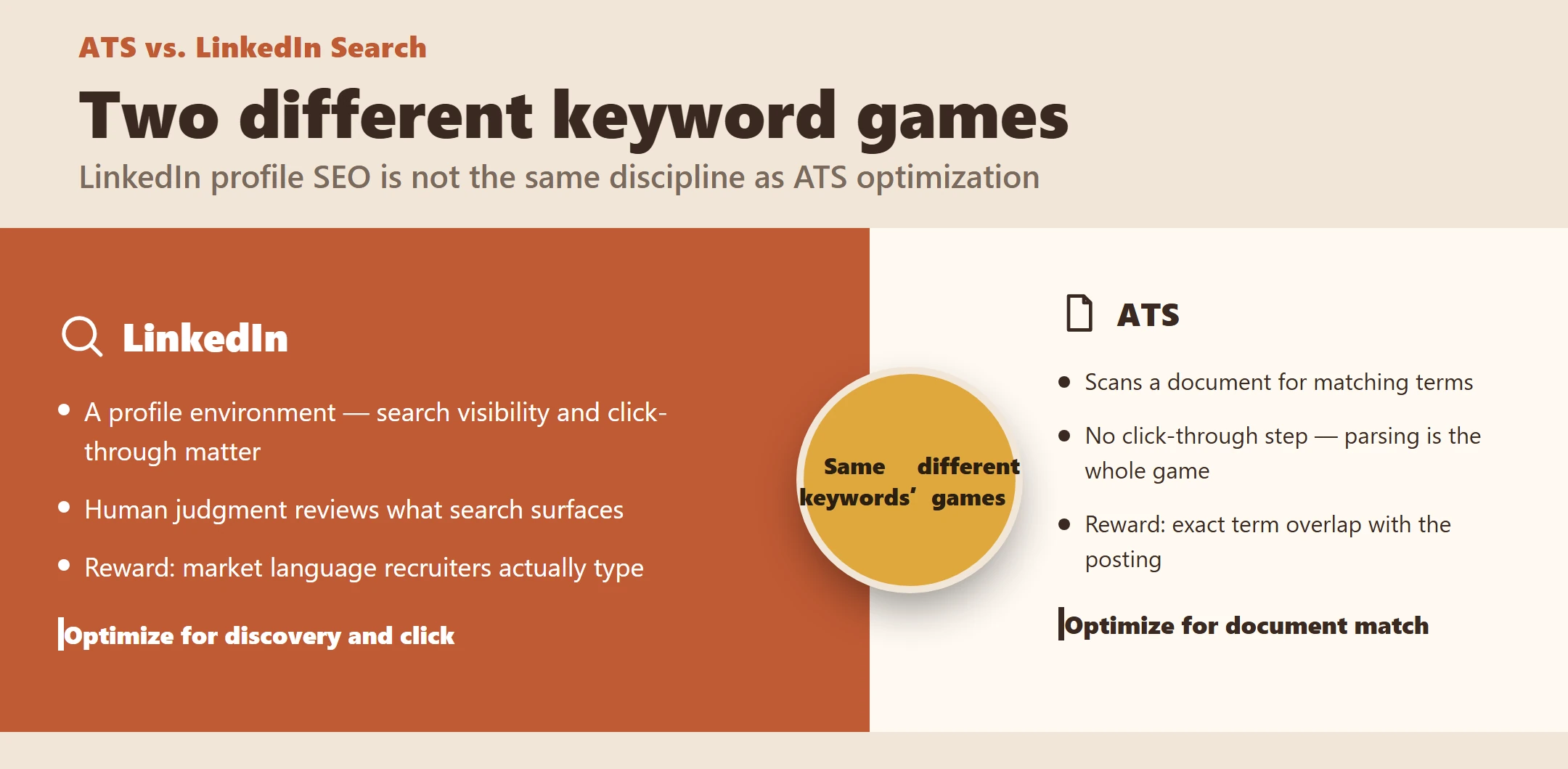
LinkedIn profile SEO is not the same as ATS optimization. An ATS usually scans a document for matching terms. LinkedIn is a profile environment where search visibility, click-through, and human judgment all matter.
So your keyword strategy should focus on the terms recruiters are likely to type, including:
- Standard job titles
- Functional skills
- Core tools and systems
- Industry terms
- Seniority indicators
Use market language, not internal company jargon. A recruiter is more likely to search for “Finance Manager” than a custom internal title. They may search for “Supply Chain Planning” or “CRM,” not vague phrases that sound impressive but are not searchable.
The best keywords are not the fanciest words. They are the clearest searchable words.
Your headline is especially important here because it affects both discovery and clicks. For practical title structures, review these LinkedIn headline examples .
Build a LinkedIn Keyword Bank Before You Edit
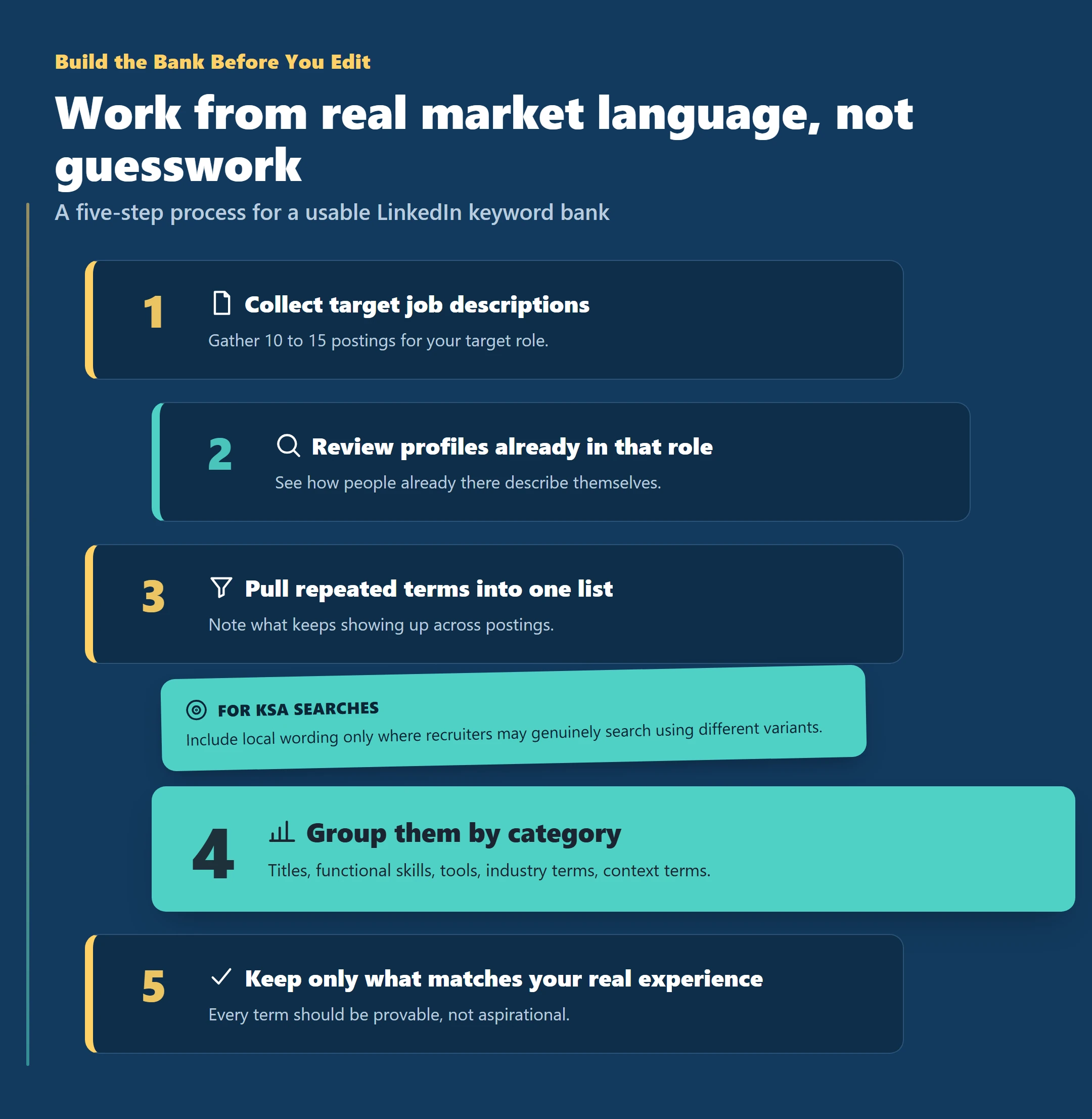
Before changing your profile, build a keyword bank. This helps you work from real market language instead of guessing.
A simple process works well:
- Collect 10 to 15 target job descriptions.
- Review profiles of professionals already in your target role.
- Pull repeated terms into one list.
- Group them by category.
- Keep only the terms that match your actual experience.
A useful keyword bank often includes:
- Role titles: Marketing Manager, Senior Accountant, Product Manager
- Functional skills: Budgeting, stakeholder management, forecasting, process improvement
- Tools and systems: SAP, Salesforce, Excel, Power BI
- Industry terms: Banking, healthcare, logistics, retail
- Context terms: B2B, compliance, transformation, regional operations
For Saudi-focused searches, include local wording only where it is relevant and true. In some cases, both international and local phrasing can help if recruiters may search using different variants.
Where to Place Keywords Across Your LinkedIn Profile
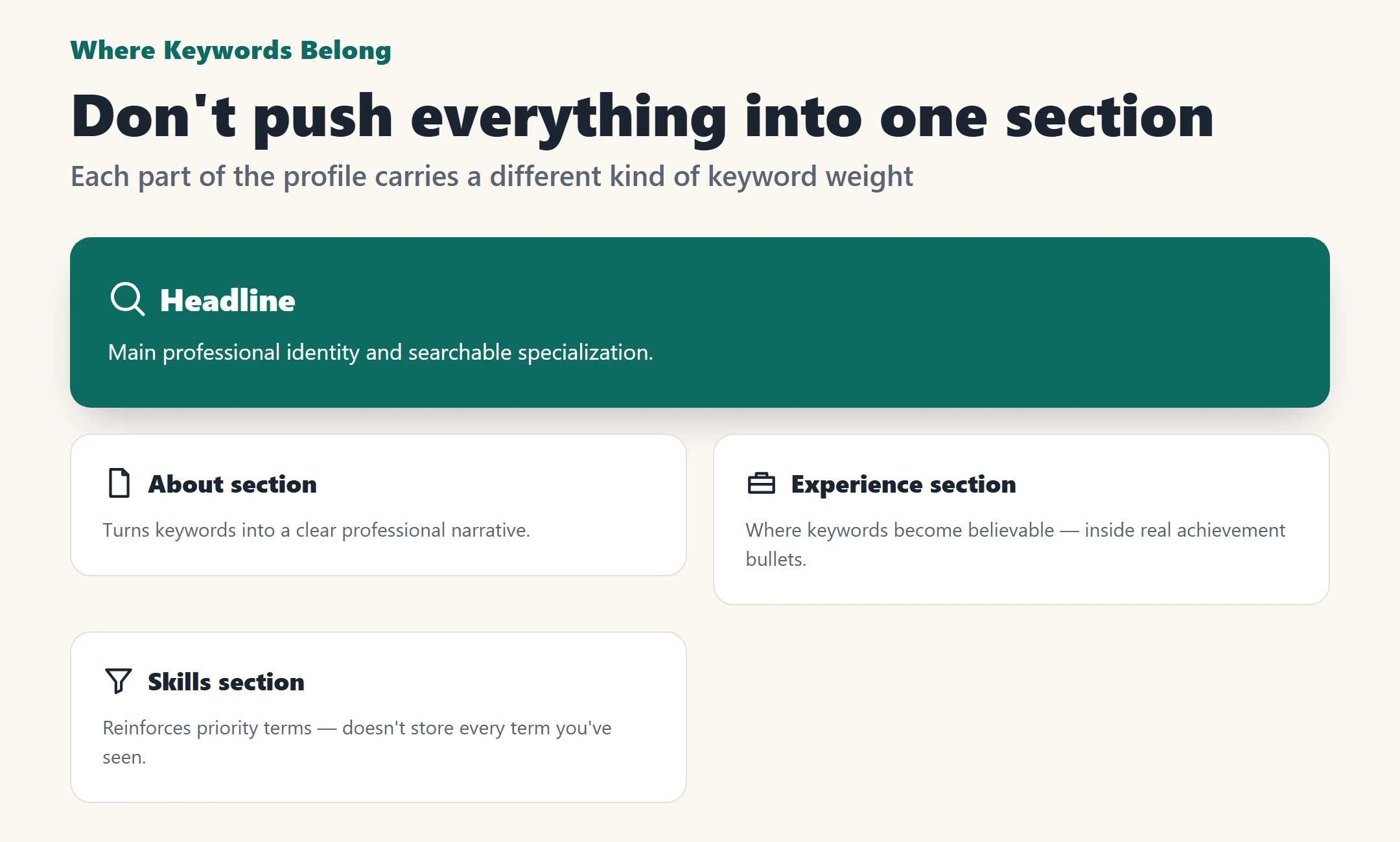
Once your keyword bank is ready, place terms where they belong. Do not push everything into the skills section.
Headline
Your headline should carry your main professional identity and searchable specialization.
Good headline elements often include:
- Current or target role
- Area of specialization
- Industry or function
- One or two high-value keywords
About section
Your About section should turn keywords into a clear professional narrative. Use your most important role terms naturally in the opening lines, then support them with scope, strengths, and outcomes.
Experience section
This is where keywords become believable. Add role-relevant terms inside achievement bullets, project descriptions, and responsibility statements. If you mention planning, compliance, forecasting, pricing, CRM, or transformation, show where and how you used them.
Skills section
Use the skills section to reinforce priority terms, not to store every term you have ever seen. It should support your profile story, not compete with it.
Avoid Keyword Stuffing and Weak Buzzwords
Keyword stuffing makes your profile weaker. It hurts readability, reduces trust, and can make your profile sound machine-written.
Common signs of stuffing include:
- Repeating the same title too many times
- Listing disconnected skills with no proof
- Adding trendy words that do not match your real background
- Writing a headline that reads like a keyword list
Use a simple rule: every important keyword should either describe your real role, reflect your genuine expertise, or be supported somewhere in the profile.
It also helps to remove weak buzzwords such as:
- Results-driven
- Dynamic professional
- Strategic thinker
- Go-getter
These words are rarely strong for search and rarely persuasive without evidence. Better terms are specific, relevant, and supported by your experience.
Skills Section Strategy: Choose Relevant Skills and Order Them Well
For many experienced professionals, the skills section is either ignored or overloaded. Both reduce quality.
A stronger approach is to choose roughly 30 to 50 relevant skills, then prioritize the top 3 carefully. Those top skills should match your target role closely and align with your headline and experience.
Your skills list should be:
- Role-based
- Ordered by importance
- Consistent with your profile story
- Free from random, outdated, or weakly relevant items
Example skill structures by role
Growth or marketing role
- Core: Growth Strategy, Performance Marketing, Demand Generation, CRM, Analytics
- Supporting: A/B Testing, Lifecycle Marketing, Content Strategy
- Tools: Google Analytics, HubSpot, Meta Ads
Sales role
- Core: B2B Sales, Negotiation, Account Management, Forecasting, Pipeline Management
- Supporting: Proposal Development, Client Retention, Commercial Strategy
- Tools: Salesforce, CRM Reporting, Excel
Finance role
- Core: Financial Reporting, Budgeting, Forecasting, Internal Controls, Audit Support
- Supporting: Variance Analysis, Business Partnering, Compliance
- Tools: Excel, ERP Systems, Power BI
Product or tech role
- Core: Product Strategy, Roadmapping, User Research, Stakeholder Management, Delivery
- Supporting: Prioritization, Agile, Experimentation
- Tools: Jira, SQL, Analytics Platforms
Operations or supply chain role
- Core: Supply Chain Planning, Inventory Management, Vendor Management, SLA Management, Cost Control
- Supporting: Process Improvement, Quality, Demand Planning
- Tools: SAP, Excel, BI Dashboards
This kind of ordered structure is much stronger than a random list of unrelated terms.
If your CV or Resume also needs work, we can help you rewrite and optimize it so your positioning is stronger and your applications are ready to send .
Search Appearances: What to Monitor Each Month
LinkedIn provides useful signals through search appearance data. It is not perfect, but it can show how recruiters are finding you.
Review it regularly and ask:
- Which terms are bringing profile views?
- Do those terms match the jobs I want?
- Are important target terms missing?
- Am I attracting the right function and level?
If you appear in unrelated searches, your headline, skills, or About section may be too broad. If you are not appearing for important searches, your keywords may be missing, buried, or not supported strongly enough in the profile.
For most professionals, a monthly review is enough. Make small changes, then watch whether the profile starts attracting better-fit searches.
Keep Your CV and LinkedIn Consistent
Your CV and LinkedIn profile do not need to be identical, but they should tell the same career story.
Make sure these details match across both:
- Job titles
- Dates
- Employer names
- Seniority level
- Core responsibilities
- Career direction
If LinkedIn shows one title and your CV shows a very different one for the same role, recruiters may question accuracy. The same applies to date differences or changes in scope that are not explained.
Use consistent terminology across documents. Your CV or Resume is the application document, while LinkedIn is your searchable public profile. The format is different, but the facts should stay aligned.
Red Flags That Reduce Trust
Even a keyword-rich profile can underperform if trust drops.
Common red flags include:
- Too many buzzwords and too little evidence
- Inflated job titles
- Hidden or unclear gaps
- Vague claims with no context
- Headlines that combine too many unrelated functions
If your background includes career changes, hybrid responsibilities, or a move into leadership, explain it clearly rather than trying to smooth it over with inflated wording.
A profile does not need to look perfect. It needs to look credible.
Myths vs facts
- Myth: More keywords always improve visibility.
Fact: Better keyword choice and better placement matter more than volume.
- Myth: You should add every skill you have ever used.
Fact: Relevance and ordering are more useful than a long list.
- Myth: A flashy design makes a profile look stronger.
Fact: Clarity, consistency, and proof usually create more trust.
Saudi Recruiter Search Behavior and Local Relevance
In Saudi Arabia, recruiter searches may reflect both international role standards and local market expectations. Your profile should therefore be globally understandable while still showing local relevance where appropriate.
Recruiters may pay closer attention to:
- Clear location signals
- Recognizable English job titles
- Industry alignment
- Language capability when relevant
- Evidence of working across regional stakeholders or business environments
Keep localization practical. Mention market exposure, sectors, or regional scope only if they are real parts of your experience. Do not overload the profile with geography terms that do not support your actual background.
How Company Type in KSA Can Affect Profile Emphasis
Different employer types may respond to different parts of your profile, so adjust emphasis based on your target.
Startups
Startups often value adaptability, speed, ownership, and cross-functional execution. Your profile should show practical delivery, problem solving, and measurable outcomes.
Corporates
Larger companies often respond well to structured presentation, recognized titles, and evidence of scale. Clear sections and consistent wording matter more here.
Government-linked or formal institutions
These environments may place more value on professional tone, credibility, and restrained presentation. Keep the profile precise, clean, and consistent.
The goal is not to create different identities. It is to emphasize the parts of your real experience that best match the employer context.
Bilingual Profile Strategy in KSA
A bilingual strategy can help in Saudi Arabia, but too much duplicated text can reduce readability and search clarity.
If you use both English and Arabic, keep these principles in mind:
- Use your main professional language first
- Add Arabic where it improves local relevance or clarity
- Keep titles and descriptions consistent
- Avoid duplicating long blocks that make sections harder to scan
A practical approach is to keep the main structure in one language, then add selective bilingual cues in places such as:
- Headline variants
- Short About section phrases
- Featured materials
- Role or sector terms where local wording is useful
The goal is to stay searchable, readable, and locally relevant without creating clutter. After the profile is optimized, you can also improve reach through professional activity and networking to increase LinkedIn visibility Saudi Arabia .
Final Checklist Before You Share Your Profile
Before sending your profile to recruiters or using it in applications, check the basics:
- Is your headline built around real target keywords?
- Does your About section explain your value clearly?
- Do your experience bullets support the important terms?
- Are your top skills aligned with your target role?
- Is your location accurate and useful?
- Is your custom URL clean?
- Does the profile match your CV or Resume?
- Is the profile readable without buzzword overload?
- Does it fit your Saudi target market where relevant?
Get a professionally rewritten CV/Resume and positioning support for experienced professionals who need stronger applications and clearer alignment—start here .