
If you want to position yourself as high value employee, hard work alone is not enough. In most organizations, value is judged by outcomes, reliability, and the level of trust you create around your work.
For experienced professionals, this matters even more. At this stage, people are rarely assessed only on effort or technical ability. They are assessed on whether they can reduce complexity, move priorities forward, and handle responsibility with confidence.
A high-value employee is not simply busy or visible. A high-value employee becomes trusted for meaningful work.
Ownership, Leverage, Reliability, and Outcomes
High-value employees usually stand out in four ways: ownership, leverage, reliability, and outcomes.
Ownership means you do not wait for constant reminders. You understand the goal, clarify what success looks like, and keep the work moving.
Leverage means your contribution improves more than your own output. You simplify a process, unblock another team, improve decision quality, or help others execute faster.
Reliability means people trust your execution. You meet deadlines, raise risks early, and document decisions clearly.
Outcomes mean your contribution can be described in business terms. That may be faster turnaround, better quality, fewer errors, lower risk, or stronger stakeholder alignment.

Many professionals confuse value with effort. But effort without visible impact is not enough. The more senior you become, the more your value comes from solving the right problems consistently.
Ownership vs Participation
There is a major difference between taking part in work and owning a result.
A participant attends meetings, completes assigned tasks, and responds when asked. An owner does those things too, but also clarifies next steps, anticipates blockers, and follows through until the result is secured.
Ownership often appears in small but important behaviors:
- Clarifying the target before work begins
- Confirming roles, deadlines, and dependencies
- Escalating risks early
- Closing loose ends without being chased
- Following an issue through to the business outcome
If you want stronger internal positioning, choose one problem that matters and become associated with solving it well. This is usually more powerful than trying to look impressive across many unrelated tasks.
A simple rule helps: do not only report activity. Report progress, blockers, decisions, and next actions. That shift makes your judgment look more senior.
Who Decides, Who Influences, and Who Observes
High-value employees understand that career growth is rarely shaped by one person alone. Promotions, trust, and expanded scope are often influenced by three groups:
- Decision-makers who approve promotions, larger responsibilities, or key assignments
- Influencers whose opinions carry weight with leadership
- Observers who see your day-to-day behavior and form a view of your consistency
Your stakeholder map does not need to be political. It needs to be practical.
Ask yourself:
- Who decides whether I get bigger scope?
- Who depends on my work most directly?
- Who sees my performance under pressure?
- Who is likely to mention my name when opportunities come up?
A useful point for many professional environments, including Saudi corporate settings, is that hierarchy awareness matters. You do not need to bypass structure to build influence. In fact, respect for reporting lines and professional tone often strengthens credibility.
Map stakeholders by value, not by title alone. Sometimes the person who sees your reliability most clearly is not the most senior person in the room.
Weekly Updates That Highlight Outcomes, Not Noise
Strong professionals sometimes lose recognition because they communicate too little, too late, or with too much detail.
A good communication cadence is simple: regular, concise, and outcome-focused.
For ongoing work, a weekly update is often enough. It should answer a few practical questions:
- What moved forward this week?
- What outcome was achieved?
- What blocker or risk needs attention?
- What happens next?
This is not about self-promotion. It is about reducing uncertainty. Managers value people who make the state of work easy to understand.
Keep updates short. Avoid long background explanations unless they are necessary. If something is urgent, do not wait for the weekly note. Raise it early, and where possible, bring options rather than only problems.
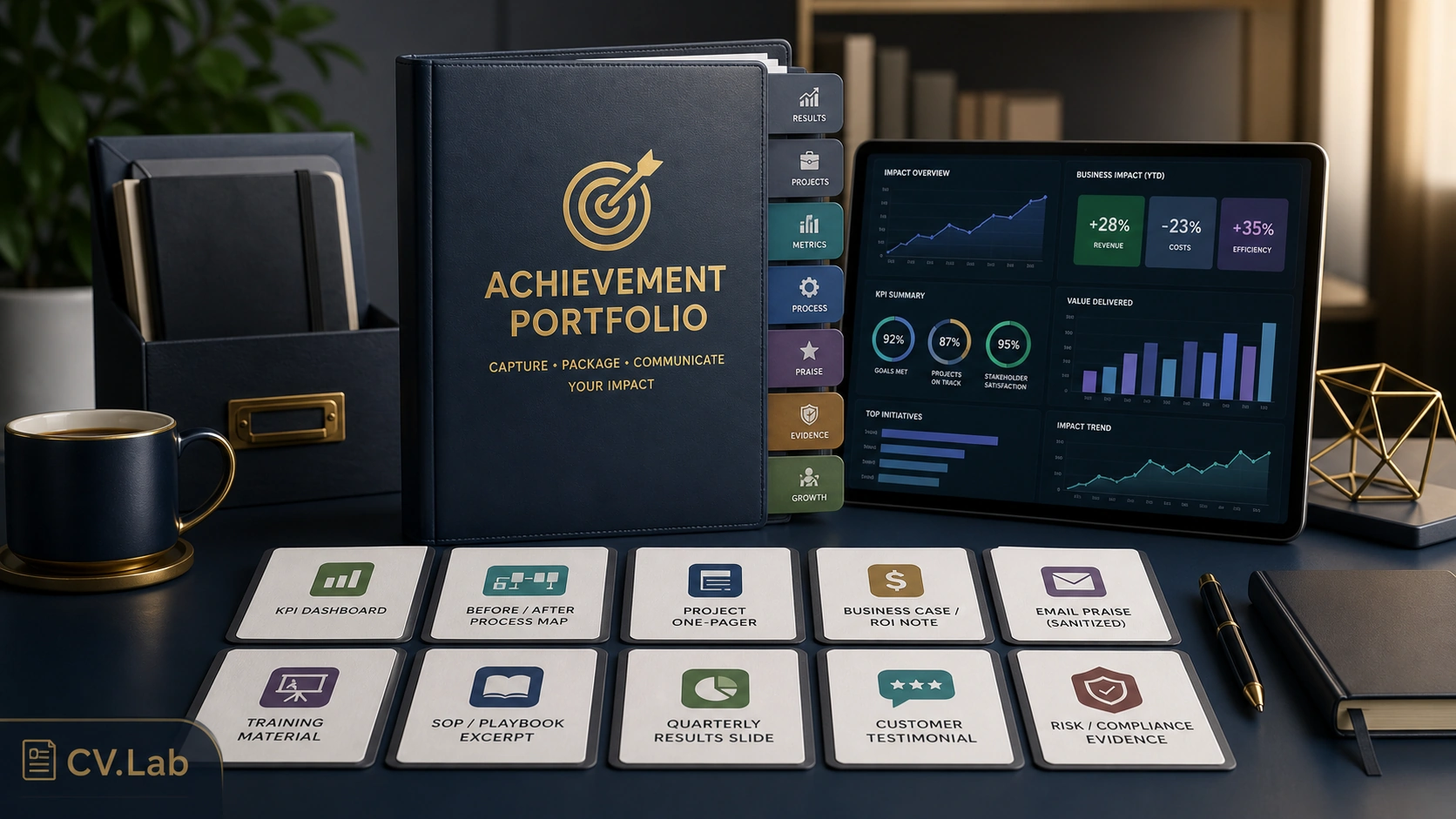
This habit becomes even stronger when you track your wins continuously in an achievement portfolio .
If you want expert help rewriting your CV/Resume so your impact is clear, credible, and ready for applications, we can help you build a stronger document for your next move
.
Measuring Your Impact with the Right Metrics
If you cannot explain your impact clearly, other people may underestimate it.
The right metric depends on your role. You do not need a complicated dashboard. You need useful measures that connect your work to business value.
Relevant impact measures may include:
- Time saved
- Cost controlled or avoided
- Error reduction
- Quality improvement
- Risk reduction
- Service speed
- Process stability
- Better stakeholder satisfaction
Choose metrics that fit your function. For example:
- An operations professional may track turnaround time and error rates
- A finance professional may track accuracy, cycle time, or issues prevented
- A project manager may track milestone delivery and fewer escalations
- A team lead may track onboarding speed, productivity, or quality consistency
If exact numbers are unavailable, use careful before-and-after evidence. You can still describe fewer rework cycles, faster approvals, smoother handoffs, or clearer accountability.
The key is to connect your work to a business result rather than only listing completed tasks. This also makes year-end discussions easier when you prepare your case for performance review preparation .
Building Cross-Functional Leverage
One of the fastest ways to become more valuable is to become useful across team boundaries.
Many business problems do not stay within one function. Delays, handoff issues, unclear ownership, and repeated errors often happen between teams. The person who helps reduce that friction becomes hard to replace.
Cross-functional leverage often looks like this:
- You understand upstream and downstream dependencies
- You communicate in a way different teams can act on
- You reduce confusion in handoffs
- You align timelines, expectations, and decisions
- You spot repeated issues and suggest a shared fix
You do not need formal authority to do this well. You need credibility, responsiveness, and practical thinking.
A strong question to ask is: where does work slow down between teams, and what can I simplify?
When you consistently improve collaboration across functions, your reputation changes. You are no longer seen only as an individual contributor. You become someone who improves execution for others too.
Reliability as a Competitive Advantage
Reliability can look ordinary, but in real organizations it is one of the clearest signs of promotability.
Reliable professionals do not create unnecessary management overhead. They do not surprise leaders with avoidable problems at the last minute. They create confidence.
Reliability includes:
- Meeting deadlines or resetting them early
- Keeping commitments visible
- Documenting decisions and follow-ups
- Following agreed processes
- Raising risks before they become failures
- Maintaining a calm and professional standard
This matters even more in high-pressure periods. When timelines tighten, people naturally trust those who stay steady.
If you want to stand out, become known for two things: you close loops, and you reduce confusion. That may sound simple, but it is a genuine advantage.
Operating Rhythm for Managers
If you manage people, your value is judged partly through your team’s operating rhythm.
A strong manager creates structure without creating unnecessary bureaucracy. Team members should know the priorities, review points, quality expectations, and escalation path.
A practical operating rhythm may include:
- Clear weekly targets
- Short progress reviews
- Coaching linked to actual work
- Fast problem solving when blockers appear
- Monthly reflection on patterns, not just isolated incidents
Managers who create this rhythm often produce better output with less stress. They also signal leadership maturity because they are managing systems, accountability, and clarity rather than only reacting to issues.
If you are moving toward broader leadership scope, this kind of evidence matters when shaping a director-level CV .
Executive Thinking: Priorities, Tradeoffs, Risk, and Governance
To position yourself as high value, start thinking beyond your own task list.
Executive thinking does not mean sounding important. It means understanding how decisions are usually made. Senior leaders often weigh five factors:
- Priority
- Tradeoff
- Risk
- Stakeholder impact
- Governance or process requirements
When you present an idea, frame it through those factors.
Instead of saying, “We should change this process,” explain:
- What problem exists
- Why it matters now
- What tradeoffs are involved
- What risk is reduced or created
- Who needs to be aligned
This makes your judgment easier to trust. It also helps you avoid proposing ideas that sound good technically but are difficult operationally or poorly timed.
Visibility Without Politics
Visibility matters, but it does not require office politics.
You do not need exaggerated self-promotion. You need consistent delivery, factual reporting, and neutral language around outcomes.
Good visibility practices include:
- Sharing progress clearly
- Giving credit to the team
- Naming your contribution without overstating it
- Escalating issues respectfully
- Keeping stakeholders informed without flooding them
A useful formula is simple: context, outcome, next step.
For example:
- “We resolved the issue affecting handoff timing.”
- “Response time improved after the revised process.”
- “Next, we are standardizing the checklist across both teams.”
This keeps the focus on value, not ego. It is especially useful in environments where professionalism, hierarchy awareness, and measured communication are respected.
Building a Reputation for Leadership
Leadership reputation often starts before a title change.
People begin to see you as a leader when you improve standards, help others perform better, and stay composed under pressure.
Common leadership signals include:
- Coaching colleagues without creating dependence
- Setting a clear quality bar
- Handling escalation calmly
- Protecting team focus
- Making practical decisions with incomplete information
- Keeping communication steady during uncertainty
You do not need to lead a large team to show leadership. You can lead through judgment, stability, and problem solving.
A useful test is this: when something goes wrong, do people trust you to make the next step clearer? If the answer is increasingly yes, your internal brand is strengthening.
KSA Corporate Norms: Professional Tone, Hierarchy Awareness, Consistency
In Saudi-based or Saudi-facing corporate environments, it is usually wise to combine initiative with professionalism and respect for structure.
That often means:
- Keep communication clear and courteous
- Understand reporting lines before escalating
- Be consistent rather than dramatic
- Build trust through delivery, not claims
- Match your style to the organization’s pace and hierarchy
This does not mean being passive. It means showing maturity.
In many settings, people notice whether you can balance confidence with respect. High-value positioning becomes stronger when others see you as dependable, measured, and easy to work with.
If you are also considering an external move, the same disciplined approach helps when you apply for jobs in Saudi Arabia .
Workload-to-Impact Filter
Not every task deserves equal attention. High-value employees learn to filter work by impact.
A simple filter is to ask:
- Does this task affect a key outcome?
- Does it reduce recurring friction?
- Does it improve quality or lower risk?
- Does it help an important stakeholder make a decision?
- Is it urgent only because it is noisy, or because it truly matters?
This helps you avoid spending too much time on low-signal work.
A practical decision rule is:
- Keep work that drives measurable results
- Automate repeated work with predictable steps
- Delegate work that helps develop others without risking important outcomes
- Reduce or drop work that creates visible activity but little business value
90-Day Plan to Become High-Value at Work
If you want a practical starting point, use the next 90 days to create three visible wins:
- Choose one KPI
Pick one metric that matters in your role and improve it in a way others can see.
- Fix one process pain point
Identify a repeated issue, propose a practical improvement, and document the result.
- Create one stakeholder win
Make one important stakeholder’s work easier through speed, clarity, or reliability.
This approach works because it is specific. It creates proof, not just intention.

High-Value Signals Employers and Managers Actually Reward
Across many functions, a few signals repeatedly stand out:
- Ownership without close supervision
- Reliable delivery
- Better decisions under pressure
- Clear, low-noise updates
- Cross-team usefulness
- Measurable improvement
- Calm escalation handling
These are the behaviors that build trust over time. They also translate well into stronger positioning for internal progression or future job searches.
Myths vs Facts
A few common beliefs can weaken your positioning:
- Myth: The loudest employee looks most valuable.
Fact: Clear and consistent results usually matter more than volume.
- Myth: Longer hours automatically improve your reputation.
Fact: Solving important problems and communicating outcomes matters more.
- Myth: Visibility always means politics.
Fact: Professional reporting creates visibility without harming trust.
- Myth: You need a title before acting like a leader.
Fact: Leadership signals usually appear before promotion.

What to Do Next
Choose one problem, one metric, and one communication habit to improve this month. Then track the result, share it clearly, and repeat.
Get a professionally written CV/Resume that turns real experience into clear, impact-focused positioning for experienced professionals—start here .