

If you are applying for corporate roles in Saudi Arabia, you do not need to know the exact software name behind every hiring process. What matters more is understanding how applicant tracking systems, HR portals, and recruiter workflows can affect your CV.
Many candidates focus too much on “Which ATS is used in Saudi Arabia?” and not enough on the practical question: will the document parse correctly, show relevance clearly, and still look credible to a recruiter? That is the real issue.
For experienced professionals, this matters even more. Senior-level CVs often include longer career histories, changing titles, regional scope, bilingual elements, and more complex achievements. Those factors can create friction if the file is not built carefully.
This article explains what is commonly happening behind the scenes in Saudi hiring, where ATS filters matter most, and what that means for formatting, keywords, language choice, and document structure.
Typical Hiring Flow in Saudi Companies and What You Can Control
In many Saudi corporate hiring processes, your application does not move straight from upload to hiring manager. It usually passes through a sequence that may include a company career page, an HR portal, an applicant tracking system, recruiter screening, and then hiring-manager review.
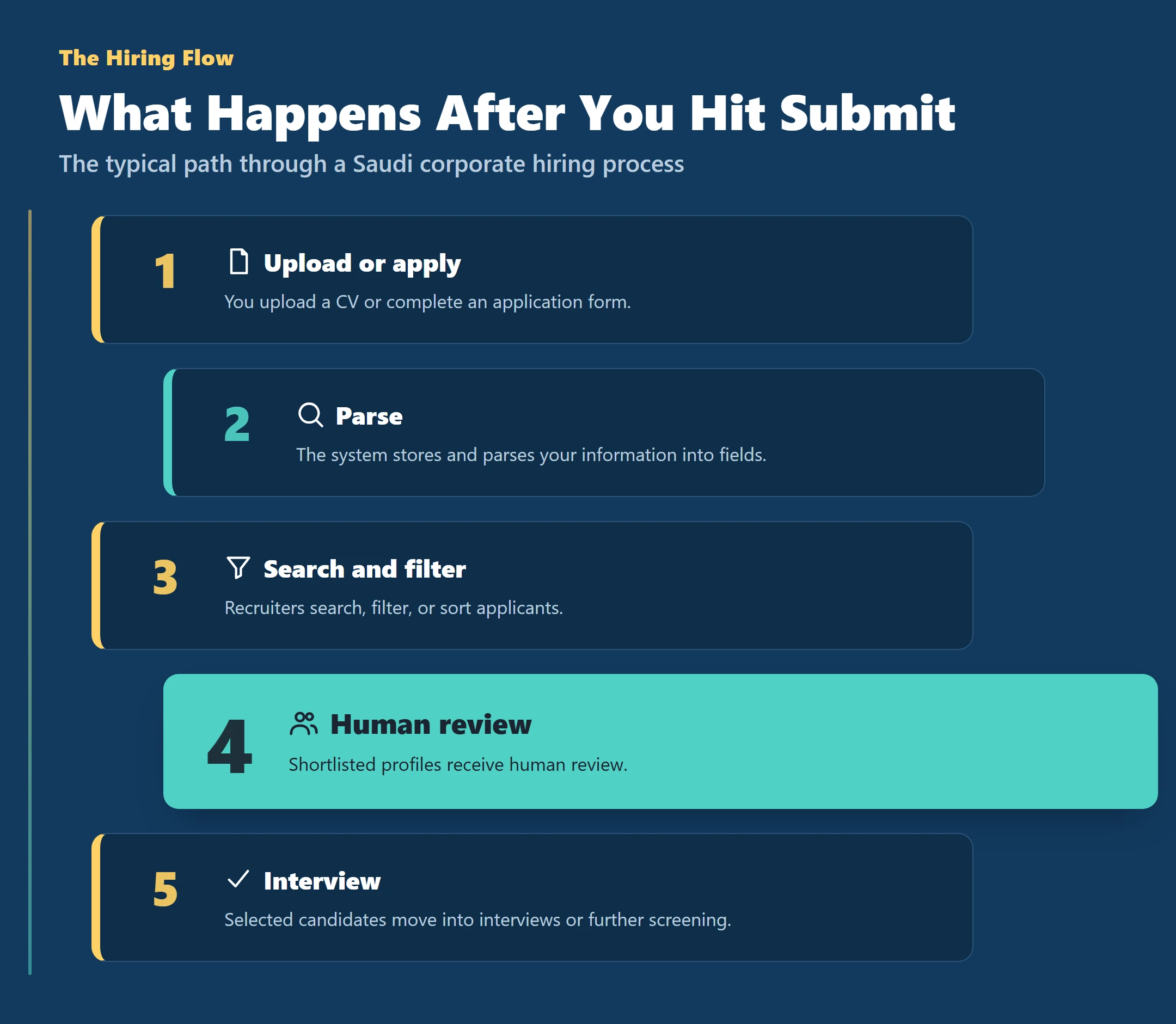
The exact tools vary by company. Large employers, multinational firms, local enterprise groups, and external recruiters may all use different systems. But the broad hiring flow is often similar:
- You upload a CV or complete an application form.
- The system stores and parses your information.
- Recruiters search, filter, or sort applicants.
- Shortlisted profiles receive human review.
- Selected candidates move into interviews or further screening.
ATS filters usually matter most at the early and middle stages. A system may help collect applications, extract content from your file, organize records, support keyword search, and make it easier for recruiters to compare candidates.
That means your CV must do four things well:
- upload without breaking
- parse into usable fields
- show clear relevance to the role
- remain easy for a person to scan
You cannot control which platform an employer uses. You can control whether your document survives that platform cleanly. For a deeper guide to building a file that parses safely, see how to make your CV ATS friendly .
ATS vs HR Portals vs Vendor Tools
A common mistake is calling every hiring platform “the ATS.” In reality, different tools may be involved, and each one may read your application differently.
What an ATS does
An applicant tracking system is usually the main hiring database and workflow tool. It often stores candidate profiles, tracks stages, enables recruiter search, and supports screening activity. It may also parse your CV into fields such as name, title, employer, dates, education, and skills.
What an HR portal does
The career site or HR portal is often the front-end application experience. You may create an account, answer screening questions, fill in work history, and upload your CV. In many cases, that portal sends your information into the ATS behind the scenes.
This distinction matters because the form itself may become highly important. If the application form says one thing and your uploaded CV says another, the mismatch can damage trust.
What vendor tools and screeners do
Some employers also use assessment tools, pre-screen questionnaires, ranking layers, or external recruiter systems. These are not always full ATS platforms, but they still affect whether your profile moves forward.
So what does each one actually read?
- The portal may read your typed form inputs.
- The parser may read your uploaded CV structure.
- The recruiter may read both.
- Search functions may rely heavily on titles and keywords.
- A hiring manager may only see the final CV or exported profile.
Case: CV vs application form mismatch
Imagine your CV says:
- Senior Operations Manager, 2020–Present
But the application form says:
- Operations Manager, 2021–Present
Even if the difference is accidental, it creates doubt. A recruiter may wonder whether the title was inflated on the CV or entered carelessly in the form. Before submitting, compare your portal fields and your CV line by line. A simple review routine helps you test your CV before applying .
Two Readers Matter: The Parser and the Recruiter
When people say a CV should be “ATS-friendly,” they often mean “machine-readable.” That is only part of the job.
Your CV always has two readers:
- the system that extracts and organizes your data
- the human who decides whether you deserve further consideration
What the parser needs
The parser prefers structure, consistency, and clear logic. It works better when your document uses standard headings, predictable sequencing, and simple formatting.
It usually handles these elements more reliably:
- clear section titles such as Experience, Education, and Skills
- straightforward date formats
- one-column layouts
- standard bullet points
- normal text for job titles and company names
It may struggle more with:
- text inside graphics
- unusual tables
- multi-column layouts
- icons replacing words
- decorative headers or footers carrying important information
What the recruiter needs
A recruiter does not only want extracted data. They want confidence. They want to scan your CV quickly and understand your current level, function, industry relevance, progression, achievements, and fit for the role.
That means the document cannot be built only for software. It also has to feel readable, credible, and professionally presented. Readability standards matter as much as parsing logic in a strong corporate CV layout .
Optimize for both, not just one
A plain file with weak positioning can still fail. A visually impressive file that breaks in upload can also fail.
The strongest CV is stable enough for machine parsing and sharp enough for human review. If your current version does not do both well, we can help rewrite or optimize it into a stronger, application-ready CV for corporate roles .
What “ATS-Friendly” Actually Means
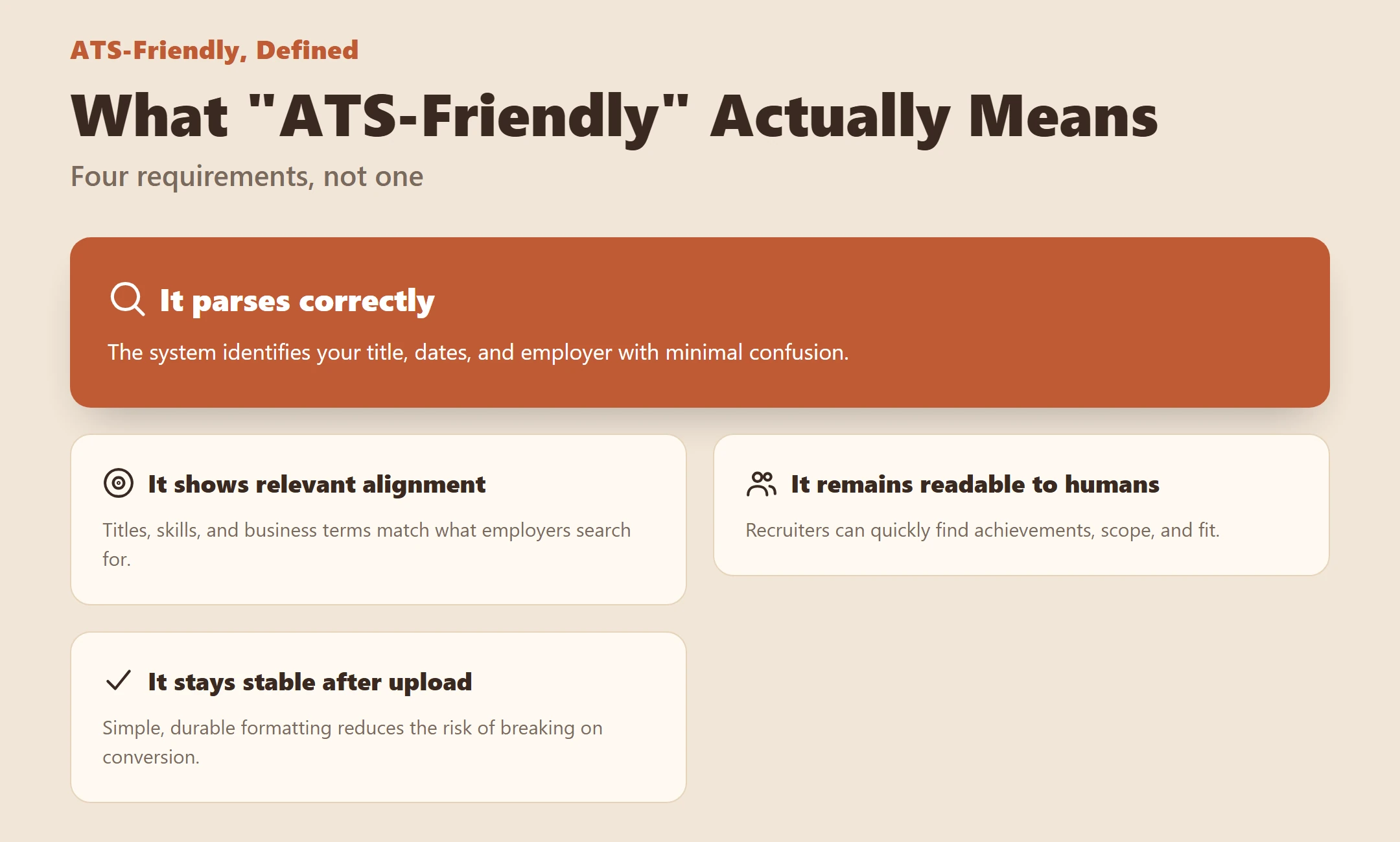
The phrase is often used too loosely. In practice, ATS-friendly usually means four things.
1. It parses correctly
The system can identify your core information with minimal confusion. Your title is read as a title. Your dates are read as dates. Your employer names are not broken across text elements.
2. It shows relevant alignment
Your CV includes the right role language without sounding artificial. Titles, skills, and business terms are aligned with what the employer is likely to search for. For business and corporate roles, that usually means thoughtful keyword placement rather than repetition. A practical approach to ATS keywords for business roles is more effective than stuffing.
3. It remains readable to humans
Your document still works as a professional profile. Recruiters can quickly find achievements, scope, progression, and functional fit. Seniority should be visible within seconds.
4. It stays stable after upload
Some files look fine on your laptop but break after upload, conversion, or parsing. ATS-friendly documents reduce that risk by using simple, durable formatting choices. If you want a direct list of safe and risky formatting choices, review CV formatting rules ATS .
So the real question is not “Will the ATS accept my file?” It is “Will my file remain accurate, searchable, and convincing from upload to recruiter review?”
Common ATS Features That Affect You
Even without knowing the exact system name, you can prepare for the features many hiring teams use.
Knockout questions
These are yes/no or multiple-choice questions used to screen for basic fit. They may relate to location, work authorization, industry background, language capability, or willingness to work in a given city.
These questions can stop an application before the CV receives serious attention. Read each one carefully and answer in a way that stays consistent with your CV.
Keyword search and ranking
Recruiters often search by title, skill, function, or industry term. That does not mean you should overload your CV with repeated phrases. It means your language should be close enough to market wording to be discoverable.
Recruiter notes and status labels
Once a recruiter opens your profile, they may add notes, move you to a new stage, or flag concerns. A well-parsed CV helps here because it makes your record easier to understand quickly.
Parsing preview
Some systems show both the uploaded file and the parsed fields. If those two views do not match well, it creates friction. That is one reason unusual design choices can hurt even when the original file looks polished.
Case: Designed PDF vs simple DOCX
A visually designed PDF may look strong, but if it uses columns, text boxes, icons, or layered elements, the parser may read the content in the wrong order.
A simple DOCX with clear headings, left-aligned text, and standard bullets is often safer because:
- the structure is easier to extract
- the reading order is clearer
- edits are easier before each application
- compatibility is usually better across systems
That does not mean every PDF fails. It means simpler structure usually carries lower parsing risk.
Case: DOC vs DOCX and why DOCX usually wins
Some candidates still keep an old DOC file and use it for applications. That can create avoidable problems. DOCX is generally the better working format because it handles modern formatting more consistently and is easier to update without damaging structure.
A safe process is simple:
- keep your master CV in DOCX
- make edits there first
- review spacing and bullet alignment
- export only when needed
- re-check the final version after saving
When ATS Matters Less
Not every application depends equally on ATS filtering. Still, a clean file remains important.
Referrals
If someone inside the company refers you, your CV may get faster human attention. That can reduce dependence on ranking or keyword search.
But a referral does not excuse a weak document. It only improves access.
Internal hiring
Internal candidates may already exist in the employer’s HR system. Their background may be partially known, and hiring teams may rely less on parsing. Even so, a clean CV still supports comparison and decision-making.
Niche or highly specialized roles
For niche leadership or specialist roles, recruiter judgment may matter more than software filters. But those roles often require very precise relevance, so title clarity and terminology still matter.
The safest mindset is simple: ATS may matter less in some situations, but document quality never matters less.
CV vs Resume in English for Corporate Roles
For English-language corporate applications in Saudi Arabia, the terms CV and resume are often used interchangeably in everyday hiring conversation. The smarter move is not to debate the label but to submit the right type of document for the employer and role level.
For experienced professionals, a CV in this context usually means a focused career document that is more detailed than a very short resume but still selective and business-oriented.
What employers usually expect
For corporate roles, especially mid-career to senior positions, employers typically expect a document that includes:
- a clear professional summary
- recent experience with visible scope
- older roles in compressed form when needed
- education
- core skills or strengths
That means your file should not become a full biography. Experienced candidates often lose impact by including too much old detail.
Case: Long career reads as noise to ATS
A professional with 20 years of experience may list every responsibility from every role since the start of their career. That rarely improves relevance. More often, it reduces signal.
A better structure is:
- detailed coverage for the most recent and most relevant roles
- shorter treatment for older or less relevant positions
- emphasis on scope, outcomes, and progression
This helps both parsing and human review because the most valuable information is easier to find.
Case: Unprofessional file name hurts perception
Your file name is a small detail, but it affects first impression. A recruiter or system may see the file name before opening the document.
Avoid names such as:
- CV-final-final2
- updated resume new
- my cv latest
Use a cleaner naming convention such as:
FirstNameLastNameTargetRole_CV
This looks more professional, is easier to track, and reduces confusion in recruiter workflows.
Language Strategy for Saudi Applications
Language choice matters in Saudi applications because the market can be English-first, Arabic-first, or mixed depending on employer type, function, and role.
For many corporate roles, especially where reporting, regional coordination, or formal business communication are involved, English is a practical default. But there are also cases where Arabic matters strongly.
The key is not to force both languages into one unstable document.
English-first is often the safer default
If the job ad, company site, and application portal are in English, an English CV is usually the simplest and safest option. It reduces parsing risk and keeps terminology consistent.
When bilingual capability matters
If the role clearly values both Arabic and English, show that in a clean way:
- mention language proficiency in a dedicated Languages section
- refer to bilingual stakeholder work where relevant
- keep the main document language consistent
Do not create a mixed-script CV unless there is a clear reason and you can preserve structure carefully.
Case: Job titles not market-aligned
Some candidates use internal or unusual job titles that are accurate but not very searchable.
For example, if your internal title was “Business Support Lead,” but your work aligned more closely with operations management, you should not invent a false title. But you can clarify honestly:
Business Support Lead (Operations Management)
This improves search visibility and recruiter understanding while staying truthful. The same principle helps when you tailor your CV to a job description .
When to Avoid a Bilingual CV
A bilingual CV can seem like a smart compromise. In practice, it often creates problems.
Why mixed-language files can fail
When Arabic and English appear side by side in one file, especially in columns or mirrored layouts, parsing can become unstable. The system may read content in the wrong order, merge fields incorrectly, or lose section boundaries.
The human reader may also struggle if the document feels crowded or repetitive.
Case: Arabic and English mix breaks structure
A candidate creates one CV where each section appears in English on one side and Arabic on the other. It looks balanced visually, but after upload:
- dates become detached from roles
- headings merge together
- bullets appear under the wrong employer
- names or titles repeat in strange order
The safer alternative is usually one of these:
- submit an English CV if the role is English-led
- submit an Arabic CV if the role clearly requires Arabic-first communication
- prepare two separate versions, one in each language
- keep one primary version and only send the second when requested
Safe bilingual rules if you must include both
If there is a strong reason to show both languages in one file, reduce risk by following simple rules:
- use one language for the main body
- place the second language only in limited fields if necessary
- avoid mirrored two-column translation layouts
- keep headings in one language only
- test the file after export and upload
This is not about rejecting bilingual strength. It is about protecting structure and readability.
Practical Implications for Experienced Professionals
If you are already established in your career, ATS strategy is not about trying to beat software. It is about reducing friction throughout the hiring process.
What usually matters most is this:
- use a stable format that parses well
- keep titles searchable and truthful
- match role language without stuffing keywords
- prioritize recent and relevant experience
- maintain consistency across the CV and application form
- avoid over-designed layouts
- choose one main document language per file
- use professional file naming and version control
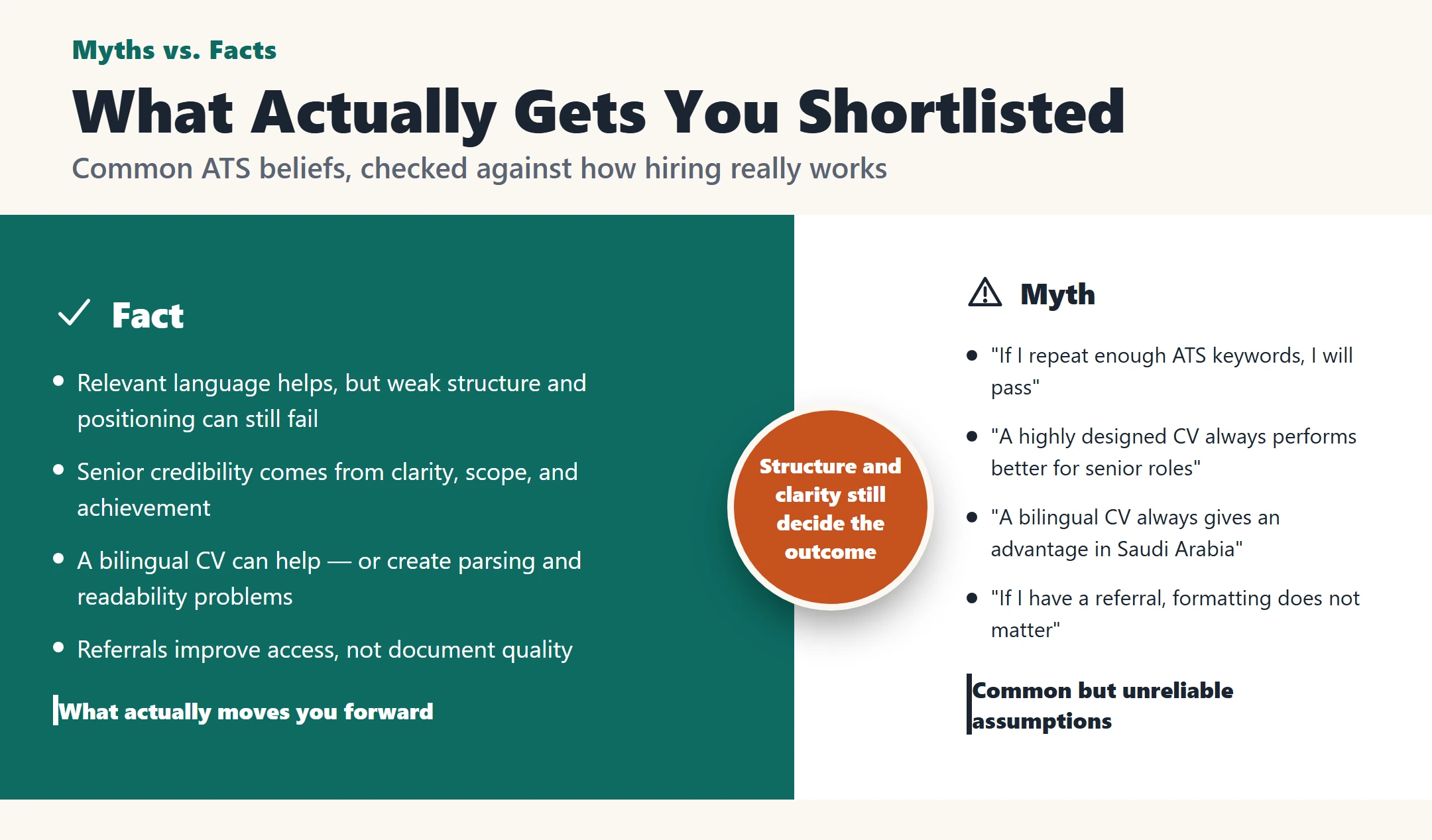
Myths vs facts
Myth: If I repeat enough ATS keywords, I will pass.
Fact: Relevant language helps, but poor structure and weak positioning can still fail.
Myth: A highly designed CV always performs better for senior roles.
Fact: Senior credibility comes from clarity, scope, and achievement, not visual complexity alone.
Myth: A bilingual CV always gives an advantage in Saudi Arabia.
Fact: It can help in specific cases, but it can also create parsing and readability problems.
Myth: If I have a referral, formatting does not matter.
Fact: Referrals improve access, not document quality.
A compact checklist before you apply
Use this quick review:
- Is the file format appropriate for the application method?
- Are titles, dates, and employers consistent everywhere?
- Is the summary clear about your level and function?
- Are your most recent roles doing most of the selling?
- Are keywords natural and role-relevant?
- Is the layout simple enough to survive upload?
- Is the file name professional?
- Is the language strategy clear and consistent?
For the human side of screening, it also helps to understand what recruiters look for . If your opening section feels weak, strengthen your professional summary for CV .
Final Takeaway: Optimize for the Real Hiring Flow
The most useful way to think about ATS used in Saudi Arabia is this: different companies may use different systems, but the candidate-side implications are often very similar.
Your CV should be:
- easy to parse
- easy to search
- easy to trust
- easy to scan
That usually means simpler formatting, clearer titles, cleaner language choices, tighter relevance, and stronger consistency between your CV and your application form.
If you want a professional CV rewrite or optimization with ATS-safe formatting, stronger positioning, and clearer readability for experienced professionals, order a paid CV service here .