

If you are an expat in Saudi Arabia, Nitaqat is not just an HR label in the background. It can affect how stable a company feels, how confidently HR handles transfers, and how much friction you may face when changing jobs.
In simple terms, Nitaqat is a company status system. For you as an employee, the practical question is not “What does the color mean in theory?” but “Will this employer create a smoother move, more stable payroll, and fewer surprises?”
That is why Nitaqat matters before you accept an offer, before you resign, and during probation at a new job.
Why Nitaqat matters to your stability and mobility
A company’s status often shows up in daily behavior before it shows up in official explanations. Stable employers usually have clearer HR processes, faster document handling, and more predictable onboarding. Unstable employers may create delays, confusion, or last-minute changes.
For expats, this matters because mobility is not only about whether a transfer is technically possible. It is also about whether the employer can support the process properly. If you need the broader workflow first, review how to change jobs legally under the mobility system.
Think of Nitaqat as a practical risk signal tied to three things:
- Stability: Does the company look organized and predictable?
- Compliance culture: Does HR follow process carefully or react at the last minute?
- Transfer friction: Are your documents and onboarding likely to move smoothly?
A strong company status does not guarantee a perfect experience. A weaker one does not guarantee disaster. But it can affect your bargaining power, the speed of internal approvals, and the chance of avoidable delays.
Nitaqat colors and the practical risk to employees
The most useful way to read company status is through employee impact, not policy language.
Stronger status usually means lower friction
When a company is in a stronger position, employees often experience:
- Faster HR response
- Better document discipline
- More confidence in start dates
- Fewer internal approval surprises
- Better coordination between recruiter, HR, and finance
This does not mean you should relax completely. You still need written confirmation, a clean timeline, and proof of every major step.
Weaker status usually means more uncertainty
A weaker status may appear in practical ways such as:
- Delayed onboarding
- Unclear ownership inside HR
- Vague answers about transfer timing
- Pressure to resign early
- Confusing messages about when payroll starts
The main risk is not only delay. It is uncertainty. If the company itself is under pressure, your transfer may become one more issue in an already messy process.
How status changes bargaining power
A stable employer usually negotiates from confidence. An unstable one may make promises quickly but struggle to deliver. That can affect:
- Joining date flexibility
- Settlement timing
- Response speed to blockers
- Confidence around payroll and documentation
If your move depends on careful sequencing, it helps to understand the operational order for an Iqama transfer before you act.
How to evaluate a company’s Nitaqat trend
A single snapshot is useful, but trends matter more.
A company can improve, decline, or remain unstable for months. Your real question is: Is this employer moving toward stability or away from it?
A simple trend-check method
Use a fast, respectful check:
- Ask HR whether the company status is stable and whether transfers are being handled normally.
- Ask whether there have been recent onboarding delays.
- Ask who owns the process after offer acceptance.
- Ask what documents they need from you and when.
- Ask whether your start date depends on any internal approvals still pending.
You are not asking for confidential data. You are checking process confidence.
Why trends matter more than labels
A company moving from weaker status to stronger status may be improving. That can be positive, but it can also mean the process is still settling. A company that has been stable for a longer period usually gives you more predictability.
What matters most is whether the employer can answer basic timing and process questions clearly. If answers change every few days, that is a warning sign.
When a company moves from red to green
When a company improves from weaker status to stronger status, employees often notice practical changes first.
Typical improvements include:
- HR replies become faster
- Onboarding steps become clearer
- Start dates become more realistic
- Internal approvals happen with less confusion
- Payroll communication becomes more structured
But do not assume that “improving” means “safe now.” Ask questions before switching.
What to ask before you rely on the offer
- Has the company recently completed similar transfers successfully?
- Who is the HR contact responsible after offer signing?
- What is the expected joining sequence?
- When should you resign, if at all?
- What could delay your onboarding?
Before taking action, review what to check before resigning so you do not carry unnecessary risk.
What to ask the new employer about Nitaqat and stability
Use short, direct questions. You do not need a long speech.
Copy-and-paste question bank
- Is my onboarding timeline considered normal right now?
- Who is the main HR owner for my case?
- Are there any approvals still pending before my joining date is final?
- When do you recommend I resign from my current role?
- What documents do you need from me first?
- If onboarding is delayed, how will you confirm the revised date?
- Have you supported similar transfers recently?
- When does payroll usually start in relation to joining?
These questions help you measure process maturity. Good employers usually answer calmly and clearly.
If you want paid help to build a stronger CV/Resume for your next move, we can rewrite and optimize it so your application looks clearer and more professional to employers .
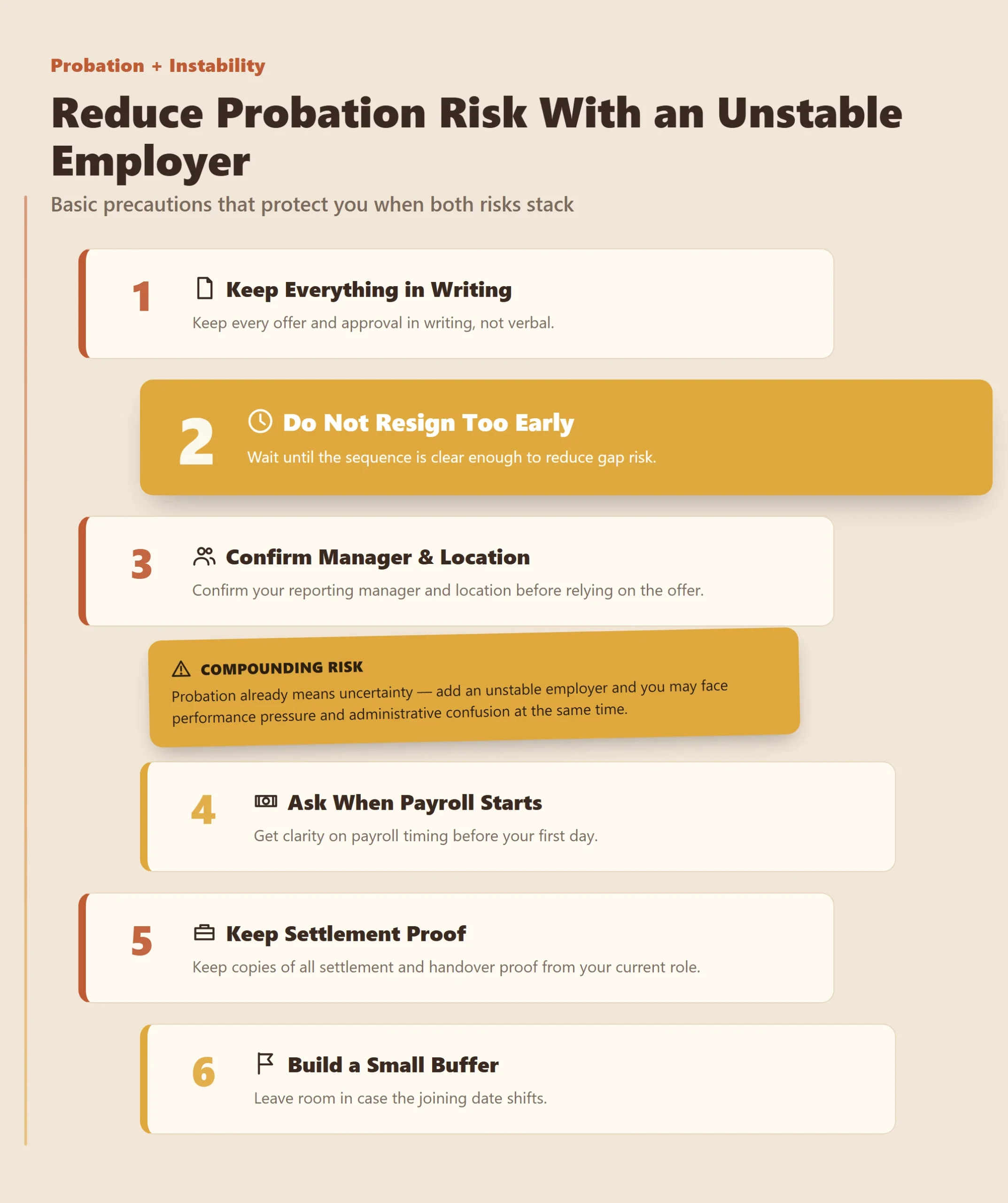
How probation risk gets worse with an unstable employer
Probation always carries risk. When you add unstable employer status, that risk becomes larger.
Why? Because probation already means less certainty. If the employer also has process instability, you may face both performance pressure and administrative uncertainty at the same time.
How the risk compounds
You may experience:
- A delayed first day
- A changed manager after joining
- Slow setup of HR records
- Unclear salary timing
- Weak support if there is a transfer issue
How to reduce the risk
- Keep every offer and approval in writing
- Do not resign too early
- Confirm reporting manager and location
- Ask when payroll starts
- Keep copies of all settlement and handover proof
- Build a small buffer in case the joining date shifts
Basic rule awareness also helps. If you need broader background, read the key labor-law basics that often affect expats.
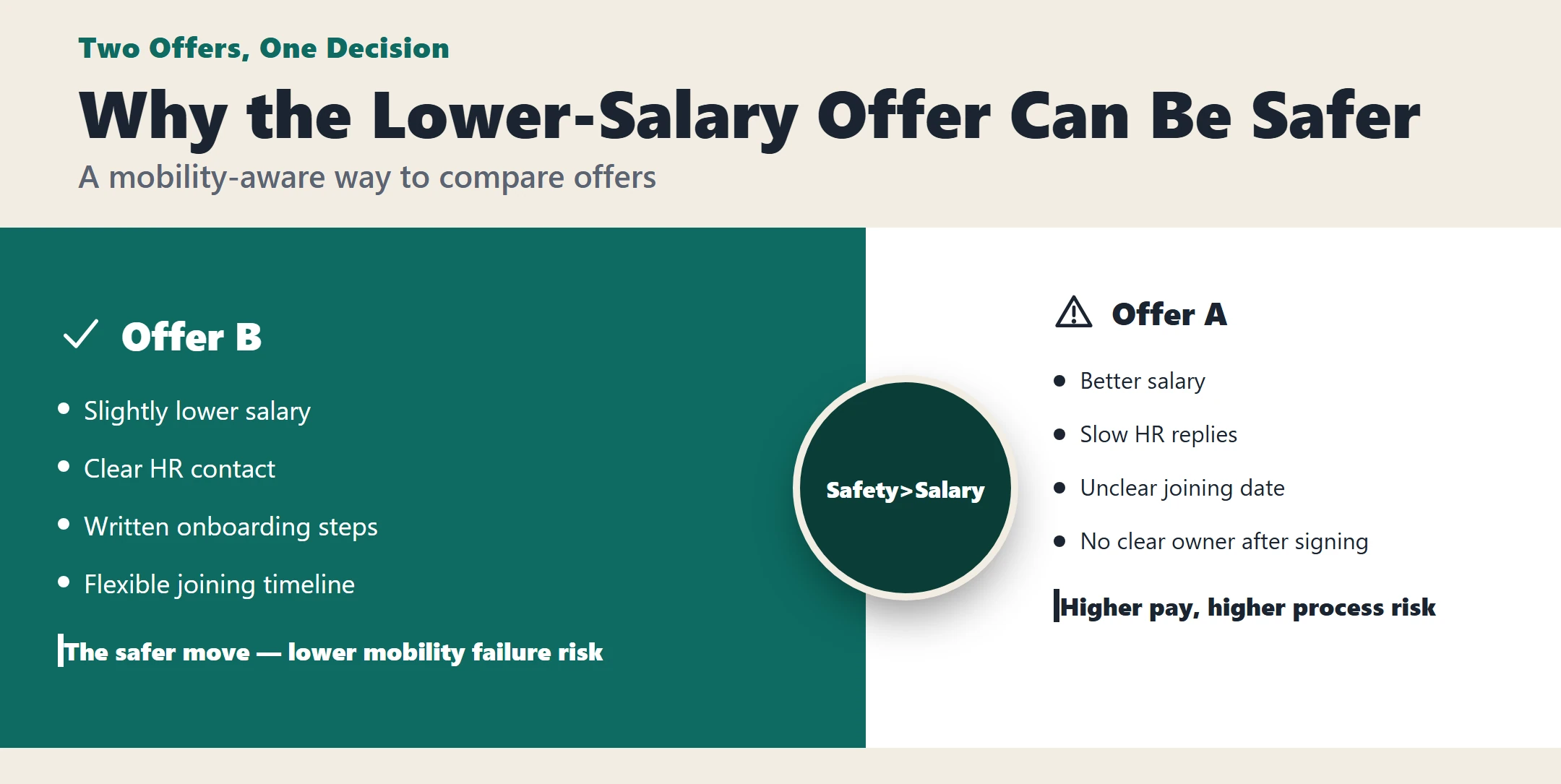
Choosing between offers with a mobility-aware matrix
A higher salary is not always the safer choice. If one offer comes from a more stable employer with clearer onboarding, it may be the better decision.
Simple scorecard
Score each offer from 1 to 5 on:
- Company stability
- HR responsiveness
- Clarity of start date
- Payroll reliability signals
- Transfer support confidence
- Document process maturity
- Flexibility if onboarding shifts
Fast decision rule
- Mostly 4s and 5s: Lower mobility risk
- Mixed 3s with unclear answers: Medium risk, verify more
- Several 1s and 2s: High risk, do not rush resignation
Worked example
Offer A
- Better salary
- Slow HR replies
- Unclear joining date
- No clear owner after signing
Offer B
- Slightly lower salary
- Clear HR contact
- Written onboarding steps
- Flexible joining timeline
In many real cases, Offer B is the safer move because it reduces mobility failure risk. Safety during transition often matters more than a short-term pay difference.
If the new employer delays onboarding
Delays do not always mean bad intent. But they do require discipline.
What to do immediately
- Ask for written confirmation of the delay
- Request a revised start date
- Ask whether any action is needed from you
- Save all messages and approvals
- Keep your current employer relationship professional if you have not fully exited
Do not burn bridges
If the delay happens before your full exit, stay calm. Avoid emotional messages. A delayed onboarding is easier to manage than a damaged reputation with both employers.
If the new employer withdraws the offer
This is one of the most painful scenarios, especially if you already resigned.
Damage control steps
- Stop or pause resignation if still possible
- Request the withdrawal in writing
- Ask for the reason in simple, professional language
- Secure proof of settlement, handover, and all previous approvals
- Start your next job search quickly with organized documents
The goal is to protect your position, reduce confusion, and move fast without panic.
Contract clauses that complicate transfers
Some offers look fine until you read the details closely.
Clauses that may create friction
- Non-compete language
- Repayment clauses for training or relocation
- Vague probation terms
- Unclear notice requirements
- Broad policy wording without practical detail
Risk questions to ask
- What exactly triggers repayment?
- Does any clause affect my ability to leave later?
- Are notice and probation terms written clearly?
- Is there any condition that could delay settlement or document release?
If any clause feels vague, ask for written clarification before you rely on the offer.
Switching to a bigger company
Switching to a bigger company is not automatically easier. Bigger employers often require cleaner documentation and tighter process compliance.
What to prepare
- Clean passport and ID copies
- Updated CV/Resume
- Clear employment dates
- Education and experience documents
- Written settlement and handover proof
- Consistent job title information
Large employers often reject files because of inconsistency, not because of candidate quality.
Switching to a smaller company
Smaller employers can move fast, which is helpful. But they can also carry more stability risk if process discipline is weak.
What to check
- Payroll reliability
- HR process maturity
- Clear owner for onboarding
- Realistic joining timeline
- Stability signals beyond verbal promises
A smaller firm is not automatically risky. The real issue is whether it can handle your move in a controlled way.
Early warning signals to watch during interviews
Many stability signals appear before you sign.
Warning signals
- HR gives different answers each time
- Start date sounds urgent but nothing is written
- Interviewers avoid process questions
- Employees seem to leave quickly
- There is visible chaos around approvals
- Benefits or reporting lines remain unclear late in the process
These signs do not prove failure. But together, they increase your caution level.
The Ask HR script for mobility questions
Use this short script if you want a direct but polite approach:
- “Can you confirm who will manage my onboarding after I sign?”
- “Is the proposed joining date fully approved?”
- “If there is any delay, how will I be informed?”
- “What documents should I prepare now to avoid rejection?”
- “At what point do you advise me to resign?”
- “How quickly are settlement and transfer-related steps usually handled?”
Short questions often get clearer answers than long explanations.
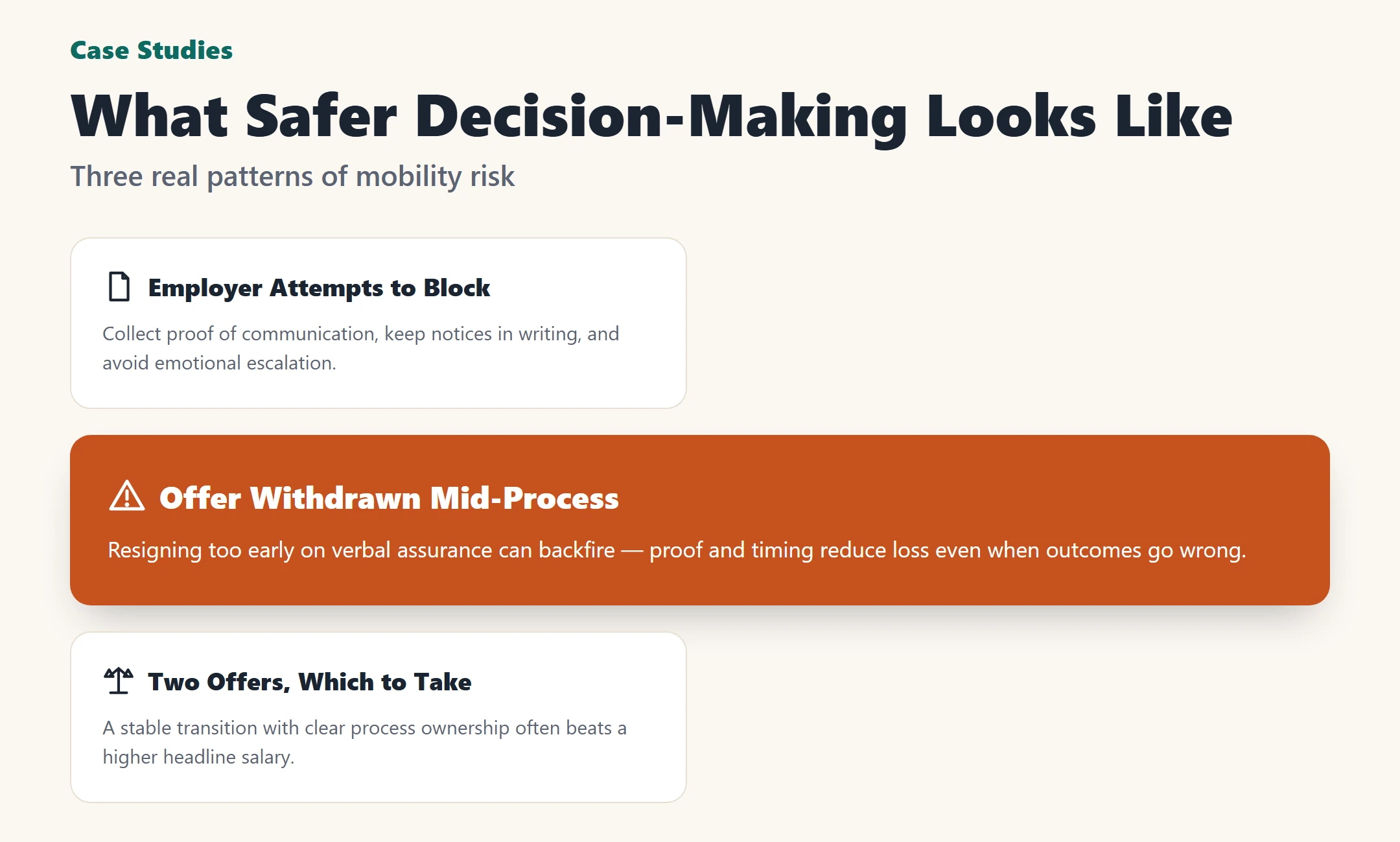
Case studies: what safer decision-making looks like
Case study: employer attempts to block
An employee receives a new offer and hears verbal pressure from the current employer not to move. Instead of arguing emotionally, he collects proof of communication, keeps all notices in writing, and asks the new employer to confirm next steps clearly.
What mattered most:
- Written records
- Clean sequencing
- No emotional escalation
- Proof of handover progress
Case study: offer withdrawn mid-process
An employee resigns too early based on verbal assurance. The new employer then pauses hiring. Damage is reduced only because she kept copies of the offer, resignation timeline, and all HR messages.
Lesson: proof and timing reduce loss, even when outcomes go wrong.
Case study: two offers, which one to take?
One offer pays more but has weak HR structure. The other pays slightly less but offers clear process ownership and a realistic joining plan. The safer choice wins because the employee values a stable transition over headline salary.
The 12 red flags before resigning
- No written offer
- Why it is dangerous: You are relying on words only.
- What to verify: Get a written offer before taking action.
- No named HR owner
- Why it is dangerous: Your case may drift.
- What to verify: Ask who handles your file end to end.
- Unclear start date
- Why it is dangerous: Payroll and notice timing can break.
- What to verify: Request written confirmation.
- Pressure to resign immediately
- Why it is dangerous: You carry all timing risk.
- What to verify: Ask what is already approved.
- HR answers keep changing
- Why it is dangerous: Process may be unstable.
- What to verify: Reconfirm key points in writing.
- Benefits are vague
- Why it is dangerous: Offer quality may be overstated.
- What to verify: Ask for a written breakdown.
- No onboarding checklist
- Why it is dangerous: Delays become likely.
- What to verify: Ask what documents are needed first.
- Contract clauses are unclear
- Why it is dangerous: Hidden friction later.
- What to verify: Request clarification before signing.
- Frequent staff exits are mentioned casually
- Why it is dangerous: Stability may be weak.
- What to verify: Ask practical questions about team structure.
- Payroll timing is not explained
- Why it is dangerous: Cash-flow stress after joining.
- What to verify: Ask when salary normally starts.
- HR avoids process questions
- Why it is dangerous: They may not control the process.
- What to verify: Ask for a realistic sequence.
- You have not prepared proof from your current job
- Why it is dangerous: Exit issues can slow your move.
- What to verify: Organize resignation, handover, and settlement records.
The 12 green flags that mean you are safer
- Written offer received
- Clear HR contact assigned
- Start date confirmed in writing
- Onboarding steps explained simply
- Document list shared early
- Responses are timely and consistent
- Benefits are clearly stated
- Payroll timing is explained
- Manager and reporting line are clear
- Delay process is explained in advance
- You are told when to resign, not pushed blindly
- You have saved all proof and confirmations
These signs do not remove all risk, but they usually indicate a more controlled move.
FAQ: Nitaqat and stability
1. Is a stronger company status always safe?
No. It may reduce some risk, but you still need written proof and clear timing.
2. Should I ask directly about company stability?
Yes, but ask through process questions, not accusations.
3. Is a higher salary worth more risk?
Not always. A delayed or failed move can cost more than the salary difference.
4. Do trends matter more than snapshots?
Usually yes. A stable pattern is more useful than one moment.
5. Can small companies still be good employers?
Yes. But check payroll, HR maturity, and onboarding discipline.
6. Are big companies automatically easier?
No. They can be stricter and reject messy documents.
7. What should I save in writing?
Offer, start date, HR instructions, settlement proof, and delay messages.
8. What if onboarding gets delayed?
Request a revised written date and keep all evidence.
9. What if the offer is withdrawn?
Pause resignation if possible, secure written proof, and protect your records.
10. What is the biggest mistake?
Resigning too early without enough written confirmation.
Mistakes that damage your reputation
Even when the employer side is messy, your behavior still matters.
Avoid:
- Ghosting HR
- Sending emotional messages
- Quitting before handover is clear
- Arguing without proof
- Speaking casually about sensitive process issues
Choose safer alternatives:
- Reply briefly and professionally
- Confirm key points in writing
- Keep your tone calm
- Save evidence
- Close your current role cleanly where possible
Glossary: Arabic terms you may see during mobility
- Iqama — residence permit
- Naql Kafala — sponsorship transfer term often used in older conversation
- HR / الموارد البشرية — human resources
- Mubashera — joining or work commencement
- Taswiyah / Settlement — final settlement
- Notice Period — required time before exit
- Probation — trial period at the start of employment
- Offer Letter — written job offer
- Handover — transfer of duties before leaving
- Compliance — following required process and documentation
Final next step
Get a paid CV/Resume rewrite and optimization service designed for expats who are comparing offers, preparing to resign, or trying to present cleaner documents to employers—order here .