

Experienced professionals usually know the STAR format: Situation, Task, Action, Result. The real challenge is not remembering the letters. It is knowing what a strong answer sounds like in a real corporate interview.
Good STAR method examples are tight, specific, and credible. They show the stakes, your role, your decisions, and a measurable outcome. If you want a broader framework for concise proof-based storytelling, see how to talk about achievements in interviews .
Tight Scope, Clear Action, Measurable Outcome
A strong STAR story usually does three things well:
- It focuses on one real challenge, not your full career history.
- It makes your ownership visible.
- It ends with a result that is easy to understand.
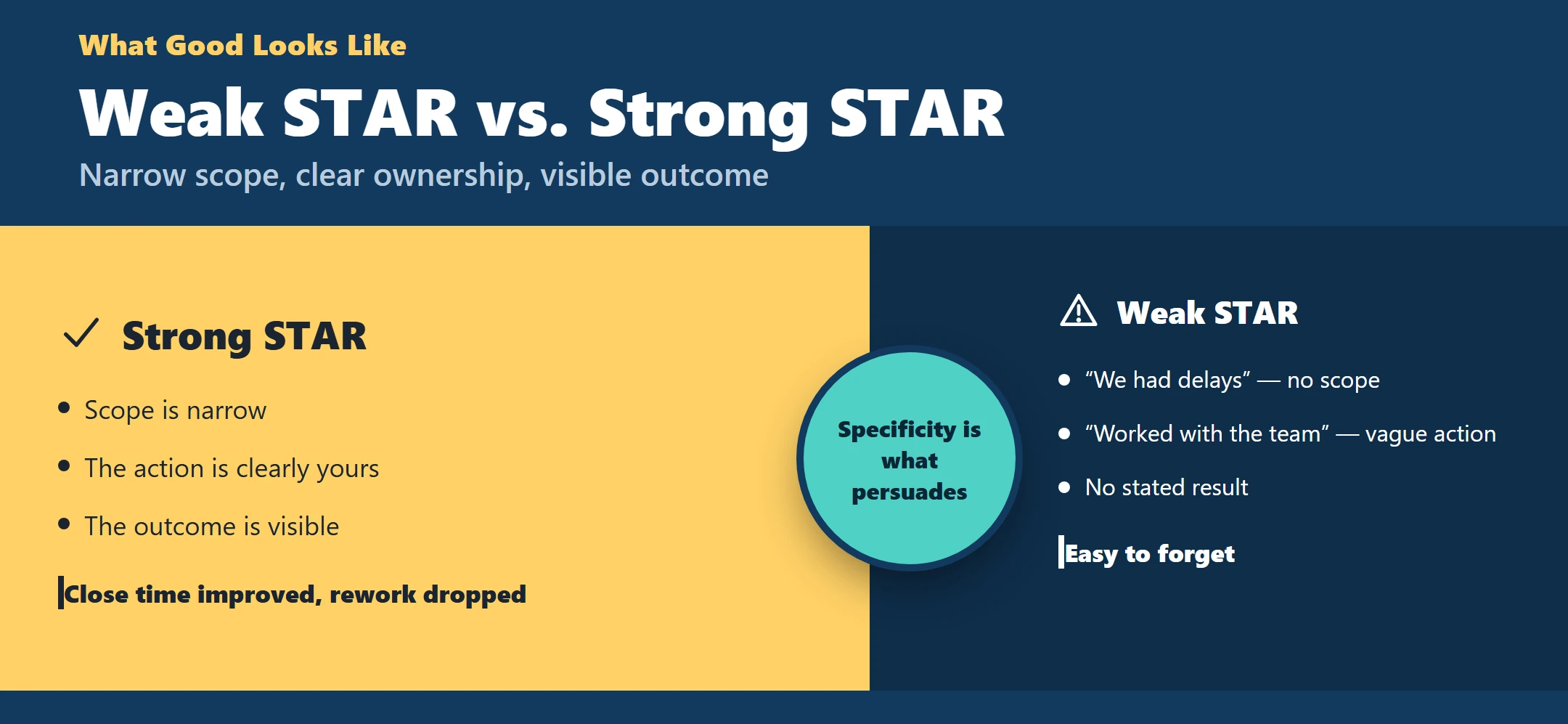
A weak answer sounds like this: “We had delays, so I worked with the team and improved the process.”
A stronger answer sounds like this: “Our monthly close was slipping, and correction work was increasing. I mapped the handoff points, removed duplicate checks, and introduced a standard review sequence. Within two cycles, close time improved and rework dropped.”
What makes the second version stronger?
- The scope is narrow.
- The action is clearly yours.
- The outcome is visible.
Add Stakes, Ownership, Actions, Metrics, and Lessons
Weak STAR
“Sales in my region were under target. I worked hard with the team, spoke to customers, and improved performance.”
Strong STAR
“My territory had missed target for two consecutive periods, and pipeline quality was weak. I reviewed stalled opportunities, reset account priorities, and introduced a weekly cadence focused on next-step discipline and dormant-account recovery. Over the following quarter, conversion improved, pipeline coverage became healthier, and the territory returned to growth.”
The strong version adds:
- stakes
- ownership
- decision points
- a timeframe
- movement in results
Choose High-Signal Stories and Avoid Trivial Wins
Not every success belongs in an interview.
High-signal STAR method examples usually involve one or more of these:
- a meaningful business problem
- cross-functional coordination
- a difficult tradeoff
- visible ownership
- a result tied to cost, quality, speed, revenue, risk, or customer experience
Avoid low-value examples such as “I completed my routine tasks on time” unless the role is highly execution-focused and the story includes unusual pressure or complexity.
A simple test helps: if the story does not show judgment, influence, or problem solving, choose another one.
Add Baseline, Delta, and Timeframe While Staying Credible
The best result statements usually include three parts:
- Baseline: where things started
- Delta: what changed
- Timeframe: how long it took
For example:
- “Reduced close delays from frequent overruns to a stable on-time cycle within two months.”
- “Cut rework from a recurring issue to occasional exceptions over one quarter.”
- “Raised feature adoption from low initial usage to sustained team-level usage in six weeks.”
If you have exact numbers, use them. If you do not, stay truthful and use clear directional language. In any interview, including Saudi job market contexts, credibility matters more than inflated claims.
Use Proxies, Ranges, and Evidence When Metrics Are Missing
Sometimes the impact was real, but you no longer have the exact figures. Do not guess and do not invent numbers.
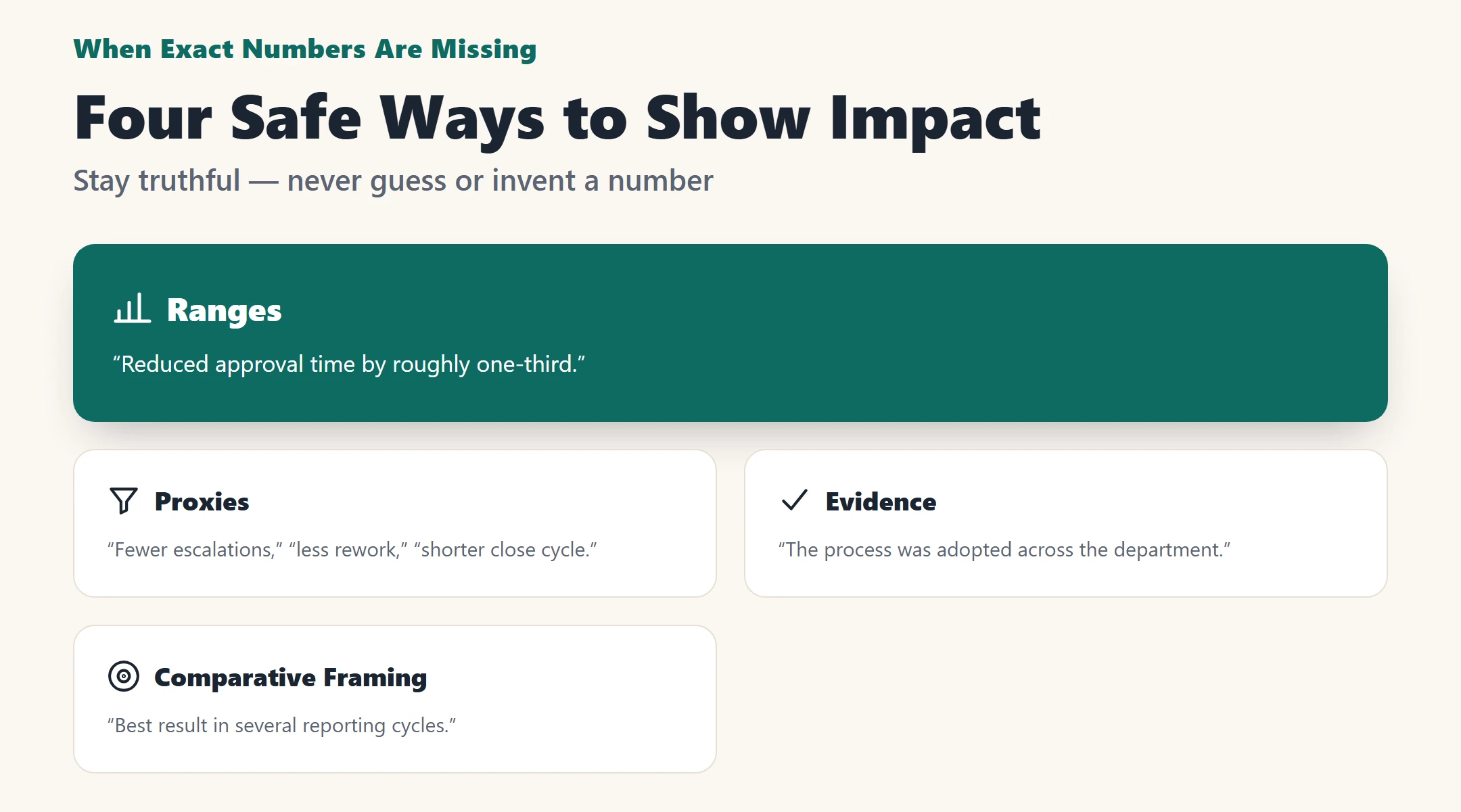
Use safer alternatives such as:
- Ranges: “reduced approval time by roughly one-third”
- Proxies: “fewer escalations,” “less rework,” “shorter close cycle”
- Evidence: “the process was adopted across the department”
- Comparative framing: “best result in several reporting cycles”
You can also tie the result to business behavior:
- fewer complaints
- faster turnaround
- more accurate reporting
- stronger pipeline quality
- lower overtime
- smoother audits
If you are actively interviewing, it helps to organize your stories alongside your application process so each example fits the role you target when you apply for jobs in Saudi Arabia .
If you want expert help turning your experience into stronger interview stories and a job-ready CV/Resume, we can help you rewrite weak content into a clearer application package. Explore our CV services here: .
Ownership Prompts With Metric Ideas
Use these five questions to pull out a strong Ownership story:
- What important problem did you take responsibility for before being asked?
- What risk would have continued if you had done nothing?
- What decision did you personally make?
- What resistance or ambiguity did you handle?
- What changed because you took ownership?
Metric ideas: cycle time, backlog size, error reduction, adoption rate, escalations avoided
Problem Solving Prompts With Metric Ideas
Use these five questions to extract a Problem Solving story:
- What was broken, unclear, or underperforming?
- How did you identify the real cause?
- What options did you compare?
- What action solved the issue?
- What measurable improvement followed?
Metric ideas: defect rate, rework, delay reduction, process stability, forecast accuracy
Stakeholder Management Prompts With Metric Ideas
Use these five questions to build a Stakeholder Management story:
- Who needed alignment?
- Where were priorities conflicting?
- How did you earn agreement?
- What tradeoff did you help clarify?
- What outcome happened after alignment?
Metric ideas: approval speed, decision turnaround, project progress, fewer escalations, smoother launch
Team Leadership Prompts With Metric Ideas
Use these five questions to shape a Team Leadership story:
- What was the team facing?
- How did you set priorities?
- How did you support performance?
- What did you change in execution?
- What result did the team achieve?
Metric ideas: delivery rate, workload balance, milestone completion, quality consistency, retention signals
Conflict Resolution Prompts With Metric Ideas
Use these five questions to extract a Conflict Resolution story:
- What tension was affecting work?
- Who were the parties involved?
- How did you separate facts from emotion?
- What agreement did you help create?
- What improved afterward?
Metric ideas: fewer delays, fewer complaints, better handoffs, faster decisions, reduced escalations
Speed and Execution Prompts With Metric Ideas
Use these five questions to build a Speed or Execution story:
- What needed to move faster?
- What was slowing delivery?
- What did you simplify or remove?
- How did you protect quality?
- What happened to turnaround time?
Metric ideas: lead time, completion rate, queue size, approval speed, release cadence
Quality and Compliance Prompts With Metric Ideas
Use these five questions to develop a Quality or Compliance story:
- What risk or failure pattern appeared?
- How did you verify the root cause?
- What control or standard did you improve?
- How did you make the fix repeatable?
- What was the recovery result?
Metric ideas: audit findings, error rate, deviation frequency, pass rate, rework reduction
Customer Obsession Prompts With Metric Ideas
Use these five questions to pull out a Customer Obsession story:
- What customer pain point did you notice?
- How did you confirm it was real?
- What did you change in response?
- How did you balance customer need with business constraints?
- What improved for the customer?
Metric ideas: complaint volume, response time, retention signals, adoption, repeat business
Cost Reduction Prompts With Metric Ideas
Use these five questions to create a Cost Reduction story:
- Where was waste showing up?
- What baseline showed there was a problem?
- Which levers did you control?
- What did you change without harming service?
- What cost result followed?
Metric ideas: overtime, scrap, packaging use, vendor spend, process hours
Revenue Growth Prompts With Metric Ideas
Use these five questions to extract a Revenue Growth story:
- Where was growth being lost?
- What segment, product, or behavior mattered most?
- What action changed the sales motion?
- How did you improve conversion or expansion?
- What revenue result followed?
Metric ideas: conversion, pipeline quality, renewal rate, average deal progress, territory trend
Innovation and Experimentation Prompts With Metric Ideas
Use these five questions to shape an Innovation or Experimentation story:
- What assumption did you want to test?
- Why was the current approach limited?
- What small experiment did you design?
- What did you learn quickly?
- What happened after the test?
Metric ideas: adoption, engagement, time saved, process uptake, reduced failure rate
Crisis Handling Prompts With Metric Ideas
Use these five questions to build a Crisis Handling story:
- What urgent disruption happened?
- What was at risk immediately?
- How did you prioritize in the first hours or days?
- How did you communicate under pressure?
- What outcome showed the response worked?
Metric ideas: downtime reduced, service restored, backlog controlled, issue containment, recovery speed
Problem to Actions to Quantified Result: Cost Reduction Example
Situation: A distribution process was creating avoidable overtime and excess packaging use.
Task: Reduce operating cost without disrupting service levels.
Action: I reviewed where waste appeared by shift and route, changed packing rules for low-risk items, adjusted staff allocation on peak days, and introduced a short daily review for exceptions.
Result: Within one reporting period, overtime hours dropped from a consistently elevated level to a more controlled range, packaging usage declined, and service continuity was maintained.

Quota and Pipeline Actions to Result Metrics: Sales Growth Example
Situation: A territory had activity, but too much of the pipeline was low probability.
Task: Improve pipeline quality and restore growth.
Action: I segmented accounts by expansion potential, focused effort on fewer high-value opportunities, improved follow-up discipline, and built clearer next-step criteria for each sales stage.
Result: Pipeline quality improved, conversion increased, and the territory finished the period above its recent trend.
Controls and Process to Close Time and Accuracy Impact: Financial Reporting Example
Situation: Reporting errors were causing manual corrections late in the close cycle.
Task: Improve accuracy while reducing pressure on the team.
Action: I identified recurring control gaps, standardized source-file checks, and moved review ownership earlier in the process.
Result: Error frequency fell, late adjustments reduced, and the close process became more predictable.
User Pain to Decision to Delivery and Adoption: Product Feature Example
Situation: Users were dropping out at a step that created friction in the workflow.
Task: Launch an improvement without delaying the roadmap.
Action: I gathered user feedback, narrowed the feature scope to the highest-friction step, aligned engineering and operations on a smaller release, and defined a simple rollout plan.
Result: The feature launched on schedule, adoption appeared soon after release, and the team had evidence to guide future iterations.
Capacity Crisis to Prioritization and Delivery Outcome: Team Pressure Example
Situation: The team faced a sudden capacity crunch during a high-demand period.
Task: Protect delivery commitments without burning out the team.
Action: I re-prioritized work into critical, deferrable, and support tasks, reassigned coverage based on strengths, and ran short daily check-ins to remove blockers.
Result: The team delivered the critical work, reduced avoidable confusion, and stabilized performance during a difficult period.
Root Cause to Corrective Actions and KPI Recovery: Quality Problem Example
Situation: A recurring quality issue was affecting output consistency.
Task: Find the root cause and recover performance.
Action: I reviewed failure patterns, tightened one weak handoff, updated the checklist, and retrained the team on the revised standard.
Result: The issue rate dropped, output consistency improved, and the corrective action held over time.
What Failed, What Changed, and the Improved Result: Failure Example
Situation: I pushed a process change too quickly without enough stakeholder buy-in.
Task: Improve efficiency.
Action: I focused too much on process logic and not enough on adoption risk.
Result: Initial uptake was weak. I then reset the rollout, involved key users earlier, added feedback checkpoints, and gained stronger adoption in the next phase.
This kind of story builds credibility because it shows accountability, learning, and better judgment.
Final Check Before You Use Any STAR Example
Before an interview, test each story against this checklist:
- Is the situation specific?
- Is the task meaningful?
- Are the actions clearly yours?
- Is the result measurable or credibly observable?
- Can you tell it in under two minutes?
- Does it match the role you want now?
Get a professionally rewritten CV/Resume and stronger achievement stories for experienced professionals who want a clearer, more credible application package—start here .