

Probation can feel like a grey zone, especially if you are new to the Saudi job market. Many expats assume probation means the employer can do anything, verbal promises are enough, or HR policy automatically overrides the contract. That is where avoidable mistakes happen.
The safer approach is simpler: read what you signed, verify what is written, and document what happens. If something changes, get it confirmed in writing. If something feels unclear, ask before it becomes a dispute.
Law, Contract, and HR Policy: What Overrides What
A practical hierarchy is:
- The legal framework comes first.
- Your signed contract comes next.
- HR policy or internal manuals usually come after that.
This matters because many disputes start when an employee is told, “This is our policy,” as if that automatically settles the issue. It does not always do that. A policy should not be treated as stronger than the contract or the wider legal framework. For a broader base, review Saudi labor law for expats .
Three common conflict examples
1. HR says probation can be extended whenever needed.
If your contract does not clearly say that, treat it as something to verify, not something to accept immediately. Ask for the exact clause and written confirmation.
2. Policy says salary deductions apply automatically after a mistake.
Do not argue emotionally. Ask for the policy or legal basis, the itemized calculation, and the document or rule you allegedly breached.
3. A manager says notice does not matter because “this is probation.”
That may or may not match your documents. The safer response is: “Please confirm the applicable clause and process in writing.”
How to respond when policy and paperwork conflict
- Ask for the specific clause or policy reference.
- Compare it with your signed contract.
- Request written clarification if the wording is vague.
- Keep copies of all emails, messages, and approvals.
- Do not rely on verbal reassurance alone.
Your Must-Know Documents Checklist
If a dispute starts during probation, the person with the better records is usually in a stronger position.
Keep copies of these documents and know why each matters:
- Job offer: shows what was promised before joining.
- Employment contract: your main working document.
- Payslips: helps you compare agreed pay with actual payment.
- Bank transfer records: helps prove what was received and when.
- Leave approvals: useful if attendance or absence is later questioned.
- Warnings: important if the employer later claims repeated misconduct.
- Handover emails: valuable if you resign or are asked to leave.
- Key approval emails: supports your version of instructions and completed work.
A simple monthly routine helps. Save your payslip, bank proof, leave balance screenshot, and key emails in one folder. Small habits like this reduce future risk.
How to Read Any Employment Contract: Clause-by-Clause Audit
Do not read a contract once and forget it. Audit it clause by clause.
Contract audit checklist
1. Job title
Does the title match the offer and the role you were told to expect?
2. Salary components
Is the pay structure clear? Can you identify the base salary and any separate allowances?
3. Probation clause
Is the length clear? Does it mention extension? Are the conditions clear?
4. Notice clause
Do not assume it works the same way in every case. Read the exact wording and compare it with Saudi notice period rules .
5. Leave clause
Check how leave is requested, approved, and recorded.
6. Penalties or deductions
Look for any wording on disciplinary deductions, cost recovery, or financial consequences.
7. Non-compete clause
Check whether any post-employment restriction exists and whether it is clearly defined.
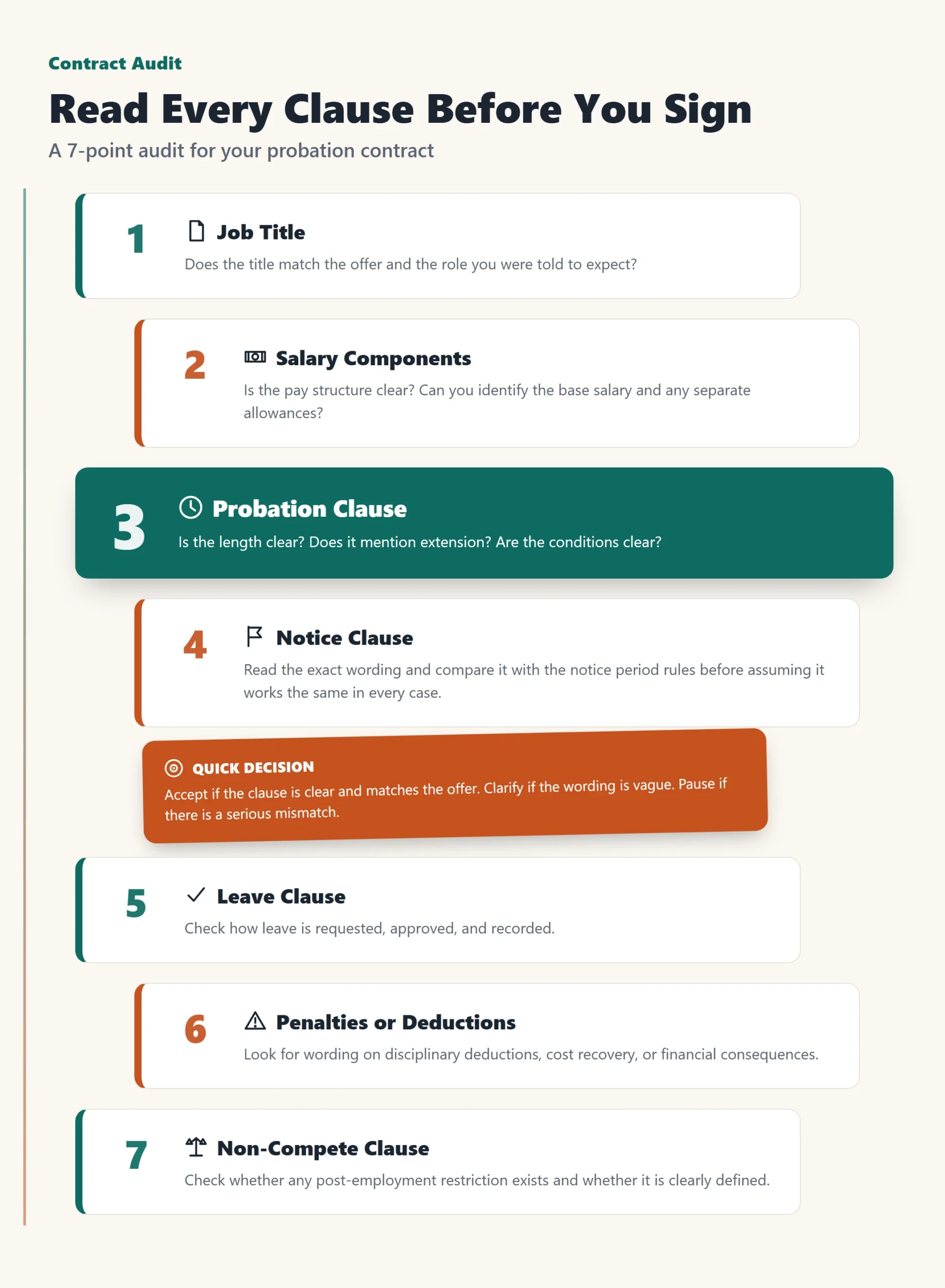
Quick decision: accept, clarify, or pause
- Accept if the clause is clear and matches the offer.
- Clarify if the wording is vague or incomplete.
- Pause if there is a serious mismatch.
Workplace Conduct and Discipline: What Commonly Triggers Problems
Many penalties start with a conduct issue, or an allegation of one. During probation, some employees become careless because they assume they are “not permanent yet.” That is risky.
Common triggers for warnings or discipline include:
- repeated lateness,
- unapproved absence,
- failure to follow reporting lines,
- refusal to carry out assigned work,
- improper communication,
- ignoring documented procedures,
- poor handover or incomplete task closure.
What you should never sign without reading
Never sign a document just because someone says it is routine. Read first, especially if it is:
- a warning letter,
- an investigation note,
- a statement of facts,
- a settlement paper,
- a resignation draft prepared by someone else,
- a salary deduction acknowledgment.
If you do not understand a document, ask for time. If the wording is wrong, request correction before signing.
Investigations: How to Respond Without Self-Damage
If HR or management raises an allegation, stay calm. Your goal is not to “win the room.” Your goal is to avoid self-damage and create a clean record.
Safe response framework
- Ask for the allegation in writing.
- Request time to review and respond.
- Gather your emails, messages, approvals, and work log.
- Answer only what you understand.
- Keep your response factual and short.
- Document what happened after the meeting.
Scenario 1: Good performance, sudden complaint
You have positive emails, completed tasks, and weekly updates. Then HR says your performance is poor.
Safer response:
- Ask for specific examples in writing.
- Compare them with your completed work.
- Submit proof of deliverables and approvals.
- Ask what standard was allegedly not met.
Scenario 2: Vague misconduct claim
A manager says you were “not cooperative,” but there is no clear incident.
Safer response:
- Request dates, events, and policy basis.
- Ask whether there was any prior warning.
- Confirm your version in writing after the meeting.
Penalties and Deductions: What Is Usually Disputed
Expats often get into trouble not because deductions are raised, but because they do not ask the right questions early enough.
Common disputed deduction types include:
- attendance-related deductions,
- damage or loss claims,
- uniform, equipment, or asset recovery,
- training cost recovery,
- other internal penalty claims.
If a deduction is proposed, ask for:
- the exact reason,
- the clause or policy relied on,
- the amount and calculation method,
- an itemized breakdown,
- any supporting evidence.
If the issue touches final dues when leaving, it also helps to understand end of service benefits Saudi Arabia .
Probation: What It Is, and What It Is Not
Probation is usually a trial period for both sides. The employer assesses fit, performance, and conduct. You also assess whether the role, team, and actual conditions match what was promised.
What probation is not is a period where documentation stops mattering. It also does not mean every promise can stay verbal, or every process can stay informal.
During probation, you should still document:
- your contract and offer letter,
- your start date,
- your job title and department,
- your reporting line,
- your salary structure,
- your performance expectations,
- approvals, warnings, and feedback.
If you later need to explain what happened, documents will matter far more than memory.
Probation Length and Extension: What to Verify
Before or after joining, check the probation clause carefully. Do not assume HR’s explanation matches the exact wording.
Look for:
- the stated probation length,
- whether extension is mentioned,
- whether extension conditions are clear,
- who decides the extension,
- whether evaluation criteria are described.
Red flags to notice early
Be careful if you see:
- open-ended extension language,
- no clear end point,
- vague wording such as “subject to management decision,”
- no explanation of how performance will be judged,
- a promise that “we will fix it later.”
If probation wording is unclear in the offer or contract, ask for correction before joining. That is usually safer than trying to fix it after a problem begins.
Termination During Probation: What to Request in Writing
If the employer ends the relationship during probation, do not leave with only verbal explanations.
Process checklist
Ask for the following in writing where possible:
- the effective last working day,
- the stated reason or basis,
- any notice instruction that applies,
- final pay items,
- leave balance treatment,
- return-of-company-property instructions,
- settlement timing and process.
Keep copies of handover emails, asset returns, and any acknowledgment you signed. A clean exit record can reduce later confusion.
Resignation During Probation: Lowest-Risk Approach
If you want to resign during probation, the safest approach is sequence, not speed.
Safer sequence
- Confirm the probation clause.
- Check the notice wording.
- Submit written notice.
- Complete a proper handover.
- Request a written settlement summary.
Before acting, review a broader exit checklist on what to do before resigning in Saudi Arabia .
Sample timeline
- Day 1: review contract, offer, and any HR communication.
- Day 2: send written notice using the correct title and date.
- During notice or transition: keep handover emails and asset return records.
- Final stage: request written confirmation of final pay and outstanding items.
Probation Performance Evidence: How to Self-Defend
The best protection during probation is a simple proof-of-performance system.
Weekly evidence checklist
- Send a short weekly summary email.
- List deliverables completed.
- Note pending items and blockers.
- Keep KPI or target snapshots if available.
- Save manager approvals.
- Record feedback, even if brief.
- Keep notes after important conversations.
Why this matters
If someone later says, “You were underperforming,” your position becomes stronger when you can show what you were asked to do, what you completed, what was approved, and what feedback you received.
A basic work log should include deliverables, approvals, dates, and any unusual hours or urgent requests. Keep it simple and consistent.
If you may need a safer move, we can help you build a stronger CV/Resume for Saudi applications and position it more clearly for your target role .
Probation Traps Expats Face: Myths vs Reality
Many probation problems are not dramatic. They begin with small assumptions.
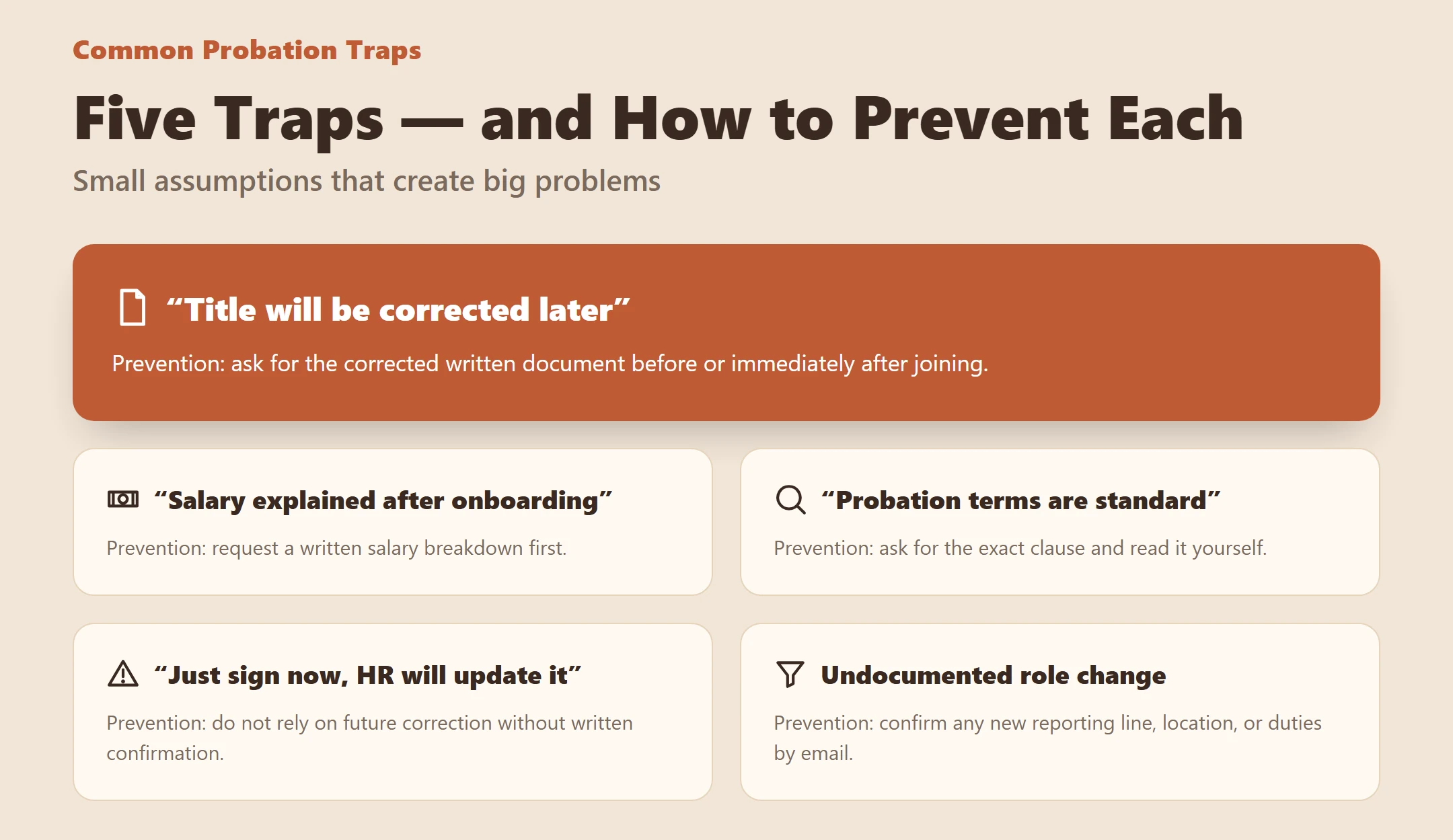
Common traps and prevention actions
Trap: “The title will be corrected later.”
Prevention: ask for the corrected written document before or immediately after joining.
Trap: “Your salary package will be explained after onboarding.”
Prevention: request a written salary breakdown first.
Trap: “Probation terms are standard, don’t worry.”
Prevention: ask for the exact clause and read it yourself.
Trap: “Just sign now, HR will update it.”
Prevention: do not rely on future correction without written confirmation.
Trap: undocumented role change.
Prevention: confirm any new reporting line, location, or duties by email.
Myths vs facts
- Myth: Probation means you have no rights.
Fact: You still need clear documents, a clear process, and written records.
- Myth: Verbal promises are enough if the manager is senior.
Fact: Written confirmation is much safer.
- Myth: If HR says it, it must override the contract.
Fact: You should still verify the actual basis.
Offer vs Contract Mismatch: How to Request Correction Safely
A common expat problem is this: the offer says one thing, but the contract says another.
Typical mismatches include:
- job title,
- location,
- salary structure,
- probation wording,
- notice terms.
Simple correction request
You can keep it professional and calm:
Thank you for sharing the contract. I noticed a difference between the offer and contract regarding the job title, location, or probation clause.
To avoid misunderstanding, could you please confirm the correct version and issue an updated copy in writing?
This protects your position without sounding confrontational.
Probation and Notice: How They Interact
Do not guess how notice works during probation. Confirm your specific case using the documents you actually have.
Confirm-your-case checklist
- What does the probation clause say?
- What does the notice clause say?
- Is there any contradiction between them?
- Has HR explained something different from the contract?
- Can they confirm the applicable process in writing?
Verbal Promises vs Written Reality
Examples of risky verbal promises include:
- “We will waive probation.”
- “Your title will be upgraded soon.”
- “The salary will be adjusted after one month.”
- “Do not worry about the location in the contract.”
The safest move is to convert the promise into written confirmation.
Simple conversion email
Thank you for today’s discussion.
As agreed, my understanding is that the position title will be X, the salary will be Y, and the probation term will be Z.
Please reply to confirm so I can keep my records aligned.
If they do not confirm, treat the promise as unfinalized.
Arabic vs English Documents: Why Mismatch Risk Matters
If you receive Arabic and English versions of a document, do not assume they say the same thing.
Check carefully:
- job title,
- salary figures,
- probation period,
- notice clause,
- penalties,
- resignation wording.
Translation and confirmation checklist
- Ask which version governs if there is a mismatch.
- Request translation help if needed.
- Ask HR to confirm the intended clause in writing.
- Do not sign first and clarify later.
A small wording difference can create a much larger dispute later.
Practical Scenarios: How Documentation Changes Leverage
Scenario A: Good performance, documented well
You send weekly summaries, keep approvals, and save feedback. At the end of probation, you are told performance was not satisfactory.
Your position is stronger because you can show a record of completed work, accepted tasks, and the lack of earlier documented warning.
Scenario B: Vague feedback, no records
You worked hard, but most instructions were verbal. There were no clear KPIs, no summary emails, and no saved approvals.
Your position is weaker because the discussion becomes your memory against theirs.
The lesson is simple: good documentation does not guarantee an outcome, but poor documentation usually weakens your position.

Red Flags in Job Offers Before You Join
Use this pre-join checklist:
- no written contract available,
- salary is vague or partly unexplained,
- job title is broad or inconsistent,
- probation clause is unclear,
- notice language is missing,
- location is not confirmed,
- reporting line changes verbally,
- “we will fix it later” is used repeatedly,
- deductions are mentioned vaguely,
- HR avoids written clarification.
What You Can Safely Request in Negotiation
Reasonable asks include:
- a corrected title,
- a clear salary structure,
- precise probation wording,
- a clear notice clause,
- written confirmation of any promised change.
These are normal clarification requests, not aggressive demands. Clear wording before joining is easier than conflict after joining.
Minimal Monthly Compliance Habits
A 10-minute monthly routine can help you stay prepared without stress.
- Save your payslip.
- Save the related bank transfer proof.
- Take a screenshot of leave balance if relevant.
- Save important approval emails.
- Keep copies of warnings or policy notices if any were issued.
- Update your work log folder.
Small consistency is often better than trying to rebuild your records later.
How to Keep a Work Log That Holds Up
Your work log does not need to be complicated. It just needs to be consistent.
Simple weekly log format
- week or date range,
- key deliverables completed,
- approvals received,
- pending items,
- blockers raised,
- unusual hours or urgent requests,
- follow-up needed.
This matters because disputes often turn on detail: what you were asked to do, when you did it, and who approved it.
Ask Before You Sign Checklist
Before you sign, ask:
- What is my exact job title?
- What is my base salary, and what are the other components?
- How long is probation?
- Can probation be extended, and how?
- What notice wording applies?
- What deductions can happen, and on what basis?
- How are leave and absence recorded?
- What happens if either side ends employment during probation?
- How will final settlement be processed?
If they cannot answer clearly in writing, slow down.
FAQ: Saudi Probation Period Rules
Can I resign during probation?
Possibly, but do not assume the process. Verify your probation and notice clauses first, then send written notice based on that wording.
If HR says “this is standard,” should I stop asking questions?
No. Ask for the exact clause and check whether it matches the offer and contract.
What if my manager gives only verbal feedback?
Treat it as incomplete. Send your own summary email after the discussion so there is a record.
Can a warning affect my probation outcome?
Yes. Read it carefully, check whether the facts are accurate, and do not sign blindly.
What if the contract and offer do not match?
Do not ignore it. Compare title, pay, location, probation, and notice, then request correction in writing.
HR says “sign now, we will update later.” What should I do?
Be cautious. Ask what is wrong or missing, and request an updated written version first.
What if a doctor note is rejected?
Ask calmly for the reason and the policy basis. Keep your medical document on file and request the rule in writing.
Should I keep my own work log during probation?
Yes. A short weekly log of tasks, approvals, and dates can help if your performance is questioned later.
Can salary deductions happen without explanation?
Do not assume they are valid just because they appear. Ask for the basis, amount, and itemized breakdown.
Checklist: Audit a New Offer Before You Accept
Accept if
- title, salary, probation, and notice are clear;
- the contract matches the offer;
- HR gives written answers;
- no important clause is left for “later.”
Avoid or pause if
- salary wording is vague;
- probation is unclear or open-ended;
- the contract conflicts with verbal promises;
- location or role can change without clarity;
- pressure to sign comes before clarification.
If you are an expat who wants a stronger, application-ready CV/Resume before joining or while planning a safer move, get a professional rewrite with clearer positioning and Saudi-focused application readiness here .