

Build a handover packet that protects your reputation
Before resigning in Saudi Arabia, treat your handover as reputation insurance. A clean, documented handover reduces friction with your manager, HR, and the new employer during the transfer period. It also protects you if anyone later claims that work was left incomplete.
A practical handover packet should be short, clear, and easy to review. Include:
- Current projects and their status
- Deadlines due in the next 2–4 weeks
- Key contacts for each task or project
- File locations and access notes
- Pending approvals or unresolved decisions
- Recurring tasks and how they are handled
- Risks, blockers, and recommended next actions
Add a one-page summary at the top. This makes your exit look organized rather than emotional. If you still need the full operational sequence, review the transfer process so your resignation timing and handover timing do not clash.
Use a clean exit kit to reduce HR friction
Keep a personal “clean exit kit” with proof that you completed what was expected. Save:
- The handover email you sent
- The handover file or shared folder record
- Manager acknowledgment
- Asset-return list
- Attendance or timesheet proof
- Salary records
- HR communication screenshots
This kit is not about distrust. It is about preventing confusion later, especially if the transfer process slows down.
Prepare your final settlement early
If you are moving to another employer, ask for an itemized final settlement early. Do not wait until your last working day or until your company access is removed. Once systems are closed, collecting records becomes harder.
Your settlement prep checklist should include:
- Request a written breakdown of settlement items
- Confirm your official last working day in writing
- Save salary slips, bank records, and attendance proof
- Save leave balance records if available
- Keep approval emails related to pay or leave
- Capture HR portal screenshots
If you want to understand what may appear in the settlement, review end-of-service benefits so you can check the breakdown calmly and ask better questions.
Save proof before access is removed
Many avoidable problems happen because employees wait too long to save records. Before email, HR portals, or internal systems are disabled, save proof of:
- Employment details
- Salary history
- Approved leave balance
- Resignation submission
- Handover completion
- HR replies on settlement timing
- Any transfer-related updates
Simple rule: if it may matter later, save it now.
Plan travel carefully during a transfer
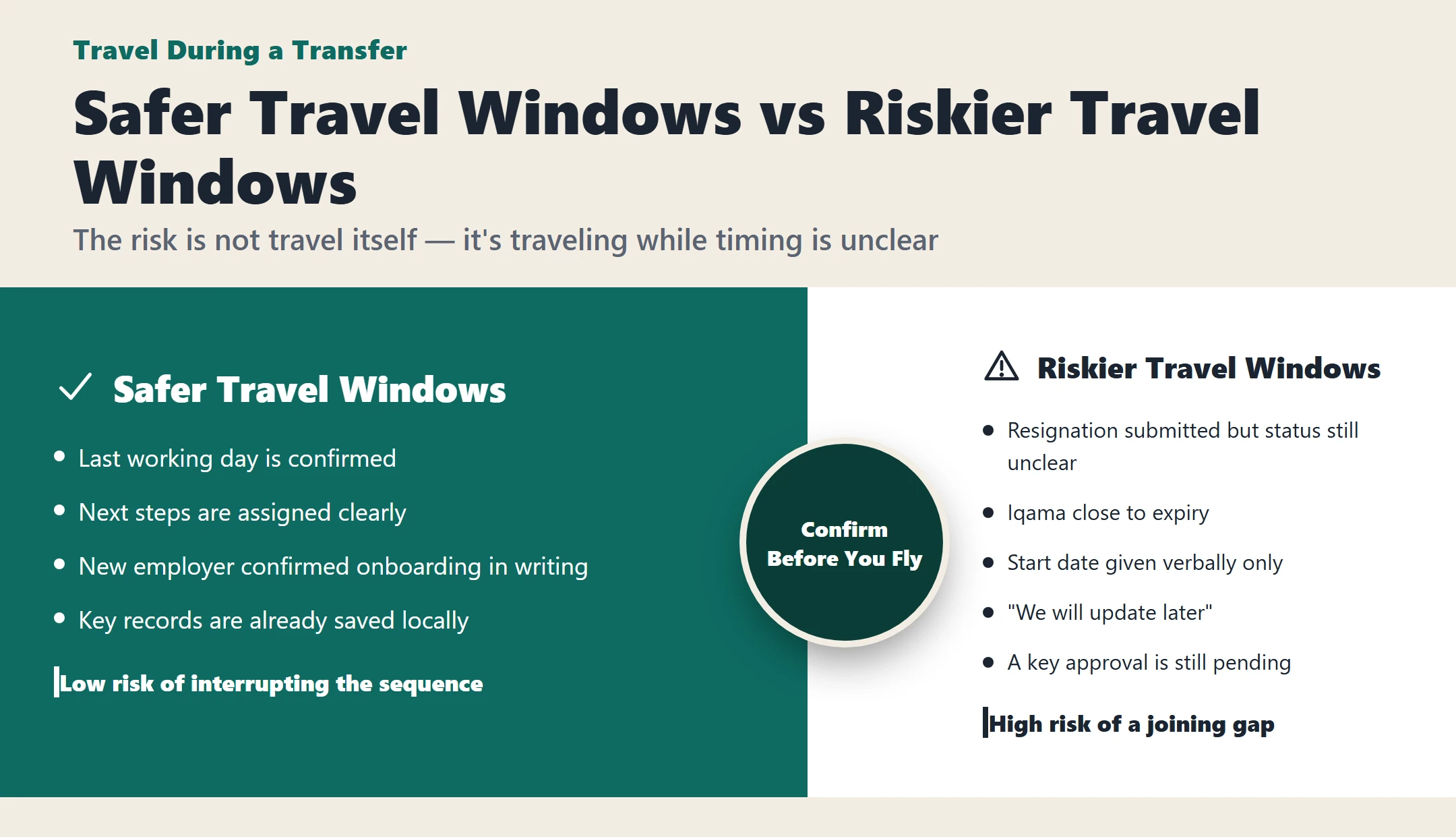
Travel can break the sequence of a job move, even if the trip is short. The main risk is not travel itself. The risk is traveling while approvals, onboarding, or document updates are still unclear.
Safer travel windows usually look like this:
- Last working day is confirmed
- Next steps are assigned clearly
- New employer has confirmed onboarding timing in writing
- Key records are already saved locally
Riskier travel windows often include:
- Resignation submitted but status still unclear
- Iqama close to expiry
- Start date given verbally only
- HR says, “We will update later”
- A key approval is still pending
Before making plans, confirm:
- Who owns the next step
- What must happen before travel
- Whether the trip interrupts the sequence
- Whether return timing creates a joining gap
If you are unsure about eligibility or workflow, check the mobility rules instead of relying on office rumors.
If your Iqama is near expiry, use a mitigation plan
An Iqama close to expiry does not always stop a move, but it does reduce your margin for error. You need tighter timing, stronger written confirmation, and more buffer.
Use this mitigation plan:
- Check the expiry date immediately
- Ask both employers for timing updates in writing
- Do not resign based only on verbal reassurance
- Build buffer weeks into your plan
- Save every written confirmation
- Delay non-essential travel
- Reconfirm status more than once before notice ends
Worked example timeline
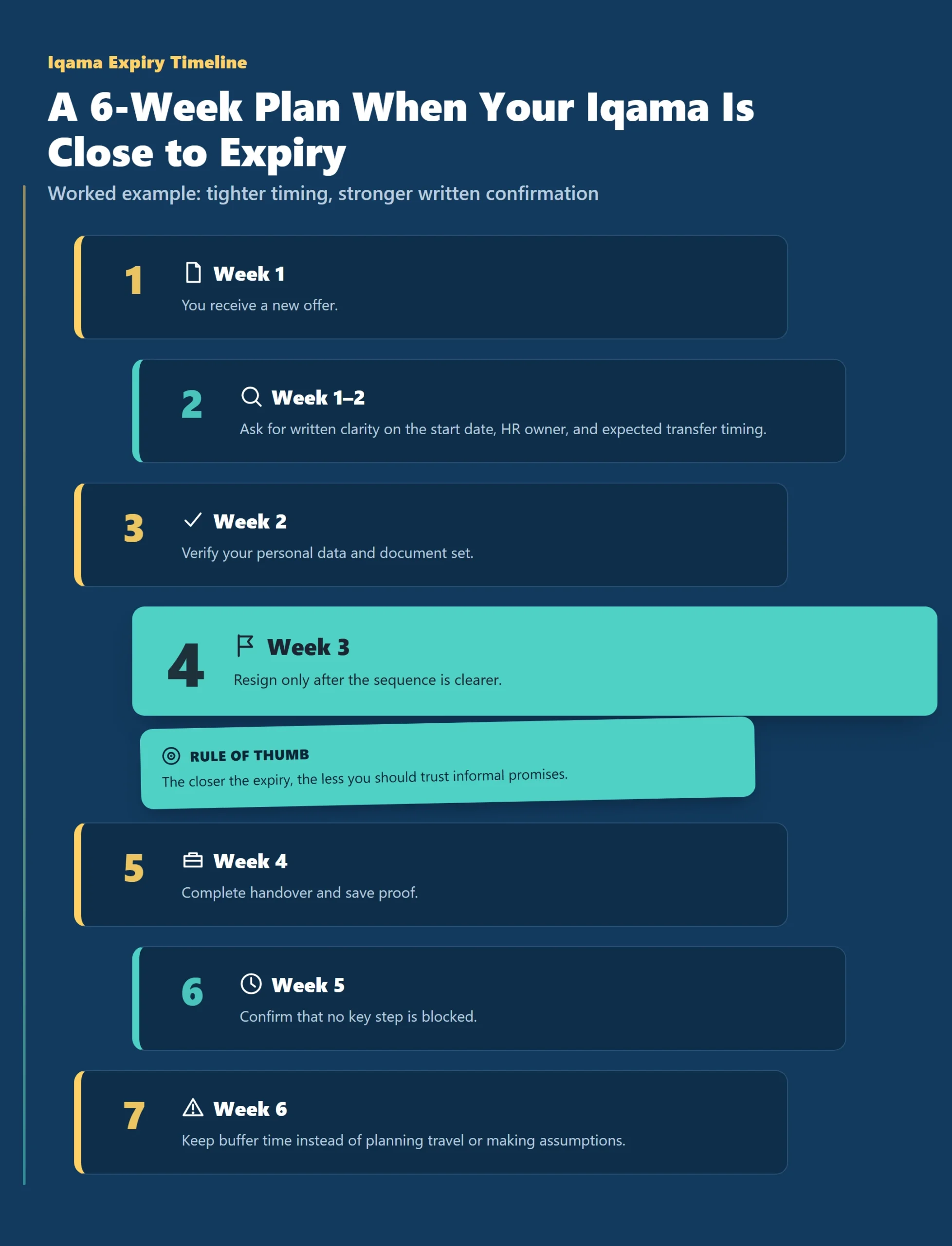
Imagine your Iqama expires in six weeks.
- Week 1: You receive a new offer.
- Week 1–2: You ask for written clarity on the start date, HR owner, and expected transfer timing.
- Week 2: You verify your personal data and document set.
- Week 3: You resign only after the sequence is clearer.
- Week 4: You complete handover and save proof.
- Week 5: You confirm that no key step is blocked.
- Week 6: You keep buffer time instead of planning travel or making assumptions.
The closer the expiry, the less you should trust informal promises.
Plan around Ramadan and Eid realistically
Holiday periods can slow approvals, onboarding, document collection, and payroll setup. That does not mean you cannot switch jobs. It means your timing needs more patience and more buffer.
Add extra time for:
- HR replies
- Manager approvals
- Document collection
- Access setup
- Insurance activation
- Payroll processing
A simple holiday-period plan could be:
- Before the holiday: collect documents, confirm the responsible HR contact, and send your written questions
- During the holiday: expect slower replies and avoid major assumptions
- First week after: reconfirm dates, documents, and status
- Following week: finish handover and check onboarding readiness
If notice timing is part of your decision, read about notice period rules so your dates are realistic, not optimistic.
If you are preparing for a move and your CV/Resume is weak, we can help you rewrite it for clearer positioning and stronger applications before you resign .
Before you resign: mobility checklist
Use this checklist before taking action:
- Is the offer written and clear?
- Is the start date written, not verbal?
- Do you know who in HR owns the transfer or onboarding?
- Is your Iqama timing safe for this sequence?
- Have you allowed for holiday delays?
- Have you saved salary and employment records?
- Have you confirmed your notice period?
- Do you have a buffer if the new employer delays?
- Do names, dates, and ID details match across documents?
- Are you resigning based on planning, not emotion?
Red flags before resigning
Pause if you notice these warning signs:
- No written start date
- No clear HR contact person
- Repeated “we will confirm later” responses
- Pressure to resign immediately
- Unclear onboarding timeline
- Weak answers on insurance or payroll timing
For basic risk awareness, it helps to understand expat labor rules so you can identify financial or status risks early.
After you resign: operational checklist
Once you resign, your focus should shift from decision-making to execution. Keep the process practical and documented.
Use this checklist:
- Send your handover plan in writing
- Save proof that handover was completed
- Request itemized final settlement
- Confirm your last working day
- Save status updates related to transfer
- Confirm onboarding date and first-day instructions
- Check payroll setup timing
- Check insurance start timing
- Save all HR and manager replies
This is the stage where small gaps in proof can become bigger problems.
Hand over properly without losing leverage
You should cooperate, but you should also protect yourself. Some employees return property, lose system access, and only then realize they did not save the proof they needed.
Save-before-access-removed checklist
Before access is cut, save:
- Resignation email or portal submission
- Manager acknowledgment
- Handover file
- Transition meeting notes
- Asset-return instructions
- Salary slips
- Bank transfer records
- HR portal screenshots
- Pending approval screenshots
- Contact details for follow-up
If someone says, “Return company property first,” stay calm. Confirm what is being returned, when it will be acknowledged, and how completion will be recorded. Proper sequence matters.
Build a payroll continuity plan
A transfer can look successful and still create a salary gap if dates are poorly aligned. Payroll continuity needs planning.
Check these items early:
- Your last salary month with the current employer
- Your first payroll cycle with the new employer
- Any delay between joining date and payroll cutoff
- Whether bank details need updating
- Whether a slight shift in start date would reduce risk
Timeline example
A practical timeline may look like this:
- Last week with current employer: confirm salary cutoff and send settlement request
- Before first day with new employer: confirm bank details and payroll cycle
- First week in new role: verify that your profile is active for payroll
- Mid-month: follow up if nothing appears in the system
The goal is simple: avoid a surprise month with no salary because nobody checked the dates properly.
Confirm insurance and benefits continuity
Benefits gaps usually become visible only when you need them. That is why this section should stay practical: confirm, save proof, and follow up if anything is unclear.
Save proof of:
- Insurance start date
- Dependents’ coverage status
- Relevant employment record updates
- Benefits enrollment confirmation
- Any messages about activation timing
Do not assume that coverage starts exactly when you expect. Ask and save the reply.
If your current employer threatens you
If your employer becomes threatening, do not react emotionally. Move the discussion into writing as quickly as possible.
Use these de-escalation steps:
- Stay polite
- Ask for the policy basis in writing
- Repeat your understanding calmly
- Summarize conversations by message or email
- Save screenshots and timestamps
- Avoid long voice-note arguments
- Do not sign rushed documents without review
Blocking pattern: “We’ll approve later”
This can be a stalling tactic. A calm response is:
“Thank you. To avoid misunderstanding, please confirm in writing what step is pending, who owns it, and the expected date.”
Blocking pattern: “Sign this resignation now”
A safer response is:
“Thank you. I would like to review the written terms first so I can respond accurately and complete the process properly.”
Written calm is stronger than verbal emotion.
If HR refuses to provide documents
Sometimes HR delays, ignores follow-ups, or keeps saying documents will come later. Your goal is not to argue. Your goal is to create a clear written trail.
Use this request sequence:
- Make the first request clearly and specifically.
- Follow up using the exact document name.
- Ask for the expected delivery date.
- Ask whether anything is pending from your side.
- Save screenshots of every request and reply.
- Capture timestamps, sender names, and the platform used.
What to screenshot
- Your original request
- Delivered or seen status if relevant
- Replies mentioning delay
- Portal status pages
- Calendar invitations or cancellations
Short communication templates
Use short, neutral wording that keeps the process moving.
Follow-up
“Hello, just following up on the document or status update. Please let me know if anything is pending from my side.”
Confirm status
“Hello, to avoid any misunderstanding, could you please confirm the current status and next step in writing?”
Request document
“Hello, may I kindly request the itemized settlement or document copy for my records? Please let me know the expected timeline.”
Schedule handover
“Hello, I have prepared the handover notes and would like to schedule a short handover meeting. Please share a suitable time.”
Case study: transfer with Iqama near expiry
An expat receives an offer while the Iqama is close to expiry. The first instinct is to resign quickly. That creates unnecessary pressure.
A safer sequence is:
- Confirm written offer quality
- Confirm who owns onboarding
- Ask about timing in writing
- Build buffer weeks
- Save every reply before resigning
What could go wrong?
- Start date slips
- HR responds slowly
- Access is removed before records are saved
- Travel interrupts the sequence
Mitigation actions:
- Delay resignation until timing is clearer
- Keep all proof
- Avoid travel during uncertain stages
- Reconfirm dates more than once
Case study: transfer after late salary
An expat wants to move, but current salary is already late. This raises the emotional temperature and makes documentation even more important.
Build an evidence pack with:
- Employment contract copy
- Salary slips
- Bank statements showing missing payment
- Attendance proof
- HR follow-up messages
- Manager replies
- Payroll status screenshots if available
The key lesson is sequencing. Do not resign in anger just because salary is late. First build the evidence pack, assess the next offer carefully, and protect your timeline.
Case study: transfer during a holiday period
A candidate receives an offer just before a holiday period. The employer expects quick onboarding, but replies become slower than expected.
A smoother response includes:
- Expecting slower communication
- Adding extra buffer
- Asking short written status questions
- Avoiding unnecessary travel
- Not promising unrealistic start dates to others
This approach keeps pressure low and reduces avoidable misunderstandings.
FAQ: before resigning in Saudi Arabia
1. Should I resign after a verbal offer?
No. Wait for clear written details.
2. What should I save before resigning?
Salary records, resignation proof, handover proof, HR messages, and key screenshots.
3. Is travel risky during a transfer?
It can be, especially when status or timing is unclear.
4. What if my Iqama is near expiry?
Use tighter timing, written confirmations, and more buffer.
5. Should I trust “we will update later”?
No. Ask for written next steps or dates.
6. When should I request settlement details?
As early as practical, before access is removed.
7. What if HR ignores me?
Follow up politely, specifically, and keep screenshots.
8. How do I reduce payroll gaps?
Align exit timing, joining date, bank details, and payroll cycle.
9. Can a good handover really help?
Yes. It reduces friction and protects your professional reputation.
10. What is the biggest mistake?
Resigning too early without proof, buffer, or written clarity.
One-page risk card before resigning
Use this compact risk card before making your move:
- Iqama timing: safe, tight, or critical?
- Offer quality: written and complete, or vague?
- Employer stability: organized, responsive, or unclear?
- Settlement readiness: requested and documented?
- Proof captured: yes or not yet?
- Start-date buffer: comfortable or too tight?
- Travel risk: avoidable or urgent?
- Data match: names, dates, and IDs correct?
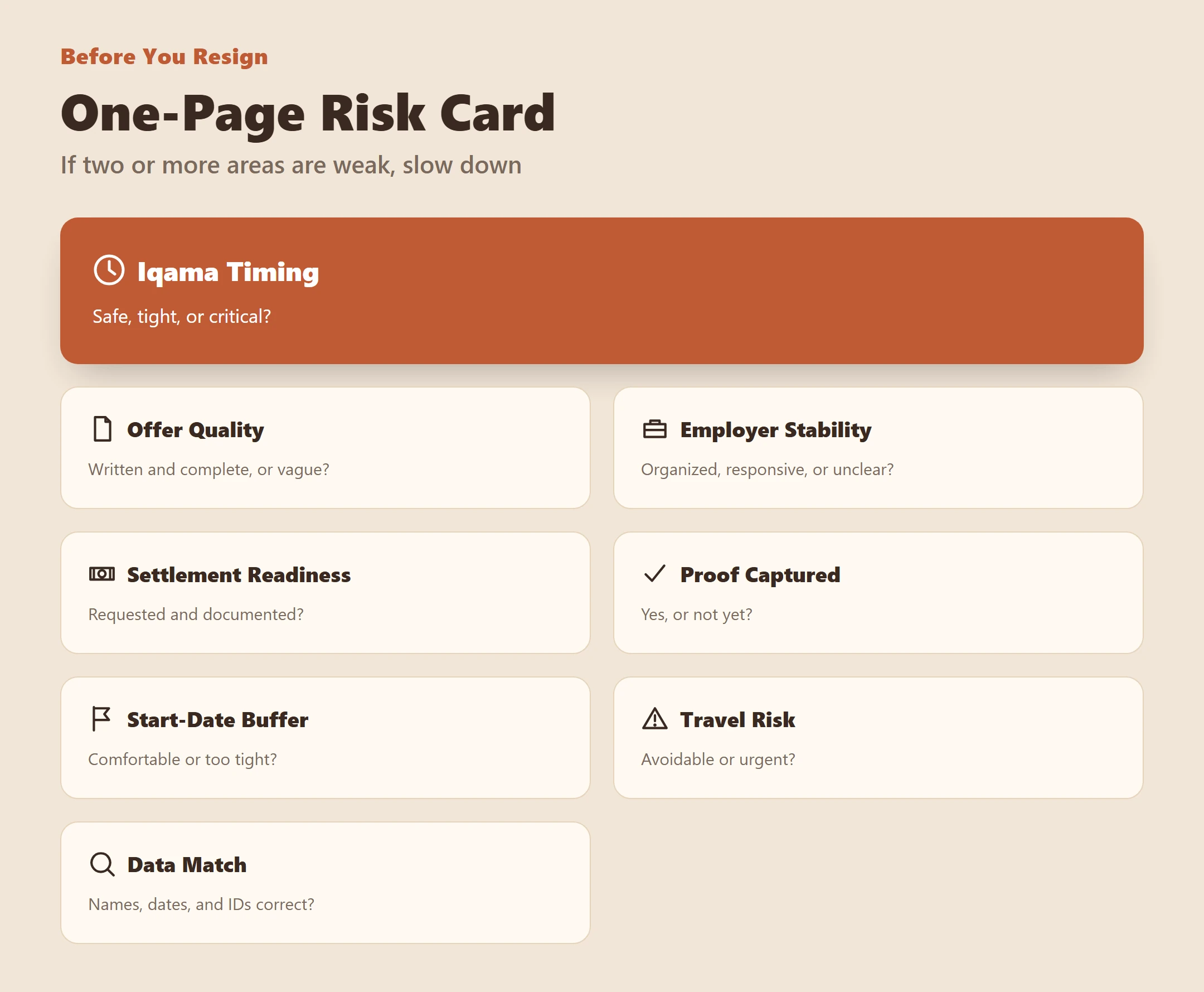
If two or more areas are weak, slow down before resigning.
Mistakes that cause payroll gaps
Common mistakes include:
- Resigning too early
- Using no date buffers
- Not checking payroll cutoff
- Not updating bank details
- Trusting verbal promises only
- Failing to save proof
Fix each one with a simple response:
- Resign only after written clarity improves
- Add buffer weeks
- Ask payroll timing directly
- Confirm bank details early
- Save every important message
Mistakes that cause transfer rejection
Technical mistakes are often small but costly. Common examples include:
- Mismatched personal data
- Missing documents
- Wrong dates across records
- Unclear handover status
- Weak communication trail
Prevention checklist:
- Check names and ID details carefully
- Match dates across all documents
- Save approvals and acknowledgments
- Keep a clean handover record
- Follow up in writing, not from memory
The 10 rules for safe job mobility
- Do not resign early.
- Get key details in writing.
- Save proof before access is removed.
- Build time buffers.
- Confirm your last working day.
- Request itemized settlement early.
- Reduce travel risk during uncertain stages.
- Keep handover clean and documented.
- Stay calm if blocked or pressured.
- Verify every date, name, and status twice.
If you only remember 5 things
- Do not resign before the sequence is clear.
- Verify your data and dates.
- Capture proof while you still have access.
- Plan buffers, especially around holidays and expiry dates.
- Evaluate employer stability before you move.
Get a professionally written CV/Resume, optimized for expats in Saudi Arabia who want stronger applications and a safer next move—order here .