
If you are an experienced professional, one of the biggest career mistakes is relying on memory.
You finish projects, improve processes, support stakeholders, and move important work forward. Then, months later, when it is time to update your CV, prepare for a performance review, or answer interview questions, the details are blurred. What remains is often a vague sense that you “did a lot.”
An achievement portfolio solves that problem.
It is not a design project or a personal website. It is a practical system for capturing proof of impact as you go, so your CV, LinkedIn profile, interview stories, and review discussions stay current.
Building a Personal Operating System
Think of your achievement portfolio as a personal operating system for career evidence. It should be simple enough to maintain and structured enough to use quickly.
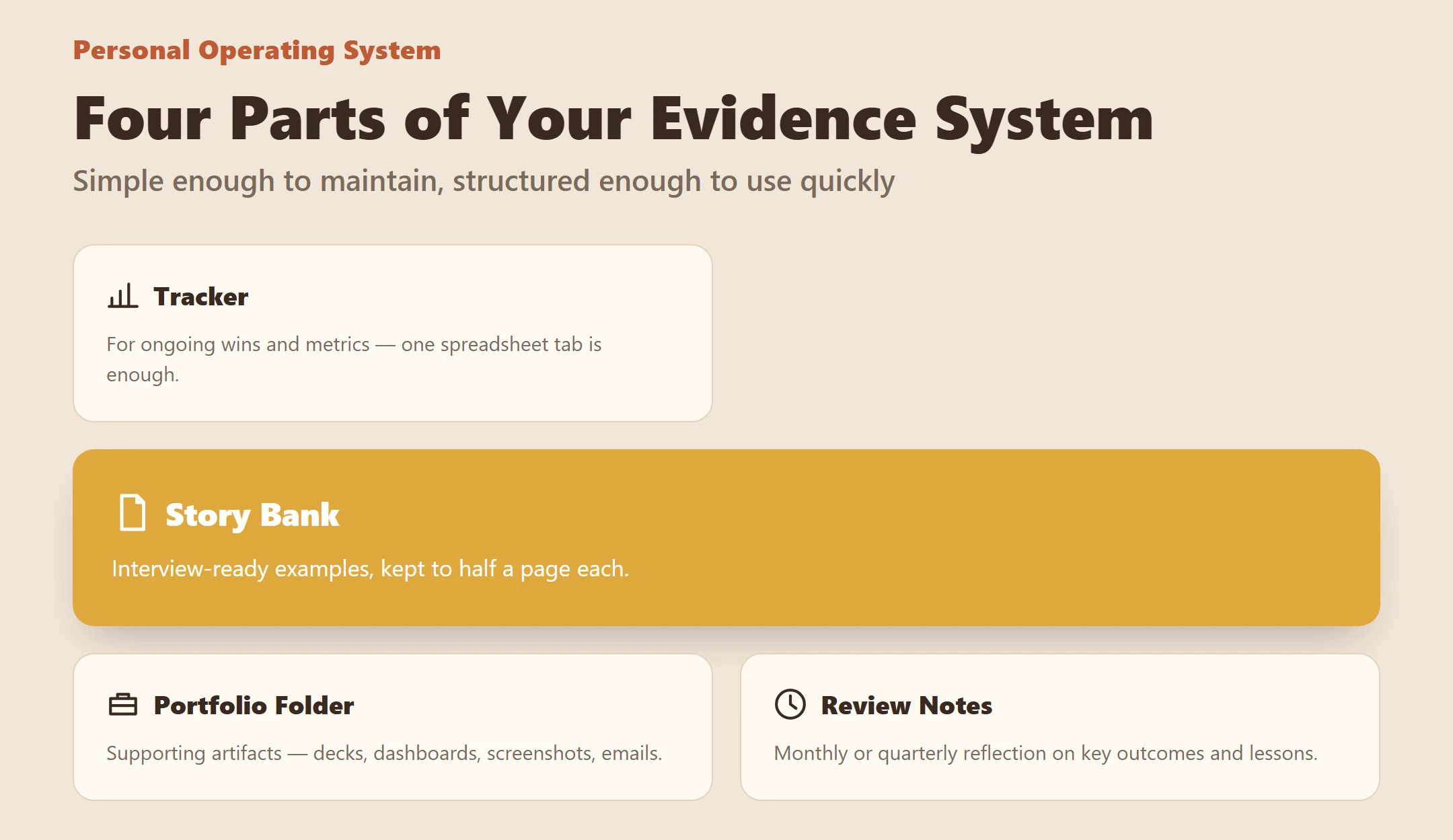
At minimum, your system needs four parts:
- A tracker for ongoing wins and metrics
- A story bank for interview-ready examples
- A portfolio folder for supporting artifacts
- Review notes for monthly or quarterly reflection
You do not need complex tools. A notes app, spreadsheet, and organized cloud folder are enough if you use them consistently.
A practical setup might look like this:
- One spreadsheet tab for weekly wins
- One document for polished stories
- One folder with subfolders for dashboards, decks, emails, screenshots, and process documents
- One short monthly review note with key outcomes and lessons
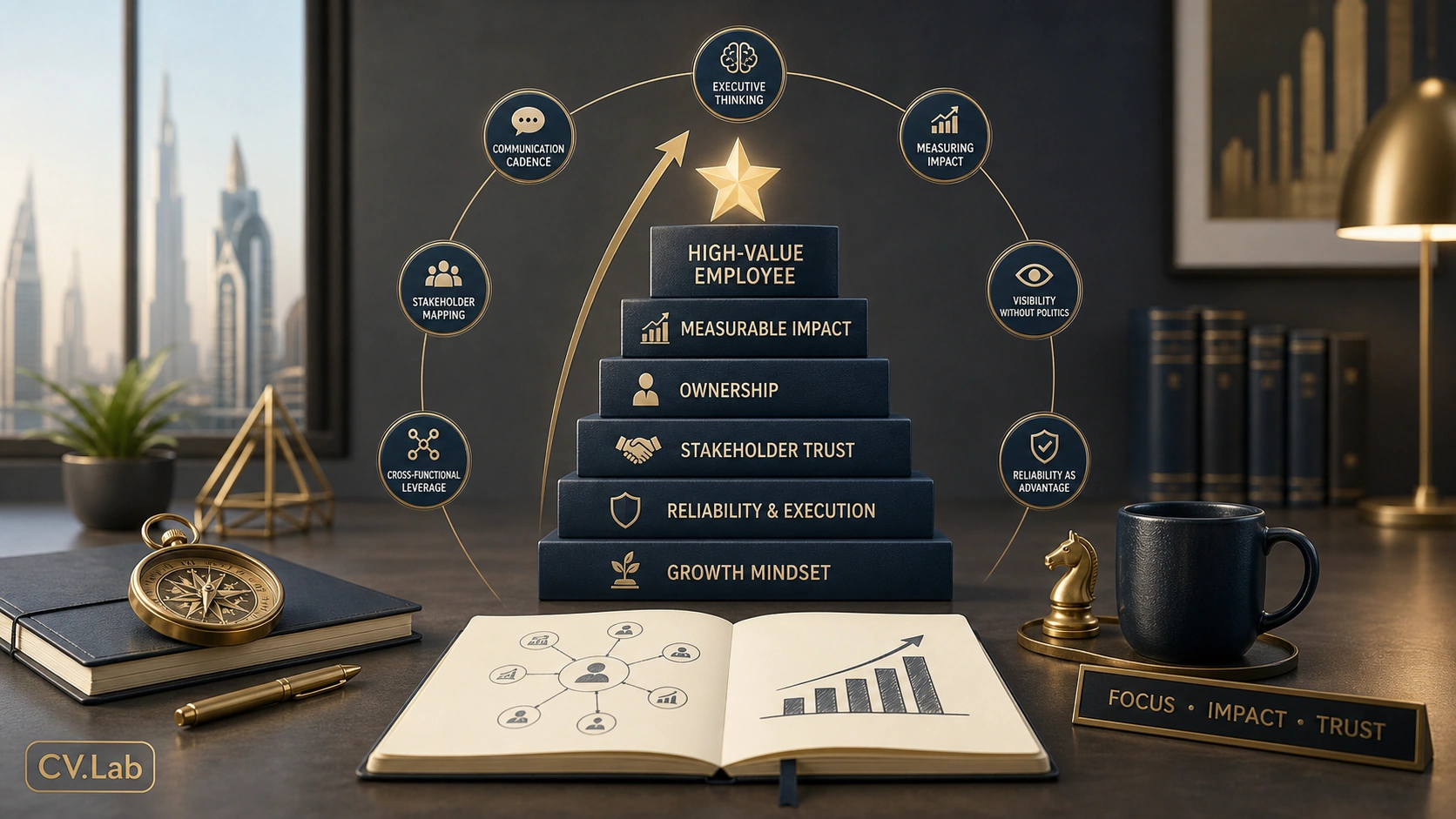
This structure also makes it easier to position yourself as a high-value employee inside your company, because you are not waiting for others to define your contribution.
Why an Achievement Portfolio Matters
Most professionals only start collecting evidence when they need it urgently. That is usually the worst time.
When you wait until a job application, promotion conversation, or annual review, three problems appear:
- You forget important wins
- You lose access to documents or emails
- You describe work too vaguely to sound credible
Continuous capture prevents last-minute scrambling. Instead of trying to rebuild a year from memory, you work from real records.
This matters for several career moments:
- Updating your CV or resume with stronger bullets
- Refreshing your LinkedIn profile
- Preparing evidence for a manager conversation
- Building concise stories for interviews
- Supporting a case for broader responsibility
It also improves the quality of your examples. If you document results while they are still fresh, you preserve the real context, your actions, what changed, and the proof behind it. That gives you stronger material when you need to talk about achievements in interviews .
Portfolio Artifacts to Collect
Your portfolio should include artifacts that show what you did, what changed, and how others experienced the result.
Useful artifacts include:
- Presentation decks
- KPI dashboard screenshots
- SOPs and playbooks
- Process maps
- Business case notes
- Quarterly result slides
- Training materials
- Stakeholder praise emails
- Customer or partner feedback
- Risk or compliance sign-offs
Do not collect everything. Collect the items that best prove ownership, judgment, execution, and outcomes.
A useful question is: If someone challenged this achievement, what document would make it easier to believe?
That helps you focus on evidence rather than clutter.
Story Bank Structure
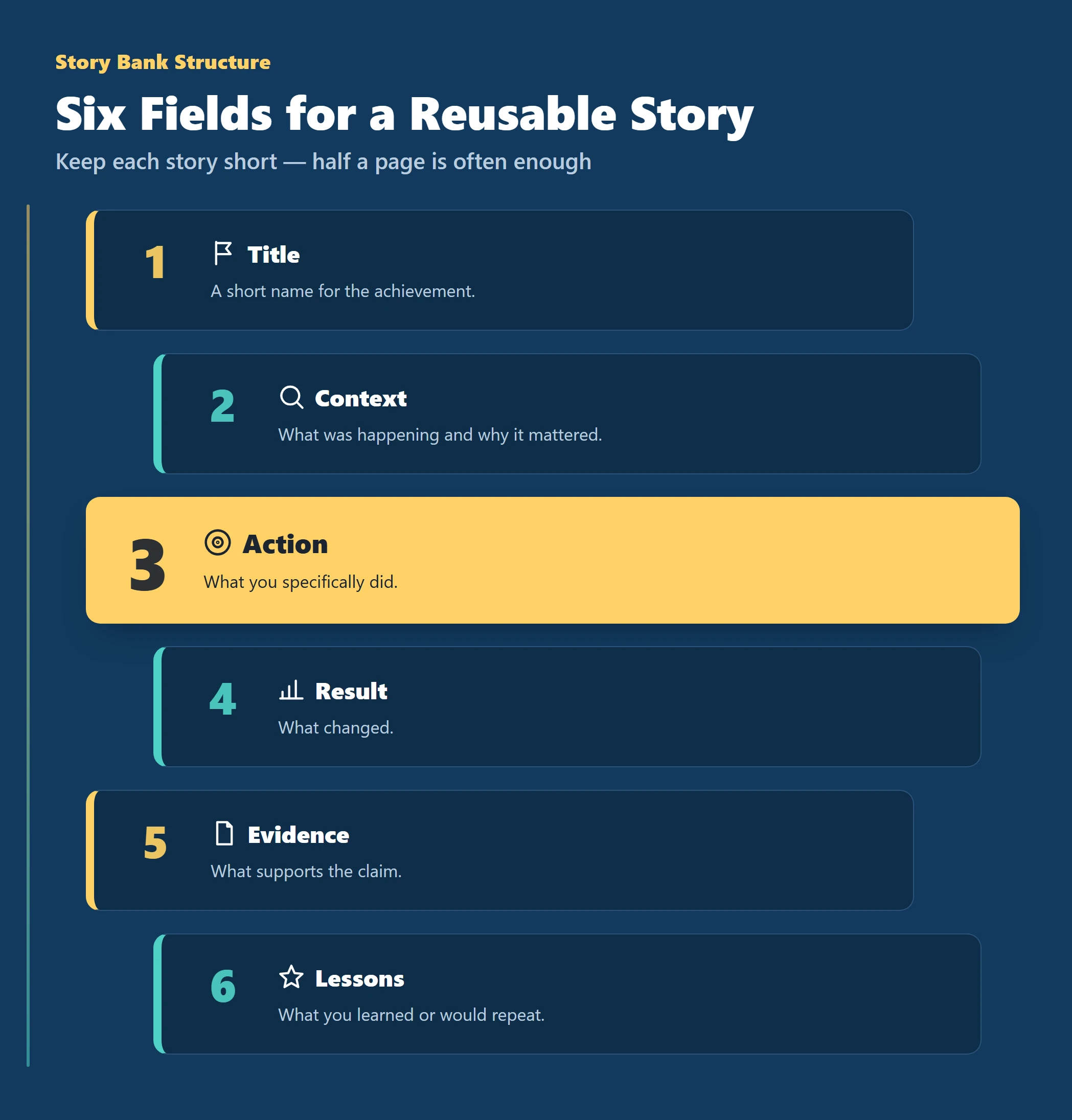
Your story bank is different from your artifact folder. Artifacts are raw proof. Story-bank entries are short, reusable narratives for interviews, reviews, and CV writing.
A strong story entry should include:
- Title: a short name for the achievement
- Context: what was happening and why it mattered
- Action: what you specifically did
- Result: what changed
- Evidence: what supports the claim
- Lessons: what you learned or would repeat
Keep each story short. Half a page is often enough.
Example:
- Title: Reduced reporting delays across a regional team
- Context: Monthly reporting was inconsistent and late
- Action: Standardized inputs, created review checkpoints, and trained contributors
- Result: Faster reporting cycle and fewer quality issues
- Evidence: Dashboard snapshot, updated SOP, manager feedback
- Lessons: Early stakeholder alignment reduced rework
This structure makes it much easier to turn tasks into achievements instead of listing responsibilities with no visible impact.
Metrics Capture Routine
Strong portfolios are not built only on stories. They are built on a routine.
A practical routine is to take a monthly snapshot of your key work. This can often be done in 15 to 20 minutes.
Capture three things each month:
- Baseline: where the metric or process started
- Delta: what changed
- Causality notes: what likely contributed to that change
Your causality notes should be careful and realistic. Do not claim full credit if multiple teams were involved. Note your actual contribution.
For example:
- Baseline: manual approval turnaround was slow
- Delta: process moved faster after workflow redesign
- Causality note: introduced clearer handoff rules and reduced duplicate checks
If you do not have full data, record safe estimates with clear labels. Use ranges, proxies, or directional language only when they are honest and defensible.
How to Turn Work into Short Case Studies
A useful case study does not need to be long. In fact, shorter is often better.
Use this format:
- Problem
- Approach
- Result
- Next steps
That structure creates clarity and makes your work easier to reuse in interviews, internal reviews, and summaries.
Example:
- Problem: onboarding delays were creating friction for new hires
- Approach: mapped handoffs, removed duplicate approvals, created one onboarding checklist
- Result: smoother process and fewer repeated questions
- Next steps: automate reminders and track completion consistency
A case study is especially useful when a project does not fit cleanly into one bullet point. It gives you a compact way to show thinking, action, and outcome.
If you want help turning your work history into a stronger, application-ready CV built around real proof, we can help rewrite and position it for better applications
.
Evidence Hierarchy
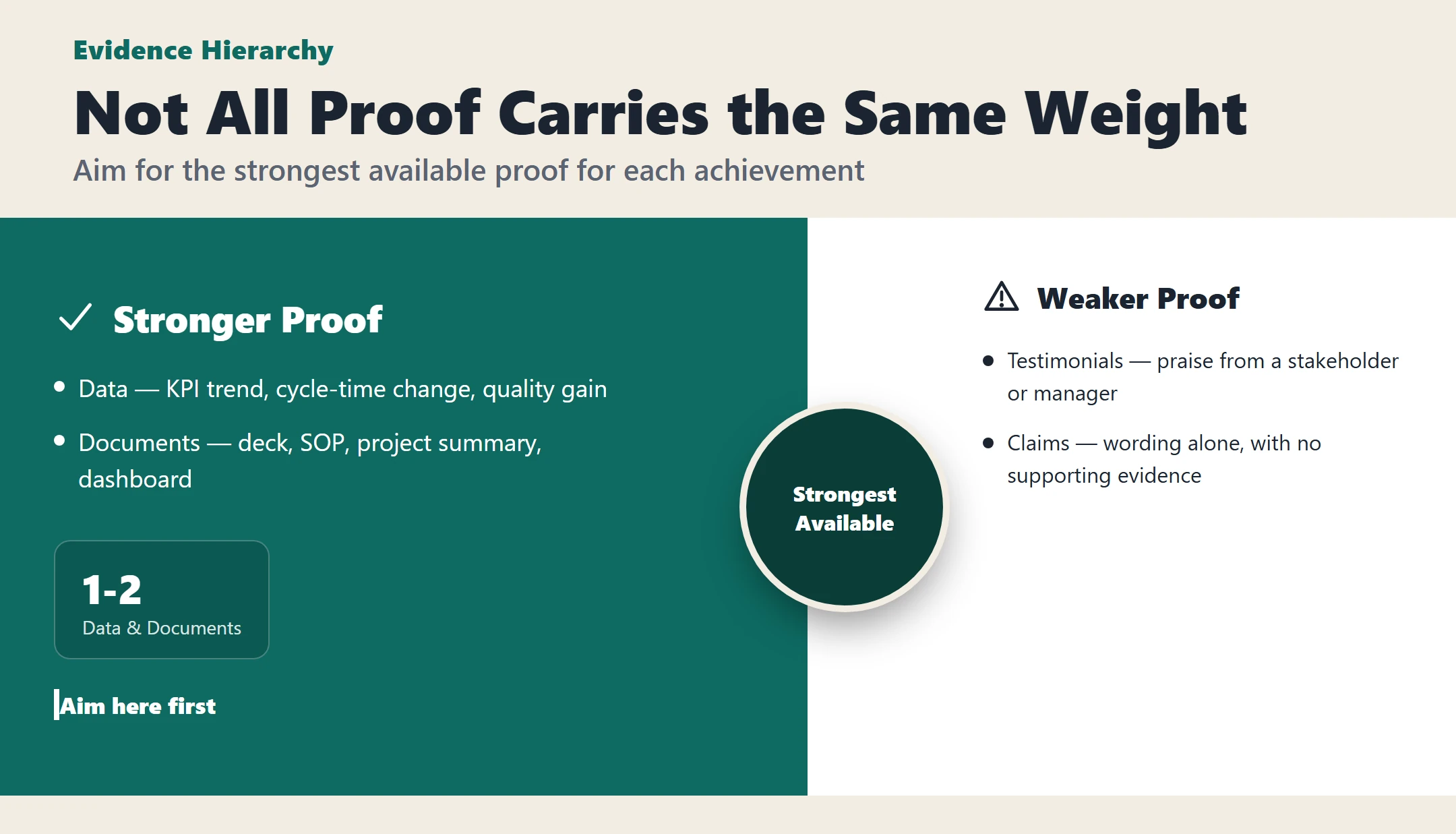
Not all proof carries the same weight.
A useful evidence hierarchy is:
- Data
- Documents
- Testimonials
- Claims
Data is strongest because it shows measurable movement. Documents come next because they show what was created, changed, or approved. Testimonials help because they reflect stakeholder trust. Claims alone are weakest because they depend only on wording.
That does not mean every achievement needs perfect numbers. It means you should aim for the strongest available proof.
Examples:
- Data: KPI trend, cycle-time change, quality improvement
- Documents: deck, SOP, project summary, dashboard screenshot
- Testimonials: praise from a stakeholder, partner, or manager
- Claims: “I improved collaboration” with no supporting evidence
This principle also improves your professional summary for CV , because strong summaries are built on patterns of proven impact rather than broad adjectives.
KPI Dashboard Snapshot
A KPI dashboard snapshot proves that your work influenced measurable outcomes or operating health.
Capture it by saving a dated screenshot and adding a short note covering:
- What metric is shown
- What period it covers
- What changed
- What your role was
When you reference it in a review or CV, avoid weak wording such as “managed dashboards.” Focus instead on the business value, such as supporting visibility, decision-making, or operational improvement.
Before-and-After Process Map
A before-and-after process map proves process thinking, simplification, and execution discipline.
Capture both versions if possible. If not, recreate the earlier state carefully and label it as a reconstruction.
In your review or CV, reference what changed:
- Steps reduced
- Duplicate handoffs removed
- Approval path clarified
- Rework points addressed
This artifact is especially useful in operations, project, quality, and transformation work.
Project One-Pager
A project one-pager proves that you can frame work clearly and connect actions to value.
Capture a one-page summary with:
- Objective
- Scope
- Stakeholders
- Actions taken
- Result
- Next step
This is one of the most reusable documents in an achievement portfolio because it supports interviews, CV updates, and internal conversations.
Business Case or ROI Note
A business case or ROI note proves judgment, prioritization, and commercial awareness.
You do not need a full finance model. Even a short note can be useful if it explains:
- The problem
- The expected gain
- The cost or effort involved
- The decision logic
In your CV or review, reference the decision-support value, not only the document itself.
Stakeholder Email Praise, Sanitized
A sanitized stakeholder email proves trust and perceived value.
Remove confidential details, sensitive numbers, and names where needed before saving it. Keep the part that shows your contribution, reliability, or impact.
This is not stronger than hard data, but it is still useful when it confirms influence, support quality, or cross-functional contribution.
Training Material
Training material proves subject-matter depth and internal enablement.
Save workshop slides, facilitator notes, onboarding guides, or quick-reference documents you created. These show that you can transfer knowledge, build team capability, and create repeatable standards.
In a CV, this can support leadership, coaching, and process-improvement narratives.
SOP or Playbook Excerpt
An SOP or playbook excerpt proves that your work outlasted the original task or project.
It shows that you did not just fix something once. You helped make the solution repeatable.
Capture the relevant section, date it, and note whether it was adopted by a team, function, or broader process.
Quarterly Results Slide
A quarterly results slide proves that your work appeared in a reporting context.
If your contribution showed up in business reviews, team updates, or leadership decks, keep a version of the slide or a short summary note. This matters because it connects your work to business rhythm and formal reporting.
Customer or Partner Testimonial
Customer or partner feedback proves external value, not just internal effort.
Capture short feedback that reflects responsiveness, problem-solving, quality, or delivery reliability. Sanitize it where needed.
This is especially useful in service, account, implementation, delivery, and relationship-facing roles.
Risk or Compliance Evidence
Risk and compliance evidence proves diligence, trustworthiness, and control.
Examples include:
- Approval records
- Issue-resolution logs
- Control updates
- Policy implementation notes
- Audit-ready documentation
In many roles, preventing problems is as valuable as driving visible growth. Your portfolio should show both.
Weekly Impact Log
Your weekly impact log is the simplest habit that keeps the whole system alive.
Keep it to one page and update it once a week using this format:
- 3 wins
- 1 lesson
- 1 next action
That is enough to reduce memory loss and reveal patterns over time.
For each win, capture:
- Context
- Action
- Metric
- Evidence
- Stakeholder
Example:
- Win: simplified monthly reporting input flow
- Context: repeated delays from inconsistent templates
- Action: standardized fields and clarified owners
- Metric: fewer corrections needed
- Evidence: updated template and review note
- Stakeholder: finance and department leads
Performance Review Evidence Folder
Your performance review folder should make retrieval easy, not impressive.
Organize it by theme rather than by random file name. A practical structure could be:
- Leadership
- Execution
- Analytics
- Stakeholder management
- Process improvement
- Risk and compliance
- Learning and capability building
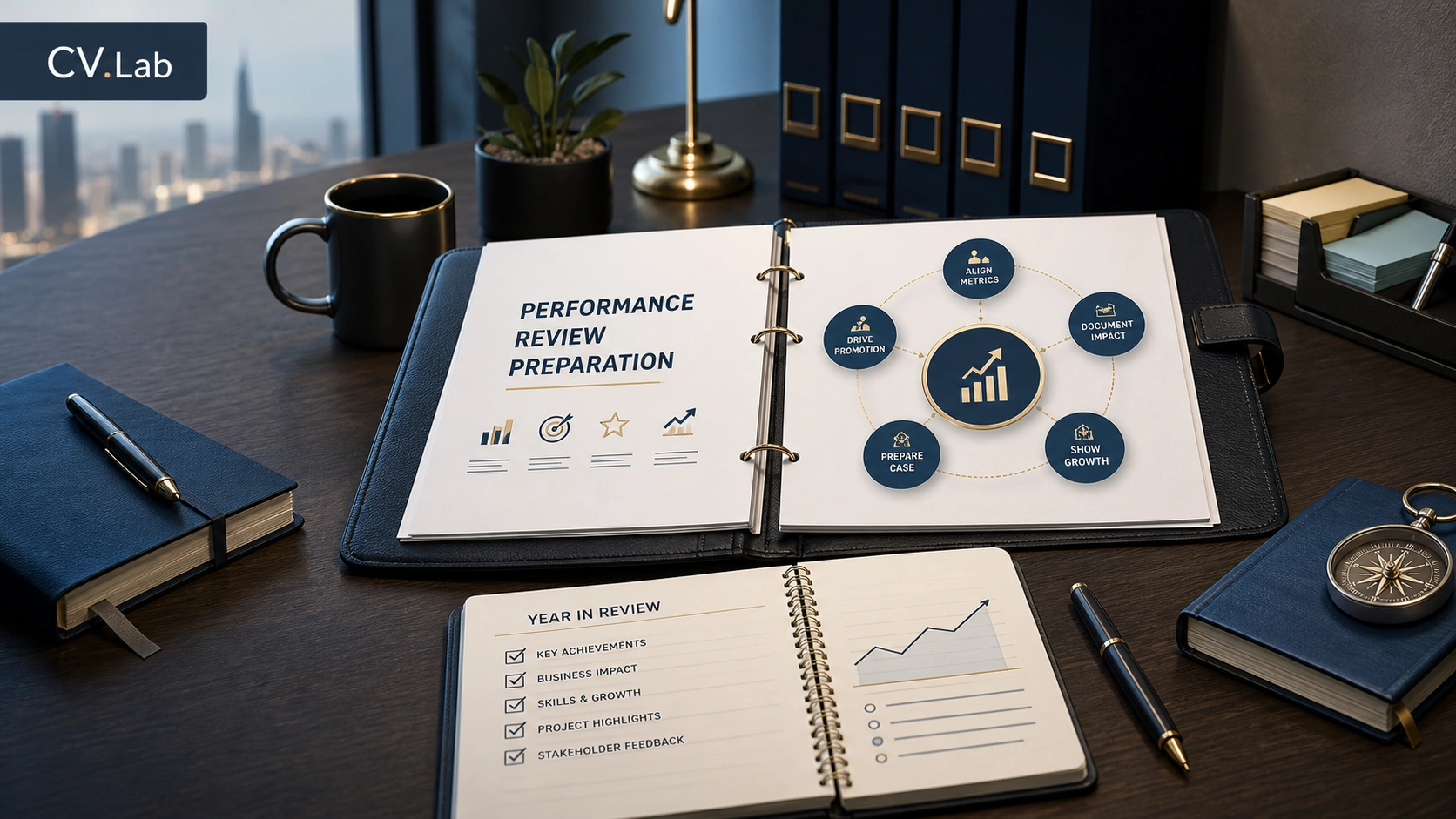
Inside each folder, store the related artifacts and one short summary note explaining why they matter. This makes performance review preparation much faster because you are not searching through scattered files at the last minute.
You can also keep a simple quarterly summary with:
- Top wins
- Lessons learned
- Risks or blockers
- Next priorities
- Support needed
Personal KPI Dashboard
A personal KPI dashboard helps you track your own development, not just business outputs.
Think in three categories:
- Impact: results, improvements, quality, efficiency
- Learning: skills applied, tools used, methods learned
- Visibility: presentations, cross-team work, stakeholder recognition
This gives you a fuller picture of progress. Not every quarter will be defined by one large metric shift. Some periods are stronger in systems building, capability growth, or visibility.
A simple personal dashboard might include:
- Number of documented wins
- Number of completed case studies
- Number of reusable artifacts collected
- Business improvements supported
- Training or enablement contributions
- Cross-functional initiatives joined
Practical Examples You Can Copy
Weekly achievement capture template
Use this short format every week:
- Achievement title
- Context
- Action
- Result or signal of progress
- Evidence saved
- Stakeholder involved
Achievement portfolio folder structure
A clean folder structure might include:
- Screenshots
- Decks
- KPI snapshots
- Emails
- Write-ups
- SOPs and playbooks
- Case studies
- Quarterly summaries
One-page case study template
Use these headings:
- Problem
- Baseline
- Actions taken
- Results
- Evidence
- Learnings
Achievement bank organized by competency
Tag each story under one or more competencies:
- Leadership
- Execution
- Analytics
- Stakeholder management
- Process improvement
This is useful because different roles and promotion conversations require different proof.
Skill gap plan: learn, apply, document, repeat
If you are trying to grow into a new level or function, use a simple loop:
- Learn one relevant skill
- Apply it in a small work project
- Document the output and result
- Repeat with a slightly bigger challenge
This is better than collecting unrelated certificates with no evidence of application.
Learn without collecting certificates
A practical development loop is:
- Learn a method or tool
- Use it at work
- Capture the before-and-after effect
- Share the result internally
That creates stronger career evidence than training alone.
Quantify without full data
If full numbers are unavailable, use safe rules:
- Use ranges instead of exact figures when needed
- Label assumptions clearly
- Use operational proxies if they are reasonable
- Avoid claiming impact you cannot support
Vague win versus high-conviction win
A vague win sounds like this:
- Improved reporting process
A stronger version sounds like this:
- Standardized reporting inputs, clarified ownership, and reduced recurring quality issues in the monthly reporting cycle
The second version shows change, ownership, and scope.
Quarterly impact summary template
At the end of each quarter, capture:
- Key wins
- Learnings
- Next bets
- Risks
- Requests for support
This creates a promotion-friendly record and gives you material for future CV and interview updates.
Common Mistakes to Avoid
- Saving only final outputs and not the supporting context
- Writing wins too vaguely
- Keeping evidence in too many places
- Waiting until year-end to update records
- Claiming impact without clarifying your contribution
- Storing confidential material without sanitizing it
A few myths are also worth clearing up:
- Myth: Only senior leaders need an achievement portfolio
Fact: Any experienced professional benefits from having proof ready.
- Myth: Every achievement must have exact numbers
Fact: Strong documentation can also include documents, approvals, and stakeholder evidence.
- Myth: The portfolio has to be polished before it is useful
Fact: A simple, updated system is far more useful than a perfect one you never maintain.
The goal is not to build a huge archive. The goal is to build a usable one.
What to Do Next
Start small. Set up one folder, one tracker, and one weekly log. Then build the habit before trying to perfect the system.
Within a few weeks, you will have better material for interviews, faster access to proof for reviews, and stronger input for your CV.
Get a professionally written, achievement-focused CV package for experienced professionals who want a sharper, evidence-based application document—start here .