

Task vs achievement: the exact difference on a CV
Most experienced professionals do more than their CV shows. The issue is usually not lack of value. It is that the CV lists responsibilities instead of impact.
A task tells the reader what you were expected to do. An achievement shows what changed because of your work. Tasks read like activity. Achievements read like value.
Here are simple examples:
- Task: Prepared monthly reports
- Achievement: Standardized monthly reporting packs for leadership reviews, improving consistency and reducing manual rework across recurring cycles
- Task: Coordinated with internal teams
- Achievement: Coordinated cross-functional stakeholders to keep deliverables aligned, reducing handoff delays and improving execution visibility
- Task: Managed vendor relationships
- Achievement: Improved vendor follow-up and issue tracking, helping maintain service continuity and cleaner escalation handling
This difference matters because recruiters scan quickly. A task sounds like cost. An achievement sounds like contribution. If you want more side-by-side rewrites, review weak vs strong achievements .
The bullet formula: Action → Scope → Result → Evidence
A strong achievement bullet usually follows one repeatable structure:
Action → Scope → Result → Evidence
This formula keeps your writing specific without becoming too long.
What each part means
Action
Start with a precise verb that shows what you did.
Examples:
- streamlined
- improved
- coordinated
- built
- standardized
- resolved
Scope
Add the size, frequency, complexity, or business context.
Examples:
- across monthly reporting cycles
- for multiple internal stakeholders
- in a high-volume workflow
- during peak operating periods
Result
State what changed because of your work.
Examples:
- reduced delays
- improved accuracy
- lowered rework
- supported faster decisions
- improved service consistency
Evidence
Anchor the result with proof, even if it is light.
Examples:
- reflected in dashboard trends
- adopted by stakeholders
- used in leadership reviews
- seen in fewer escalations
Fill-in template
[Action verb] + [what you improved or managed] + [scope] + [result] + [evidence]
Completed example
Standardized monthly reporting templates across recurring business reviews, improving consistency and reducing manual consolidation, as reflected in smoother stakeholder sign-off.
This structure also helps when you need to talk about achievements in interviews , because it already includes ownership, context, and proof.

Selecting which tasks to convert first: a signal ranking method
Not every task deserves the same space on your CV. Start with tasks that send the strongest hiring signal.
Use this 1–5 scoring rubric:
- 1 = Low signal: routine admin with no visible outcome
- 2 = Basic signal: necessary support work, but limited business effect
- 3 = Useful signal: regular work with some visible impact
- 4 = Strong signal: work that improved speed, quality, cost, coordination, or customer experience
- 5 = High signal: work tied to business outcomes, leadership trust, risk reduction, or process improvement
Decision rule
Prioritize tasks that score high on at least two of these factors:
- visible business impact
- cross-team relevance
- repeatability
- proof available
- fit with your next target role
Ranked example
Suppose one role included these tasks:
- Sent weekly status emails — 2
- Updated tracker for open items — 2
- Coordinated issue resolution across finance and operations — 4
- Improved monthly reconciliation workflow — 5
- Prepared leadership-ready reporting packs — 4
In this case, tasks 3, 4, and 5 should be converted first. They show stronger signal, clearer value, and better relevance for experienced candidates. If you are applying to different roles, combine this ranking with a method to tailor CV to job description .
Finding the result when your work felt routine
Many professionals say, “My work was just routine.” In most cases, the process was routine, but the effect was not.
Look for results in six categories:
Six result categories
- Time
Faster turnaround, shorter approvals, quicker response
- Cost
Less waste, less rework, avoided unnecessary spending
- Quality
Better accuracy, consistency, completeness, or standards
- Risk
Fewer exceptions, better control, stronger compliance support
- Growth
Better capacity, smoother delivery, stronger support for expansion or demand
- Customer experience (CX)
Better service clarity, faster resolution, fewer complaints, better partner or client experience
How routine tasks map to results
- Processed requests → time, quality, CX
- Prepared reports → visibility, decision speed, quality
- Managed schedules → coordination, time, risk
- Updated systems → accuracy, compliance, reporting quality
- Handled follow-ups → service continuity, issue resolution, retention support
A useful mindset is this: do not ask only, “What did I do?” Ask, “What became easier, faster, safer, cleaner, or more reliable because I did it?”
Adding scope safely: scale, frequency, complexity
Scope makes a bullet feel real. Without it, even a true achievement can sound generic.
Three types of scope descriptors
Scale
- across multiple stakeholders
- for a regional function
- within a high-volume workflow
- across recurring reporting cycles
Frequency
- weekly
- monthly
- during peak periods
- on an ongoing basis
Complexity
- cross-functional
- time-sensitive
- compliance-linked
- multi-step
- stakeholder-facing
Safe phrasing rules
Use scope you can defend. Strong and safe phrases include:
- across
- within
- for
- as part of
- supported
- contributed to
Avoid inflated wording unless it is fully true, such as:
- transformed the company
- led enterprise-wide change
- delivered major business growth
Scope without inflation examples
- Weak: Managed reporting
- Better: Managed monthly reporting for recurring leadership reviews across multiple internal stakeholders
- Weak: Improved operations
- Better: Improved a high-volume operational handoff process during weekly coordination cycles
Evidence hierarchy: what counts as proof
A strong bullet does not only claim impact. It hints at proof.
Useful evidence types
From stronger to lighter forms of proof:
- dashboards or tracked metrics
- audit results or compliance outcomes
- reports or recurring performance reviews
- stakeholder adoption or leadership use
- process changes that remained in place
- manager, client, or partner feedback
How to reference evidence subtly
You do not need to over-explain. Just add a short phrase that increases credibility.
Examples:
- as reflected in monthly dashboards
- adopted across the team
- used in leadership reporting
- contributing to fewer escalations
- supporting cleaner audit preparation
Quantifying without data: proxy and range methods
Sometimes you know the impact was real, but you do not have exact numbers. You can still write credible bullets if you estimate carefully.
For a deeper method, review how to quantify CV achievements .
Three safe estimation patterns
1. Frequency proxy
Use how often the work happened.
- supported monthly reporting cycles
- handled daily service requests during peak periods
2. Volume proxy
Use approximate scale without pretending precision.
- supported a high-volume workflow
- coordinated across several stakeholders
- managed recurring requests across multiple functions
3. Range method
Use a range only when you can defend it.
- reduced turnaround time by approximately 10–15%
- supported response handling in the low hundreds per month
Warnings for safe wording
Do not:
- invent exact percentages
- claim savings with no source
- take ownership of team-wide outcomes you only supported
- stack multiple uncertain estimates into one bold claim
Safe quantification example
- Unsafe: Increased efficiency by 38%
- Safer: Streamlined the reporting handoff process, cutting preparation time by an estimated 10–15% based on recurring cycle comparison
If your CV still reads like a job description, we can help rewrite it into a clearer, stronger document built for real applications. Explore our CV writing services here:
Writing achievements for cross-functional work
Cross-functional work is common in experienced roles. The challenge is showing contribution clearly without overstating ownership.
Contribution framing rules
Use phrases such as:
- partnered with
- coordinated with
- supported delivery of
- contributed to
- aligned stakeholders around
Avoid phrases such as:
- single-handedly delivered
- solely responsible for
Two templates for shared ownership
Template 1
Coordinated [teams or stakeholders] across [context], helping [result], supported by [evidence].
Template 2
Partnered with [function] to improve [process or output], contributing to [result] through [specific action].
Example
- Partnered with operations and finance to improve issue-tracking visibility, contributing to faster resolution of recurring exceptions through a standardized escalation log
Leadership vs individual achievements: word choice differences
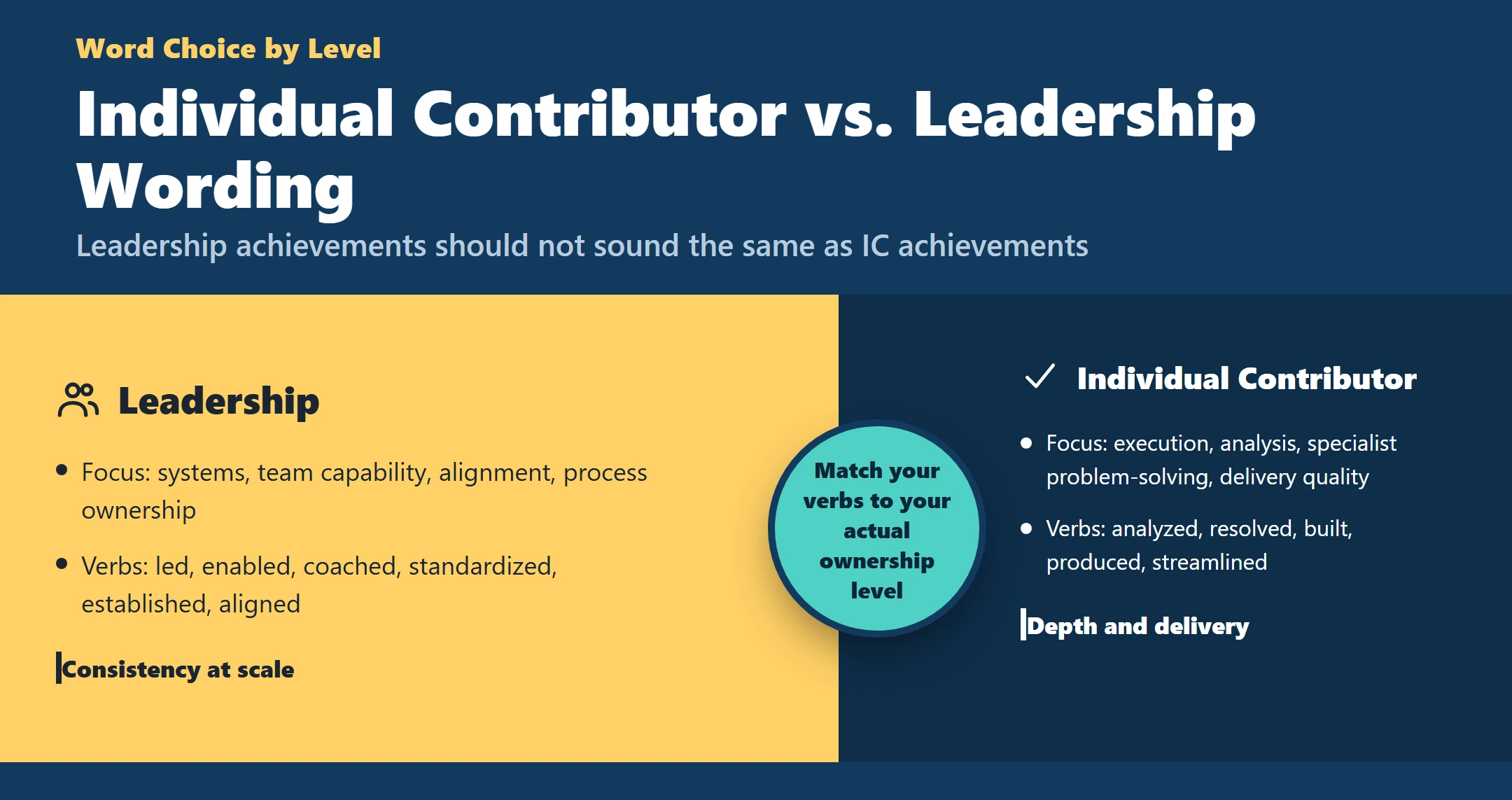
Leadership achievements should not sound the same as individual contributor achievements.
Individual contributor wording
Focus on:
- execution
- analysis
- specialist problem-solving
- delivery quality
Common verbs:
- analyzed
- resolved
- built
- produced
- streamlined
Leadership wording
Focus on:
- systems
- team capability
- alignment
- process ownership
- consistency at scale
Common verbs:
- led
- enabled
- coached
- standardized
- established
- aligned
Paired examples
IC version:
Improved monthly data validation checks, reducing reporting errors and supporting cleaner submissions.
Manager version:
Established a standardized validation process for the team, improving reporting consistency and reducing recurring error patterns.
IC version:
Resolved vendor issues and tracked follow-up actions to maintain service continuity.
Manager version:
Led vendor performance reviews and escalation routines, strengthening service continuity and improving accountability across external partners.
Process improvement achievements: use a before → after structure
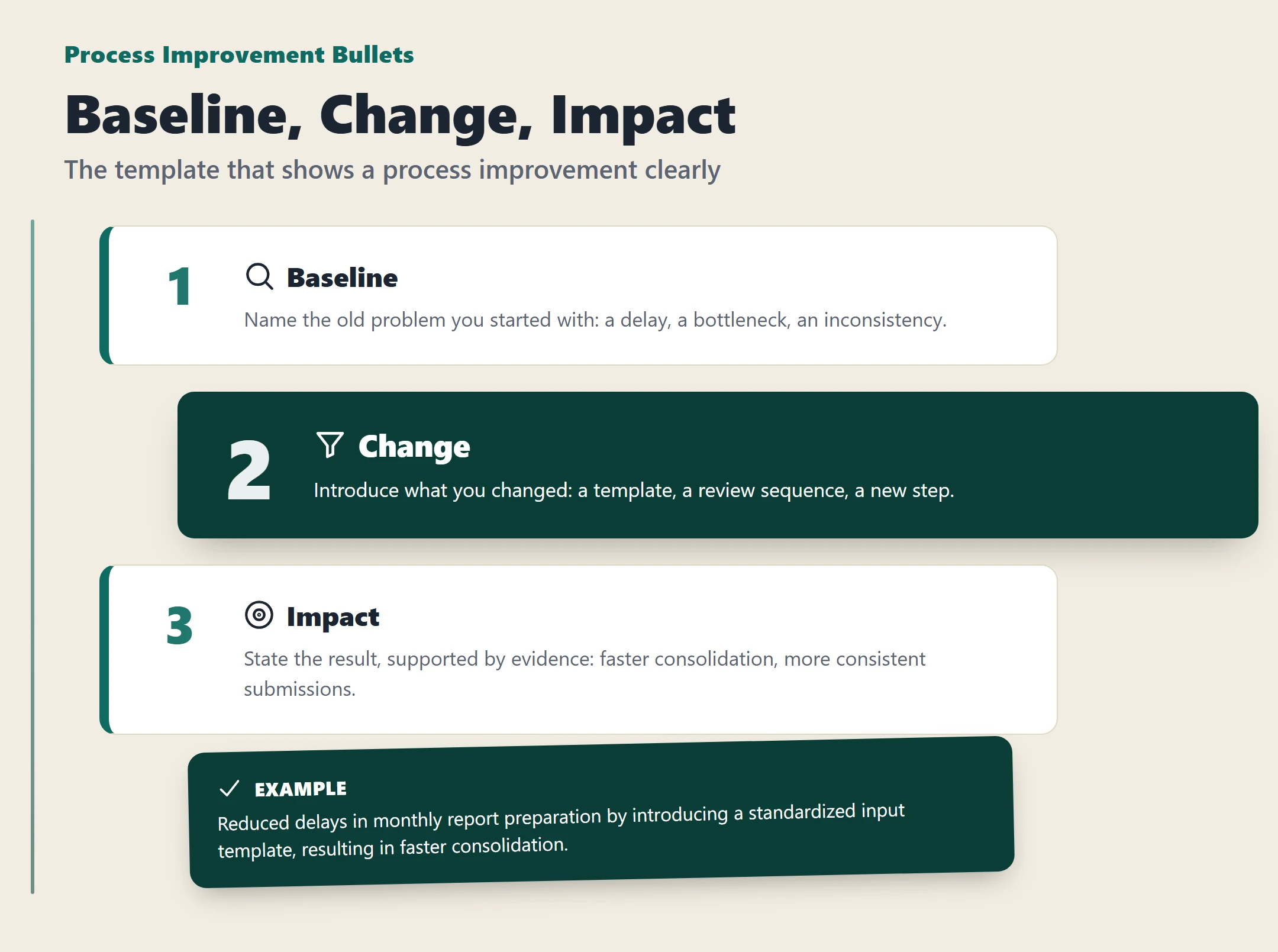
Process improvement bullets work well because they show change clearly.
Standard template
Baseline → Change → Impact
You can also write it this way:
Reduced [old problem] by introducing [change], resulting in [impact], supported by [evidence].
Example
- Reduced delays in monthly report preparation by introducing a standardized input template and review sequence, resulting in faster consolidation and more consistent submission quality
Customer impact achievements: CX and retention framing
Not all customer impact is direct sales. Many roles improve customer experience by making service faster, clearer, more reliable, or easier to navigate.
Metrics you can use carefully
- response time
- resolution time
- repeat contacts
- complaint volume
- escalation rate
- satisfaction feedback
- renewal or retention support
Two example bullets
- Improved customer response consistency by standardizing reply templates for common issues, helping reduce repeat follow-ups and improve service clarity
- Coordinated internal handoffs for time-sensitive customer requests, contributing to faster resolution and a smoother client experience during peak periods
Risk and compliance achievements: quiet but powerful
Risk reduction often gets ignored on CVs, even though it is valuable in operations, finance, procurement, quality, HR, and regulated environments.
How to frame risk reduction
Show:
- what exposure existed
- what control or discipline you introduced
- what safer outcome followed
Acceptable evidence phrases
- strengthened audit readiness
- reduced exceptions
- improved control visibility
- supported policy adherence
- improved documentation completeness
Two example bullets
- Standardized document checks for recurring submissions, reducing avoidable errors and supporting stronger audit readiness
- Improved escalation tracking for policy-related exceptions, helping reduce missed follow-ups and strengthen compliance visibility
Rewrite clinic: 5 weak bullets into 5 strong bullets
These rewrites show how to turn flat responsibilities into achievement language.
Five side-by-side rewrites
- Weak: Responsible for monthly reports
Strong: Prepared and standardized monthly reporting packs for leadership reviews, improving consistency and reducing manual rework across recurring cycles
- Weak: Coordinated with teams
Strong: Coordinated cross-functional updates across operations and support teams, helping reduce handoff delays and improve execution visibility
- Weak: Helped improve process
Strong: Improved a recurring approval workflow by clarifying ownership steps, resulting in faster turnaround and fewer follow-up escalations
- Weak: Handled customer issues
Strong: Resolved customer issues through structured follow-up and clearer escalation paths, contributing to faster closure and improved service continuity
- Weak: Managed vendors
Strong: Managed vendor follow-up and issue tracking for recurring service needs, helping maintain delivery continuity and improve response accountability
What changed in each rewrite
The stronger version usually adds four things:
- a better action verb
- clear scope
- a result
- a light proof signal
Reusable rewrite checklist
- Did I start with a strong verb?
- Did I show scope?
- Did I state a result?
- Did I hint at evidence?
- Did I remove pure duty language?
- Can I defend this wording in an interview?
Building an achievement bank: a simple capture system
The easiest way to write good achievements is not to rely on memory during a job search. Capture evidence weekly, then convert it later.
Simple achievement bank table
| Date | Task/Project | What changed | Scope | Proof | Draft bullet |
|—|—|—|—|—|—|
| Week of X | Monthly report cycle | Faster consolidation | 3 stakeholder groups | Email feedback, fewer revisions | Draft later |
| Week of X | Vendor follow-up | Fewer delays | Recurring service requests | Tracker trend | Draft later |
What to capture every week
- repeated problems you solved
- delays you reduced
- templates you improved
- stakeholder comments
- recurring reports or dashboards
- cleaner handoffs or fewer escalations
This makes it much easier to write a professional summary for CV , because your summary should reflect the same pattern of value, relevance, and proof.
Language discipline: verbs, tense, and specificity
Achievement writing becomes stronger when your language is controlled.
Verb bank by impact type
Efficiency: streamlined, reduced, accelerated, simplified
Quality: improved, standardized, strengthened, refined
Risk: controlled, safeguarded, aligned, verified
Growth: enabled, supported, expanded, advanced
Customer impact: resolved, improved, clarified, retained
Tense rules
- Use past tense for previous roles
- Use present tense carefully for current role responsibilities
- Keep achieved outcomes clear and consistent within each role
Fixes for vague verbs
- Did → completed, delivered, resolved
- Worked on → improved, built, analyzed
- Helped with → supported, coordinated, contributed to
Final QC checklist for achievement bullets
Before you finalize your CV, test each bullet against this 10-point checklist:
- Starts with a specific action verb
- Shows what you actually did
- Includes scope or context
- States a result, not just activity
- Uses believable wording
- Hints at evidence or proof
- Matches your real ownership level
- Avoids vague filler words
- Aligns with the target role
- Can be defended in discussion or interview
Common failure points
- sounds like a job description
- no result is visible
- scope is missing
- numbers look invented
- ownership is overstated
- wording is too generic
Red flags to remove
- Responsible for
- Worked on
- Various duties
- Successfully handled
- Improved many things
- Led, when you only participated
Common pitfalls: inflation, ambiguity, and credit theft
The fastest way to weaken a strong CV is to overstate or blur the truth.
Pitfall 1: Inflation
Bullets get rejected when they sound too big for the role level.
Safer alternative: use supported, contributed to, or helped improve with a clear action.
Pitfall 2: Ambiguity
If the reader cannot tell what changed, the bullet adds little value.
Safer alternative: name the process, the outcome, and the context.
Pitfall 3: Credit theft
Claiming team results as solo wins creates credibility risk.
Safer alternative: separate your contribution from the shared outcome.
Pitfall 4: Empty metrics
A number without context is still weak.
Safer alternative: connect volume to speed, quality, control, or service impact.
Pitfall 5: Generic language
Words like excellent, dynamic, and hardworking do not prove value.
Safer alternative: show the outcome instead.
For experienced professionals who want a stronger, application-ready CV with sharper achievements, clearer positioning, and expert rewriting, start here: