

Changing jobs legally in Saudi Arabia is not just about leaving one employer and joining another. In practice, mobility works like a controlled transfer workflow with checks, records, statuses, and timing risks.
Many expats still rely on old “sponsor permission” advice or hearsay from friends. That often leads to rushed resignations, weak documentation, or a preventable gap between jobs. The safer approach is to follow the workflow in the right order and make decisions based on written proof.
What Job Mobility Means in Practice
Job mobility is a structured transfer from one employer to another through an official process. It is not simply a personal agreement between you and a new company.
The biggest mindset shift is this: instead of thinking, “My sponsor must personally approve everything,” think, “My move depends on rules, records, eligibility, and process readiness.”
That does not mean every transfer is easy. It means the move is judged through a system. If your data is inconsistent, your timing is weak, or your new employer is not ready, the process can stall even when the job offer sounds good.
Actors and Platforms: Who Controls What
A mobility case usually involves four main actors:
- You, the employee
- Your current employer
- Your new employer
- The platforms and official records
Your role is to verify your information, collect documents, confirm the offer in writing, and avoid acting too early.
Your current employer may affect handover timing, final payroll handling, notice scheduling, and practical cooperation.
Your new employer controls offer quality, onboarding timing, document requests, and whether they actually understand how to complete the transfer properly.
The platforms are the operational layer. They reflect statuses, requests, and data fields. If one party delays action or one field is wrong, the case may stop moving. If you want a broader understanding of company-status risk, review Nitaqat explained .
Mobility Glossary: Qiwa, Nitaqat, Transfer, and Status
Use these terms carefully so you do not confuse one stage with another:
- Qiwa: A platform commonly connected to employment and transfer-related workflows.
- Nitaqat: A company classification concept that may affect hiring and mobility risk.
- Transfer: The official movement of your employment relationship from one employer to another.
- Status: The visible stage of a request, such as pending, accepted, rejected, or delayed.
- Iqama: Your residency record; its timing and validity affect your transfer risk.
- Notice period: The exit-timing window that must be aligned with transfer milestones.
- Eligibility: Whether your case appears fit to proceed under the system.
- Escalation: Moving the issue upward when normal follow-up does not solve it.
The Golden Rule: Sequence Beats Speed
The most important principle is simple: the order of steps matters more than moving fast.
A common mistake is resigning first because of frustration, then trying to solve the transfer later. That sequence can create avoidable problems such as:
- delayed income
- confusion over the last working day
- a rushed start date
- mismatched records
- weaker negotiating power
A safer method is to prepare first, verify second, and resign only when the path is clear enough to reduce gap risk. If you want a focused pre-exit checklist, see before resigning in Saudi Arabia .
Bad Sequence vs Good Sequence
Bad sequence
- Accept a verbal offer
- Resign immediately
- Discover missing documents
- Find a data mismatch
- New employer delays action
- Income gap begins
Good sequence
- Get the offer in writing
- Check employer credibility
- Review your records
- Build your document pack
- Align notice timing with transfer readiness
- Resign at the right stage
The lesson is not to move slowly. It is to move in the right order.

Offer Quality Checklist Before You Touch Platforms
Before any platform step starts, make sure the offer itself is solid.
Check that these points are clearly written:
- job title
- salary
- location
- start date
- probation terms
- work schedule if relevant
- any promised benefits
- who handles transfer steps
- what documents they need from you
- whether the start date includes a realistic buffer
Verbal promises are weak protection. If a detail matters to your move, it should be written clearly.
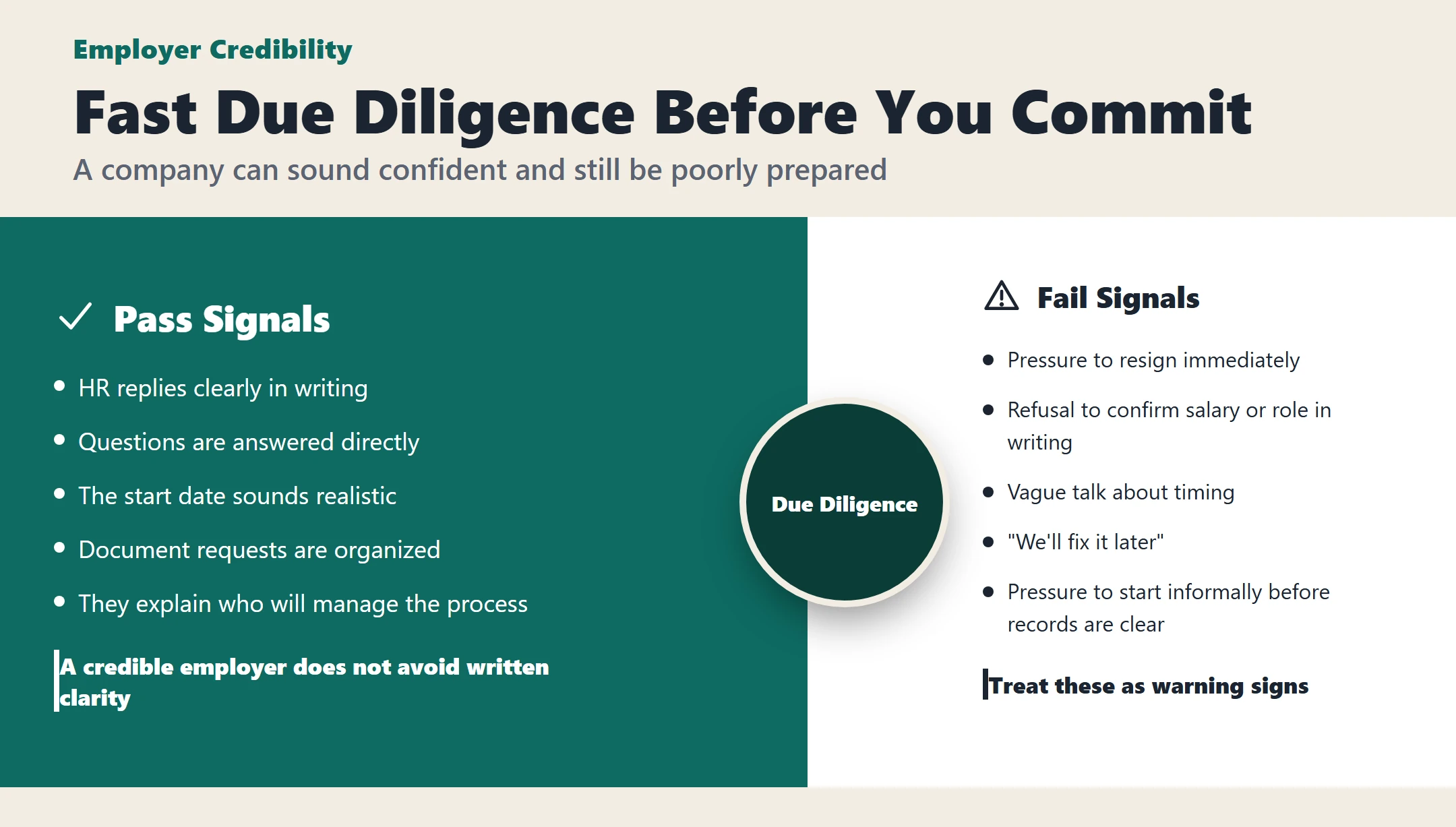
Employer Credibility Signals: Fast Due Diligence
A company can sound confident and still be poorly prepared.
Pass signals
- HR replies clearly in writing
- questions are answered directly
- the start date sounds realistic
- document requests are organized
- they explain who will manage the process
Fail signals
- pressure to resign immediately
- refusal to confirm salary or role in writing
- vague talk about timing
- “We’ll fix it later”
- pressure to start informally before records are clear
A credible employer does not avoid basic written clarity.
Risk Categories: Low, Medium, and High Transfer Risk
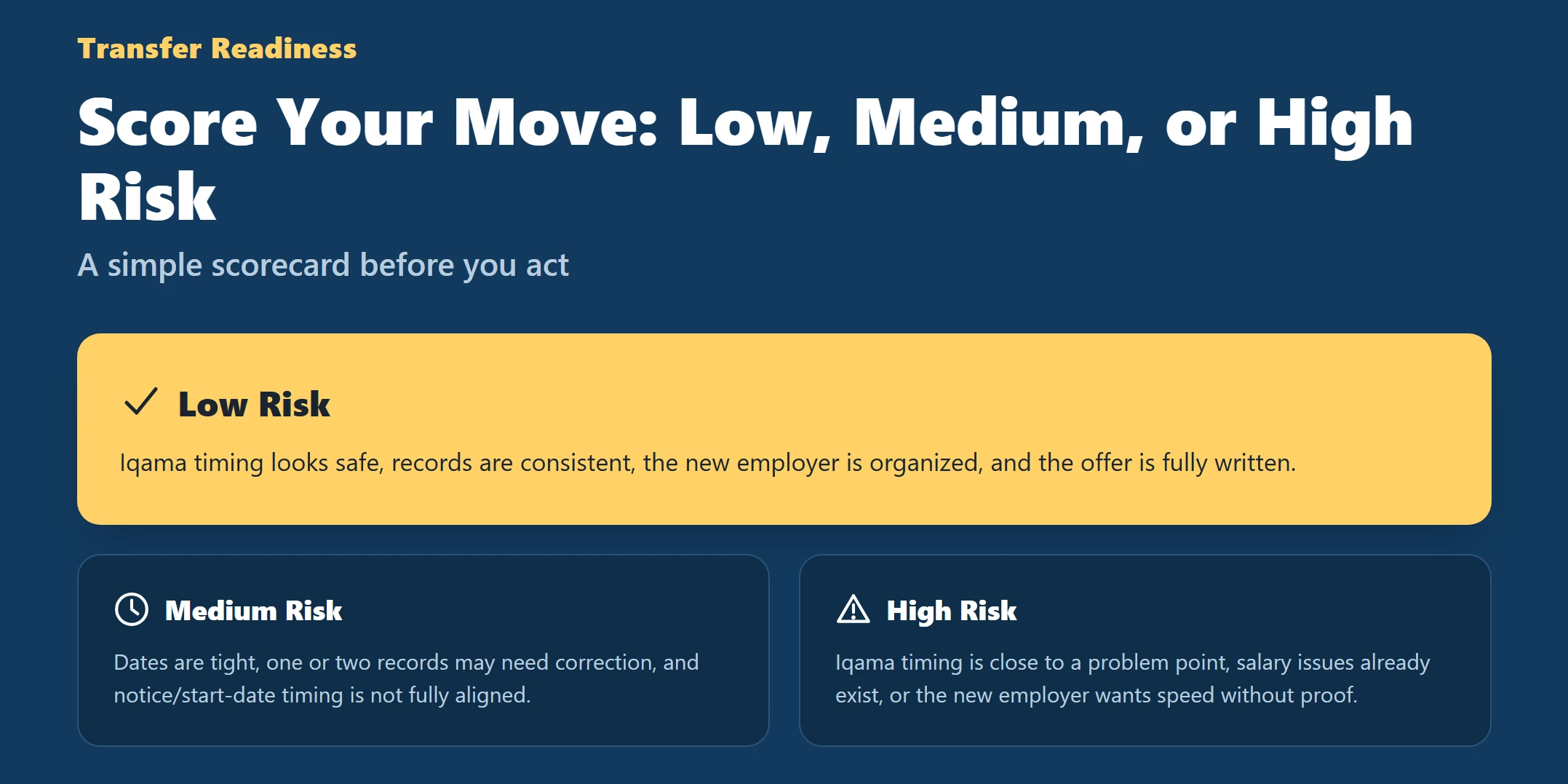
Not every move carries the same risk. A simple scorecard can help.
Low risk
- Iqama timing looks safe
- your records appear consistent
- the new employer is organized
- the offer is fully written
- there is no major conflict with the current employer
Medium risk
- dates are tight
- one or two records may need correction
- notice and start date are not fully aligned
- the new employer is responsive but slow
High risk
- Iqama timing is close to a problem point
- salary issues already exist
- conflict with the current employer is active
- key data does not match
- the new employer wants speed without proof
Transfer Readiness Gate: Pass/Fail Checklist
Pause and check these before moving forward:
- written offer confirmed
- Iqama timing reviewed
- personal data checked across records
- screenshots saved
- notice plan drafted
- start-date buffer discussed
- escalation contact identified
If two or more items are unclear, treat the case as not ready yet.
When to Resign vs When to Transfer
This is where many avoidable mistakes happen.
Resign early only if
- the path is already clear
- the offer is fully written
- the new employer has confirmed process timing
- you can absorb a delay financially
Resign after confirmation if
- platform steps are still uncertain
- documents still need correction
- the new employer is vague
- you cannot afford an income gap
As a rule, if your move depends on “hopefully,” it is too early to resign. For the workflow side of timing and handover, see Iqama transfer step by step .
The No-Gap Strategy: How to Protect Income
A good mobility plan protects both status and cash flow.
Use this no-gap strategy:
- keep your current role active until the transfer path is real
- ask for a start-date buffer, not the earliest possible date
- save written confirmations at each stage
- avoid resigning in anger
- align notice timing with actual milestones, not promises
Scenario 1: Organized move
You receive a written offer, confirm the salary and title, verify your records, and agree on a buffered start date. You resign only after the move reaches a reliable stage. This reduces pressure and lowers the risk of a payroll gap.
Scenario 2: Rushed move
You resign after a phone call, then learn the new employer still needs internal approval and one of your records is inconsistent. Now both timing and income are under pressure.
Start-Date Negotiation Template
You can send a message like this:
Thank you for the offer. I’m ready to proceed and want to make the transition smooth and compliant. To avoid handover or status gaps, can we agree on a start date with a short buffer after the transfer milestones are confirmed?
If you want stronger job-search support during a move, we can help you rewrite or optimize your CV/resume for clearer positioning and better applications in Saudi Arabia .
Notice Period in a Mobility Context
Notice period should be treated as a scheduling issue, not just an HR formality.
Your resignation date should fit:
- handover timing
- transfer progress
- onboarding date
- income protection planning
Do not choose your notice date based only on excitement or frustration. Choose it based on written progress and realistic timing.
If Your Salary Has Been Delayed
Late salary changes your risk posture. It may increase urgency, but it should also increase your need for documentation.
Collect this evidence
- bank statements or payment history
- salary slips, if available
- your employment agreement
- messages with HR or finance
- screenshots of delayed-payment discussions
Cautious escalation steps
- Ask politely in writing for clarification.
- Save the response, or save the lack of response.
- Keep your language calm.
- Organize payment evidence separately from transfer evidence.
- Escalate step by step, not emotionally.
If salary, notice, or other work issues are becoming serious, it helps to understand Saudi labor law for expats .
Data Mismatch Fixes: Name, Dates, and IDs
A small mismatch can delay the entire case.
Checklist to identify mismatches
- compare name spelling across records
- check ID numbers carefully
- compare joining dates
- review birth date and nationality fields
- verify contract details if shown
Before-and-after proof capture
Before correction:
- take screenshots
- note where the mismatch appears
- save files with dates
After correction:
- take fresh screenshots
- keep both versions
- save any written confirmation
A simple naming method helps, such as:
2026-05-07_name-mismatch_before2026-05-08_name-mismatch_after
Status Messages: How to Interpret Them
Status messages should be read as signals, not as reasons to panic.
Quick status dictionary
- Pending: waiting for action or review
- Accepted: one step has moved forward, not necessarily the whole case
- Rejected: something needs correction or clarification
- No change for too long: follow-up may be needed
- Error or mismatch: stop and verify the data first
What action comes next
- If the status is recent and clear, wait reasonably.
- If it is unclear, ask for a written explanation.
- If HR says one thing and the record shows another, trust the record and request clarification.
- If the case does not move after follow-up, prepare to escalate.
Employer Blocking Tactics: Recognize the Patterns
Some employers do not block openly. They delay indirectly.
Common patterns include:
- repeated “come tomorrow” answers
- refusal to reply in writing
- different answers from different people
- emotional pressure to cancel the move
- delaying handover or release discussions without clarity
Calm response script
You can say:
I want to complete the transition properly and avoid mistakes for everyone. Please confirm in writing what is still pending and what action is required from my side.
Evidence to collect
- screenshots
- dates of requests
- names of contacts
- copies of replies
- proof of no reply
Escalation Path When Things Stall
Use a step ladder, not a sudden jump.
- HR follow-up: short, written, specific
- Formal request: summarize the issue and request action by a reasonable date
- Platform support: raise the technical or status problem with evidence
- Official channels: use them when internal and platform-level steps have not solved the problem
Timing rule
Give each step a reasonable response window. Escalating too fast can create noise without progress.
Counteroffers and Retention Pressure: How to Handle It
A counteroffer can feel positive, but it can also confuse your timing and weaken your focus.
Use this framework:
- ask for all improvements in writing
- compare certainty, not emotion
- ask whether the counteroffer solves the real problem
- avoid same-day decisions
Sample dialogue 1
Employer: “Stay with us and we’ll improve things.”
You: “Thank you. If there is a revised offer, please share it in writing so I can review it carefully.”
Sample dialogue 2
Manager: “Why are you leaving now? Just give us your word.”
You: “I want to handle this professionally. I can only make a final decision based on written terms and confirmed timing.”
Negotiation Timing: Before vs After Transfer Starts
The safest time to negotiate is before sensitive transfer actions begin.
Lock in these points early:
- salary
- title
- location
- start date
- probation wording
- who handles the process
Negotiating after the process has started can increase risk because expectations are already set and timing pressure becomes stronger.
Switching Jobs While Outside KSA: Risk Checklist
Switching while outside Saudi Arabia can be harder because access, timing, and coordination may become weaker.
Risk checklist
- Can you access needed platforms and messages?
- Do you have your identity and employment documents?
- Is your travel status clear?
- Can the new employer manage timing properly?
- Do you have a reliable HR contact?
Don’t start if
- you cannot access your records
- key documents are missing
- timing is already tight
- no one will confirm the process in writing
Distance usually means you need more buffer, not less.
The Mobility System Eligibility Logic: If/Then
Think about eligibility through inputs and logic.
- If your records are consistent, then move to offer and timing checks.
- If the offer is still verbal, then stop and get it in writing.
- If Iqama timing is tight, then review your risk before starting.
- If the new employer cannot explain the workflow, then treat the case as higher risk.
- If current-employment problems exist, then increase documentation and caution.
- If status messages conflict with verbal promises, then trust the documented record and verify first.
Inputs to verify first
- identity and employment data
- Iqama timing
- written offer terms
- notice timing
- who handles each step
- what proof you already have
Common Eligibility Misreads: What People Get Wrong
People often misunderstand mobility because they rely on rumors instead of evidence.
Myth vs fact
- Myth: “If a company wants me, I can resign now.”
Fact: Interest from a company is not the same as a safe transfer path.
What to check: written offer and timing confirmation
- Myth: “If HR says it’s easy, I don’t need proof.”
Fact: Even simple cases can fail when records or timing are weak.
What to check: written message confirming the process owner and steps
- Myth: “A small name mismatch won’t matter.”
Fact: Small mismatches can create major delays.
What to check: before-and-after screenshots
- Myth: “I should negotiate after I resign.”
Fact: Your leverage may weaken after commitment.
What to check: final written terms before resignation
FAQ Bank: Sponsorship Transfer
- Can I rely on a verbal offer?
No. What to check: written salary, title, and start date.
- Should I resign before the transfer starts?
Usually not. What to check: confirmed milestones and your buffer plan.
- What if HR says “don’t worry”?
Ask for written details. What to check: message or email confirmation.
- Can a delay create income risk?
Yes. What to check: payroll timing and notice overlap.
- Do I need screenshots?
Yes. What to check: status pages and messages.
- What if my current employer stops responding?
Move to structured follow-up. What to check: dated contact history.
- Is a counteroffer always good news?
Not always. What to check: written terms and the real risk.
- Can data errors block progress?
Yes. What to check: name, dates, and ID fields.
- Should I rush if I’m unhappy?
No. What to check: your readiness gate first.
- What matters most?
Sequence. What to check: whether each step supports the next one.
FAQ Bank: Mobility Eligibility
- What is eligibility in simple words?
It means your case looks suitable to proceed. What to check: your core records.
- Is eligibility just about my current employer?
No. What to check: your data, new-employer readiness, and timing.
- Does offer quality affect risk?
Yes. What to check: salary, title, location, and start date.
- Can I ignore Iqama timing until later?
No. What to check: validity and any tight deadlines.
- If one detail is wrong, should I continue?
Usually fix it first. What to check: mismatch screenshots.
- What if statuses are unclear?
Pause and clarify. What to check: official status text.
- Does notice period affect eligibility?
It affects timing risk. What to check: resignation date versus milestones.
- Can outside-KSA cases be harder?
Yes. What to check: access, documents, and timing.
- Should I trust friends’ advice?
Use it carefully. What to check: your own case evidence.
- What makes a case safer?
Written proof and proper order. What to check: your full document pack.
Troubleshooting Index by Symptom
Request rejected
- likely causes: missing detail, mismatch, weak readiness
- proofs to collect: rejection screenshot, offer copy, personal data records
- fix steps: identify the exact issue, correct it, then resubmit carefully
- escalation point: when the rejection reason is unclear
Stuck status
- likely causes: one party has not acted, a hidden mismatch, or a processing delay
- proofs to collect: dated screenshots and message history
- fix steps: follow up, ask for the exact blocker, and set a response window
- escalation point: after reasonable silence
Data mismatch
- likely causes: spelling, ID, or date inconsistency
- proofs to collect: before-and-after screenshots and document copies
- fix steps: correct one field at a time and save proof
- escalation point: if the correction does not appear
No response
- likely causes: weak internal handling, avoidance, or overloaded HR
- proofs to collect: sent messages, unanswered requests, and call notes
- fix steps: move from informal contact to formal communication
- escalation point: after repeated non-response
If you are an expat in Saudi Arabia who wants a stronger CV/resume for cleaner applications, better positioning, and a more confident job move, get our paid CV support here .