

What a professional summary is for
A professional summary for CV is not a short biography. It is a decision tool.
Its job is to help a recruiter or hiring manager answer three fast questions during an initial scan: who you are, what level you operate at, and why you fit the role. That is why the summary sits at the top of the CV or resume. It frames everything that follows.
Most recruiters do not read a CV top to bottom on the first pass. They scan for role match, seniority, proof, and clarity. If your opening section is vague, the rest of the document has to work harder. If the opening is sharp, the reader immediately knows what to look for next. This is closely tied to what recruiters look for in a strong application.
In practical terms, your summary must prove four things in fewer than 10 lines:
- Your professional identity
- Your functional fit
- Your level of scope
- Your credibility
That means no life story, no generic objective statement, and no soft claims without evidence. A senior summary should sound selective, not crowded.
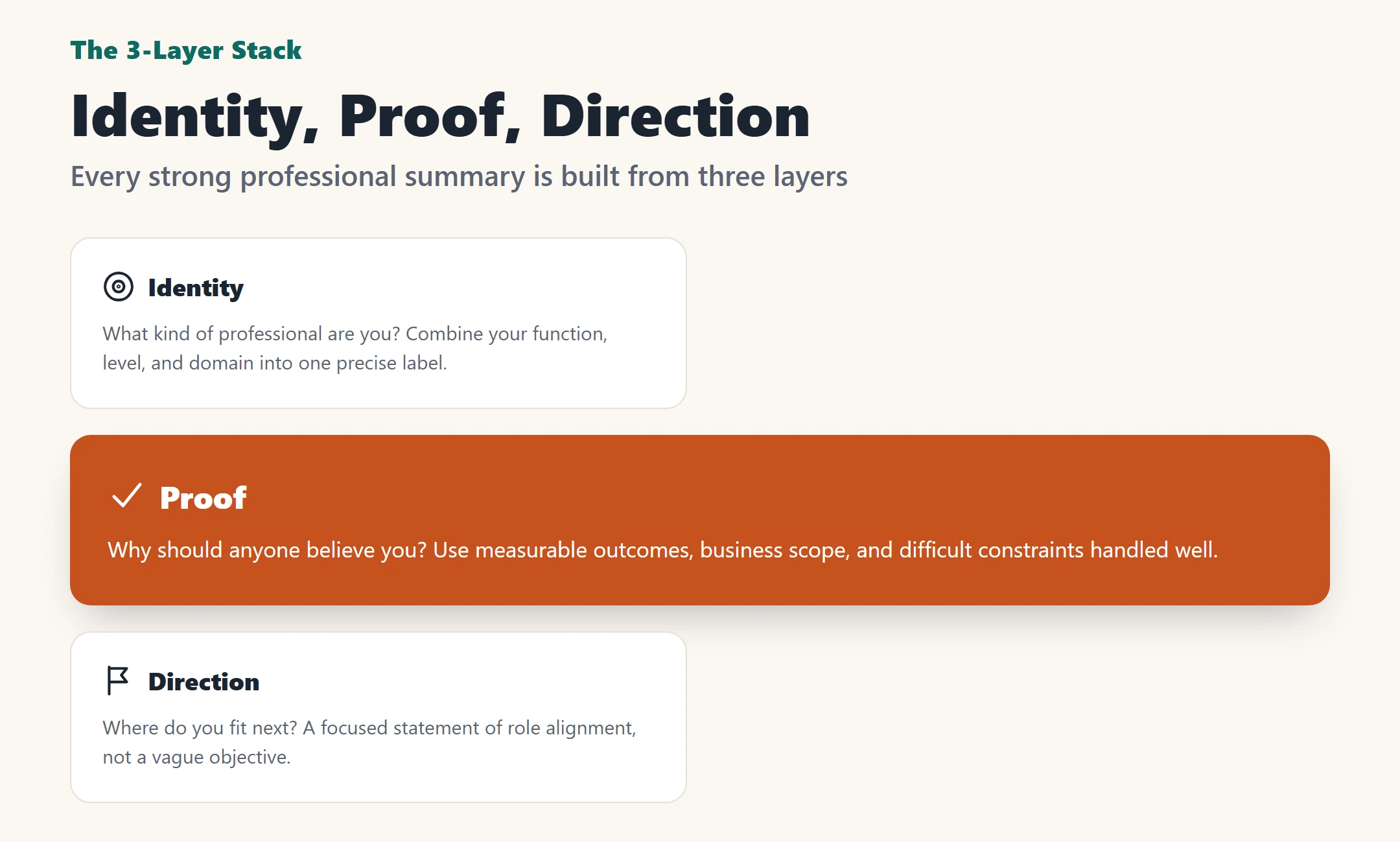
The 3-layer stack: Identity, proof, direction
A strong summary becomes much easier to write when you treat it as a three-layer stack.
Identity
This answers one question: what kind of professional are you?
Your identity should combine:
- your function
- your level
- your domain, when relevant
Examples:
- Operations Manager with multi-site delivery experience
- FP&A Manager supporting executive decision-making
- Senior Business Analyst focused on process improvement and cross-functional delivery
Useful prompts:
- What role do I perform today?
- What problem am I most trusted to solve?
- What label would the target employer use for this role?
For experienced professionals, identity must be precise. “Experienced professional” says almost nothing. “Project Manager leading cross-functional implementation programs” says much more.
Proof
This answers: why should anyone believe you?
Proof can come from:
- measurable outcomes
- business scope
- known environments
- difficult constraints handled well
Examples:
- delivered process improvements across regional operations
- supported forecasting and performance reviews for leadership teams
- led stakeholder alignment across product, technology, and commercial teams
If this part feels weak, work backward from your experience bullets and learn how to turn tasks into achievements before compressing them into a summary.
Direction
This answers: where do you fit next?
Direction is not “seeking a challenging role.” It is a focused statement of role alignment.
Examples:
- positioned for senior operations roles focused on service reliability and efficiency
- aligned with commercial finance roles requiring planning, analysis, and executive support
- suited to product roles requiring roadmap delivery and stakeholder coordination
How the stack changes by seniority
For an individual contributor, proof often leans on execution quality, specialist depth, and output reliability.
For a manager, proof should shift toward ownership, prioritization, team coordination, and business outcomes.
For a senior leader, proof should emphasize scale, complexity, cross-functional accountability, and decision influence.
The higher your level, the less useful it is to list activities. The more useful it is to show scope and consequences.
The 10-line blueprint: a template with line-by-line purpose
Use this fixed 8–10 line blueprint when drafting your professional summary for CV.
- Target identity line — state your role clearly.
- Level marker — add years, seniority, or depth only if it strengthens fit.
- Core strengths line — name 2–3 relevant functional strengths.
- Context line — show the business environment or domain.
- Impact line — describe a delivered result or type of outcome.
- Scope line — show scale, stakeholders, complexity, or ownership.
- Credibility line — add tools, systems, constraints, or defended metrics.
- Direction line — show the role type you are targeting.
- Optional keyword line — add 2–3 proof keywords if the layout supports it.
- Optional proof bullets — only if they improve scan value.
Fixed template
[Role title] with experience in [function/domain].
Known for [2–3 strengths] in [business context].
Delivered [result or business outcome] through [method or responsibility].
Worked across [stakeholders/teams/processes] to support [goal].
Experience handling [scope marker: volume, complexity, systems, timeline, portfolio].
Comfortable in [environment/constraint] where [capability] matters.
Brings strength in [relevant tools/processes/decision support area].
Now targeting [specific next-role direction].
Filled example: Project Manager
Project Manager with experience leading cross-functional delivery across business and technology teams.
Known for planning, stakeholder coordination, and execution follow-through in deadline-driven environments.
Delivered implementation milestones by aligning requirements, timelines, and owners across multiple workstreams.
Worked with operations, technical teams, and business stakeholders to reduce delivery friction and improve visibility.
Experience handling competing priorities, structured reporting, and issue escalation across complex initiatives.
Comfortable in environments where alignment, risk control, and clear communication are critical to project success.
Brings strength in project planning, governance, and cross-functional coordination.
Now targeting project and program roles with broader ownership and delivery scope.
Short role examples
Business Analyst
Business Analyst with experience translating stakeholder needs into process, reporting, and workflow improvements.
Known for structured analysis, requirement clarity, and alignment across cross-functional teams.
Delivered clearer reporting outputs and actionable requirement documentation to support business decisions.
Brings strength in stakeholder interviews, process mapping, and change support.
Now targeting analyst roles requiring strong problem-solving and delivery coordination.
Marketing Manager
Marketing Manager with experience planning growth initiatives and aligning stakeholders around commercial goals.
Known for campaign review, performance tracking, and execution discipline.
Delivered business-focused reporting and supported better prioritization across marketing activity.
Brings strength in planning, stakeholder management, and performance visibility.
Now targeting marketing roles with broader ownership and growth accountability.
Function-fit signals: how to sound like the role without buzzwords
You do not need buzzwords to sound aligned with a role. You need the right role language.
Start with the job description and pull out:
- the title language
- the core responsibilities
- repeated business goals
- the operating environment
Then mirror the meaning, not the wording.
For example, a business analyst job may mention “requirements gathering.” But “translated stakeholder needs into structured process and reporting improvements” sounds stronger because it links activity to business use. A practical way to tailor CV to job description will help you choose the right language quickly.
Five allowed proof phrases
These work because they imply evidence:
- supported decision-making through structured analysis
- improved reporting clarity for business stakeholders
- coordinated cross-functional delivery against deadlines
- managed process improvements across operational workflows
- translated business needs into actionable requirements
Five empty buzzwords to avoid
These weaken trust because they say nothing specific:
- results-driven
- dynamic professional
- strategic thinker
- team player
- go-getter
Quick rewrite
Weak:
Strategic and results-driven marketing leader with strong communication skills.
Stronger:
Marketing Manager with experience driving campaign planning, stakeholder alignment, and performance review across growth initiatives.
The second version sounds more credible because it names function and work context.
Seniority signaling without titles
A title alone does not prove level. In some organizations titles are inflated. In others they are compressed. Your summary should signal seniority through scope.
Scope levers that imply level
Use these safely:
- team size
- stakeholder range
- portfolio breadth
- budget exposure
- process complexity
- geographic coverage
- reporting level
- decision influence
- regulatory or operational constraints
Examples:
- supported executive reviews and planning cycles
- coordinated delivery across multiple business functions
- managed service performance across multi-site operations
- worked within regulated, deadline-critical, or customer-facing environments
You do not need to exaggerate. You only need to be concrete.
Weak:
Senior leader with extensive experience.
Stronger:
Led cross-functional execution across multiple operational priorities, with responsibility for planning, escalation, and delivery visibility.
If your document also suffers from weak hierarchy or clutter, a cleaner corporate CV layout helps those senior signals land more clearly.
Credibility anchors: numbers, brands, constraints, and context
A summary becomes believable when it includes anchors. Four anchor types are especially useful.
Numbers
Use numbers when they are relevant, safe, and easy to explain, such as:
- team size
- portfolio size
- volume
- time reduction
- growth contribution
- reporting cadence
If exact numbers are unavailable, use scale language carefully. When you need defensible metrics, review how to quantify CV achievements and then bring only the strongest data into the summary.
Brands
This works when the employer, client type, or sector adds useful signal. Do not name-drop for prestige alone. Use it only when it clarifies the environment.
Constraints
Constraints create credibility because they show real operating conditions, such as:
- tight timelines
- regulated processes
- high-volume operations
- cross-border coordination
- limited resources
- multiple stakeholders
Context
Context tells the reader where your work mattered:
- enterprise setting
- fast-growth company
- regional operations
- transformation initiative
- customer-facing environment
Before and after lines
Before:
Experienced operations professional with strong problem-solving skills.
After:
Operations Manager with experience improving service consistency across multi-site environments with strict timeline and coordination demands.
Before:
Finance professional with excellent analytical ability.
After:
FP&A Manager supporting planning cycles, forecast reviews, and management reporting for business decision-making.
Removing empty adjectives: a fast detox method
A simple rule: if an adjective cannot be verified, replace it with proof.
Replace map
- strategic → influenced planning, prioritization, or decision-making
- results-driven → improved, delivered, reduced, increased, supported
- proactive → identified and resolved, anticipated risks, initiated improvements
- experienced → specify years, scope, or environment
- strong communicator → aligned stakeholders, presented findings, clarified priorities
Mini checklist to detect fluff
Ask yourself:
- Can someone verify this from my experience section?
- Does this line say what I did, or only how I describe myself?
- Would many applicants use the same phrase?
- Does it show evidence, scope, or business relevance?
If the answer is no, rewrite it.
If you want expert help rewriting a weak summary and turning it into a sharper, application-ready CV, we can help you build a stronger document with clearer positioning and proof:
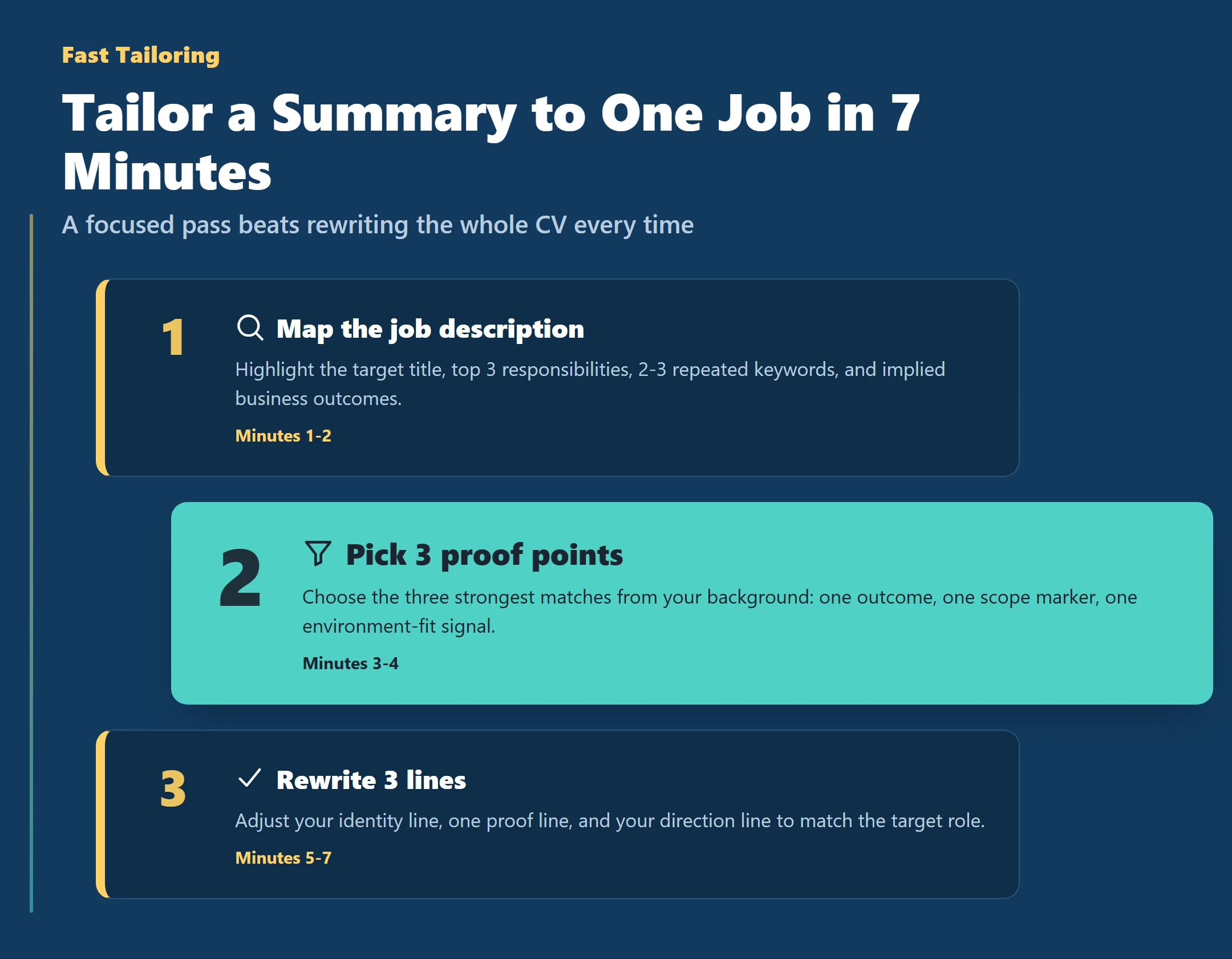
Tailoring a summary to one job in 7 minutes
You do not need to rewrite your entire CV every time. For the summary, a focused 7-minute pass is usually enough.
Minute 1–2: map the job description
Highlight:
- the target title
- the top 3 responsibilities
- 2–3 repeated keywords
- the business outcomes implied by the role
Minute 3–4: pick 3 proof points
Choose the three strongest points from your background that match the role. These can be:
- one outcome
- one scope marker
- one environment-fit signal
Minute 5–7: rewrite 3 lines
Adjust:
- your identity line
- one proof line
- your direction line
Example:
Target role: Operations Manager
JD themes: SLA performance, process improvement, stakeholder coordination
Base line:
Operations professional with experience across service teams.
Tailored line:
Operations Manager with experience improving service reliability, coordinating cross-functional workflows, and supporting SLA-focused delivery.
This is enough to improve relevance without stuffing keywords. If the CV must pass systems before human review, it also helps to understand ATS used in Saudi Arabia and what that implies for formatting and keyword placement.
Summary variants by career situation
The right summary changes with your situation.
Individual contributor
Use this when your value comes from specialist depth, execution quality, and reliable output.
Example:
Business Analyst with experience translating stakeholder needs into process, reporting, and workflow improvements. Known for structured analysis, requirement clarity, and follow-through across cross-functional teams.
Manager
Use this when you own priorities, people, delivery, or process outcomes.
Example:
Team Lead with experience coordinating daily execution, improving process consistency, and supporting target delivery across operational teams. Known for balancing people oversight with performance accountability.
Career shift
Use this when moving into an adjacent role and you need to bridge your transferable value clearly.
Example:
Marketing professional transitioning into product-focused roles, bringing experience in customer insight, cross-functional coordination, and execution planning across growth initiatives.
Do not claim a target title you have not held. Instead, connect existing proof to the new role language.
“What I do” vs “what I delivered”
A common summary problem is too much duty language and not enough value.
A useful balance is:
- about 40% role and function
- about 60% outcomes, fit, and proof
Too duties-heavy
Project Manager responsible for meetings, project plans, status updates, coordination, and stakeholder communication. Experienced in handling timelines and supporting team delivery.
Improved version
Project Manager with experience aligning stakeholders, plans, and execution across cross-functional initiatives. Known for improving delivery visibility, managing dependencies, and keeping complex workstreams moving against deadlines.
The improved version still describes the work, but it shows business value more clearly.
Keyword placement that stays readable
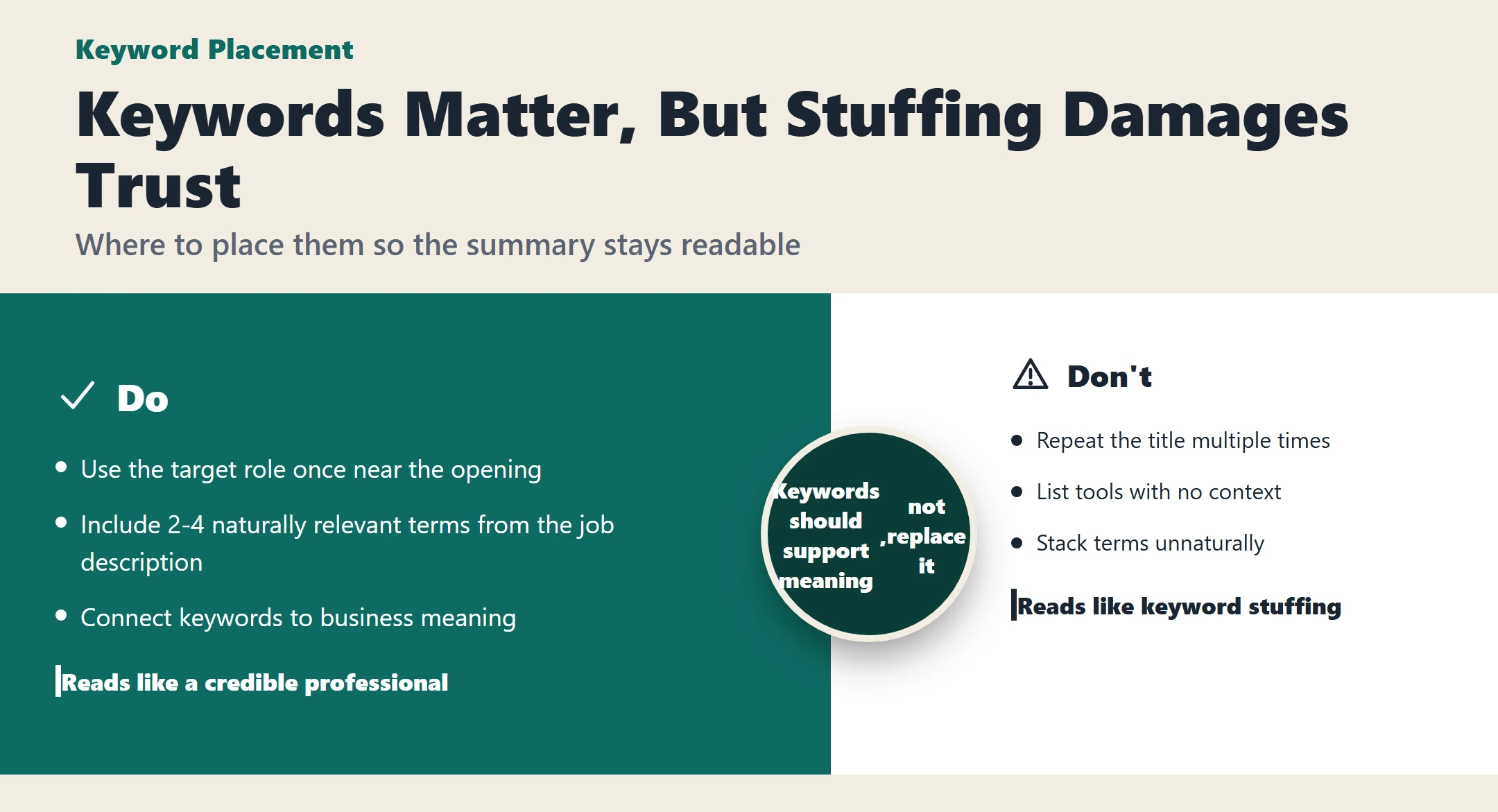
Keywords matter, but stuffing damages trust.
Place keywords in three sensible locations:
- the target title
- the functional language
- the tool or outcome line
Do
- use the target role once near the opening
- include 2–4 naturally relevant terms from the job description
- connect keywords to business meaning
Example:
Data Analyst with experience in reporting, dashboard development, and insight generation to support operational and commercial decisions.
Don’t
- repeat the title multiple times
- list tools with no context
- stack terms unnaturally
Bad example:
Data Analyst, SQL, Power BI, Excel, reporting, dashboards, analytics, analysis, data-driven.
Better:
Data Analyst with experience building reporting outputs and dashboard views that help teams track performance and act on trends.
Mini-proof bullets under the summary
Sometimes the best way to keep the summary clean is to keep the paragraph tight and add 2–3 mini-proof bullets underneath.
This works best when:
- you have strong evidence
- you want extra scan value
- your target roles are outcome-focused
Formatting rules
- keep bullets short
- use one proof idea per bullet
- prefer outcome + scope
- avoid repeating full sentences from the summary
Example set:
- Improved reporting visibility for leadership decision cycles
- Coordinated delivery across business and technical stakeholders
- Supported process improvements in high-volume operational settings
Use this add-on only if the page still looks clean and easy to scan.
Common patterns recruiters trust
Some summary phrases work because they are easy to scan and naturally credible.
Trusted pattern stems
- Known for…
- Experience in…
- Delivered…
- Supported…
- Led…
- Improved…
- Worked across…
- Brings strength in…
- Comfortable operating in…
- Now targeting…
Why they work
They are trusted because they:
- stay plain
- frame proof quickly
- avoid inflated self-description
- guide the eye during scanning
How to personalize them
Add function, context, and result.
Generic:
Known for strong leadership.
Personalized:
Known for coordinating cross-functional teams and keeping operational priorities on track during time-sensitive delivery periods.
Writing a summary for mixed-language profiles
In many professional settings, including the Saudi market, profiles may include English and Arabic job titles or function terms. Keep this clean and minimal.
Safe format
Use one primary English title in the summary, then include the Arabic equivalent only if it improves recognition.
Example:
Operations Manager (مدير عمليات) with experience improving service coordination and execution across multi-site environments.
Rules:
- do not alternate languages line by line
- do not duplicate every term in both languages
- keep readability first
- use bilingual titles only where they improve clarity
If your experience includes locally familiar Arabic titles, one parenthetical mention is usually enough.
Before and after rewrites: 3 real transformations
1. Business Analyst
Before:
Hardworking business analyst with strong communication and problem-solving skills seeking a challenging role.
After:
Business Analyst with experience translating stakeholder needs into clearer processes, reporting structures, and requirement outputs. Known for supporting cross-functional alignment and improving decision visibility.
What changed:
- removed empty adjectives
- added real function
- added proof and business use
2. Operations Manager
Before:
Experienced operations manager responsible for overseeing teams and daily activities.
After:
Operations Manager with experience coordinating service delivery, improving workflow consistency, and supporting performance across operational teams. Comfortable managing priorities in deadline-sensitive environments.
What changed:
- replaced duties-only wording
- added business environment
- improved level signal
3. Marketing Manager
Before:
Strategic marketing leader with a passion for growth and innovation.
After:
Marketing Manager with experience planning growth initiatives, aligning stakeholders, and reviewing campaign performance to support commercial goals. Brings strength in execution discipline and business-focused reporting.
What changed:
- removed abstract claims
- named real work
- tied activity to business value
A useful final test is this: could you also say these lines clearly in an interview? If not, rewrite until they sound natural. The same discipline will help when you talk about achievements in interviews .
Self-audit scorecard: pass or fail
Use this checklist before sending your CV.
Score each item:
- 2 = clear
- 1 = partly clear
- 0 = missing
Scorecard
- My opening line names my role clearly
- My summary matches the target role
- I show at least one proof point
- I signal scope or seniority
- I avoid empty adjectives
- I include relevant keywords naturally
- I stay within 8–10 lines
- My summary aligns with the experience section
- My wording is specific, not generic
- A recruiter could understand my fit in under 20 seconds
Pass threshold
- 16–20: strong
- 12–15: usable but needs sharpening
- below 12: rewrite before applying
Fix the lowest-scoring item first
Do not rewrite everything at once. Start with the weakest signal.
If your score is low because the summary is generic, replace broad adjectives with proof.
If your score is low because your level is unclear, add one scope marker.
If your score is low because the wording feels inflated, simplify the language.
The mistake list: what silently downgrades you
These are the mistakes that weaken a senior summary quickly.
Too generic
Problem:
Experienced professional with a proven track record.
Fix: name the function, context, and one proof signal.
Too long
Problem: the summary reads like a full profile paragraph.
Fix: cut it to 8–10 lines and keep only identity, proof, and direction.
No proof
Problem: the summary describes personality, not outcomes or scope.
Fix: add one outcome, one scope marker, and one context line.
Mismatch with the target role
Problem: the summary sounds broad, but the role is specific.
Fix: align your title, strengths, and proof with the actual opening.
Buzzword overload
Problem: strategic, dynamic, innovative, results-driven.
Fix: replace each term with a concrete example or remove it.
Title inflation
Problem: you sound more senior than the evidence supports.
Fix: signal level through scope, not exaggerated labels. This is one of the more expensive senior CV mistakes because it damages trust fast.
Weak next step
Problem: the summary explains the past but not the next role fit.
Fix: close with a focused direction line.
If you want a professionally rewritten CV or resume with a sharper summary, stronger positioning, and clearer proof for experienced professionals applying to serious roles, choose the service that fits your needs here: