

A strong product management CV is not a list of shipped features. It is a proof document.
Hiring managers usually scan for three things first: what changed because of you, how you made decisions, and who you influenced to make that change happen. If your CV only says you “owned roadmap” or “worked with engineering,” it hides the evidence they actually want.
This guide shows how to write a product management CV that makes your impact easy to scan, easy to trust, and easy to match to senior product and tech roles.
What Hiring Managers Want: Outcomes and Signals
For product management roles, hiring managers want signs that you can move from problem to result, not just from task to task.
The core outcomes they usually look for are:
- Better user adoption
- Improved conversion or retention
- Faster or more reliable delivery
- Clearer prioritization and trade-off decisions
- Stronger cross-functional alignment
- Measurable business impact
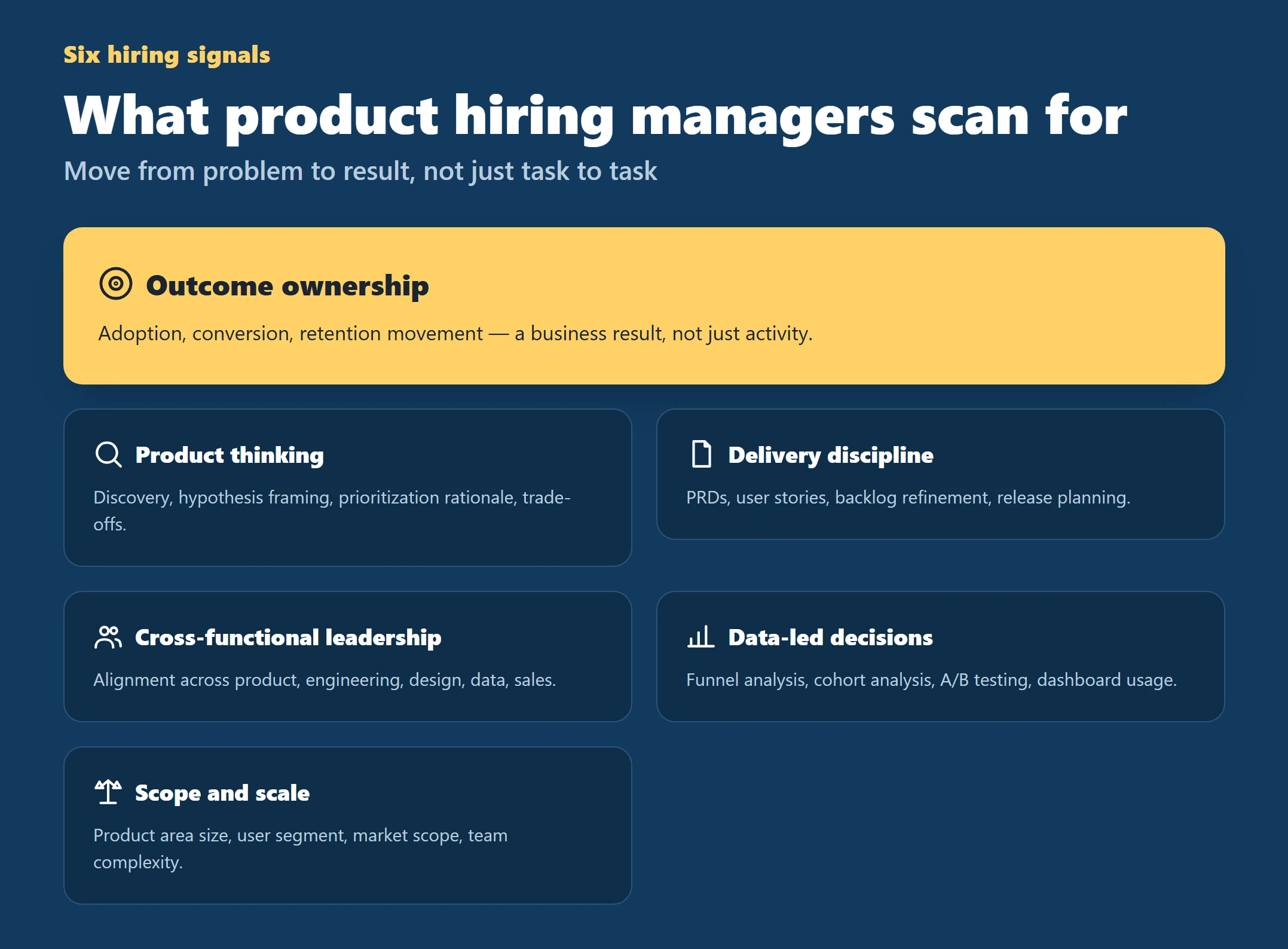
To show those outcomes, your CV should send six clear hiring signals, each supported by the right kind of proof.
1. Outcome ownership
This tells the reader you were responsible for a business or product result, not only activity.
Best proof types:
- Adoption change
- Conversion improvement
- Retention movement
- Reduction in drop-off
- Quality or efficiency gains
Example:
- Owned onboarding improvement initiative that reduced step-level drop-off and increased activation rate.
2. Product thinking
This shows you understand user problems, prioritization, and decision logic.
Best proof types:
- Discovery work
- Hypothesis framing
- Prioritization rationale
- Trade-off decisions
- Experiment design
Example:
- Prioritized checkout fixes based on user behavior data, support themes, and engineering effort.
3. Delivery discipline
A product management CV must show that you can move ideas into execution with clarity.
Best proof types:
- PRDs
- User stories
- Backlog refinement
- Release planning
- Scope control
Example:
- Defined MVP scope and aligned engineering, design, and QA around phased release criteria.
4. Cross-functional leadership
Product managers rarely succeed alone. Your CV should show influence across functions.
Best proof types:
- Alignment across Product, Engineering, Design, Data, Sales, or Leadership
- Decision workshops
- Stakeholder communication
- Conflict resolution
Example:
- Aligned sales, operations, and engineering on rollout priorities for a new self-service flow.
5. Data-led decision making
Strong product managers use data to guide action, not decorate slides.
Best proof types:
- KPI ownership
- Funnel analysis
- Cohort analysis
- A/B testing
- Dashboard usage
Example:
- Used funnel analysis to identify activation bottlenecks and redesign priority sequence.
6. Scope and scale awareness
Even strong bullets feel weak if the reader cannot tell the scale.
Best proof types:
- Product area size
- User segment
- Market scope
- Team complexity
- Stakeholder count
Example:
- Led feature rollout across a core customer journey used by multiple internal teams.
If your bullets still sound task-heavy, learn how to turn tasks into achievements without overstating your role.
Metrics That Matter in a Product Management CV
A product management CV should include metrics that reflect product outcomes, not only delivery volume.
Here is a practical KPI shortlist and what each one implies:
- Activation rate: shows whether users reach first value.
- Conversion rate: signals whether a journey or feature drives action.
- Retention: shows sustained product value over time.
- Adoption rate: indicates whether a feature was actually used.
- Time to value: reflects onboarding and experience quality.
- Churn or drop-off: highlights friction or weak product fit.
- NPS, CSAT, or user satisfaction signals: useful when tied to a product change.
- Release predictability or cycle time: supports operational credibility.
What these metrics imply:
- Activation up often means better onboarding or a clearer first-use experience.
- Retention up suggests stronger product value, better habit formation, or improved experience.
- Conversion up can show pricing clarity, UX improvements, or better flow design.
- Cycle time down may signal improved prioritization, fewer blockers, or tighter cross-functional execution.
- Adoption up proves the launch created real usage, not just release notes.
Use only metrics you can explain in an interview. Safe, credible quantification matters more than dramatic numbers.
Product Management Role Variants and How Your CV Should Shift
Not every product role is the same. The CV should reflect the role variant.
Core product manager
Focus on:
- Prioritization
- Delivery ownership
- Feature impact
- User problem solving
Your bullets should emphasize roadmap decisions, outcome metrics, and collaboration with design and engineering.
Platform or technical product manager
Focus on:
- Systems thinking
- Internal stakeholder needs
- Technical trade-offs
- Operational impact
Your bullets should show how platform work improved reliability, speed, scalability, or internal efficiency.
Growth product manager
Focus on:
- Activation
- Conversion
- Experimentation
- Funnel optimization
Your bullets should lead with metrics and testing logic, not just launch activity.
Three quick examples
- Consumer app PM: highlight activation, onboarding, retention, and experiment-driven improvements.
- B2B SaaS PM: highlight workflow clarity, stakeholder alignment, adoption by account segment, and product usage depth.
- Platform PM: highlight API, system dependency, internal user needs, and delivery coordination across teams.
If you are applying across variants, use a fast method to tailor your CV to the job description so the same experience reads as relevant to each role.
Summary Angle for Product Management Roles
Your summary should quickly answer three questions:
- What type of product manager are you?
- What outcomes do you tend to drive?
- What scope do you operate in?
Simple summary template
[Seniority] product manager with experience leading [product area/type] across [scope]. Combines [decision style or strength] with [cross-functional ability] to improve [key outcomes]. Experienced in working with [main stakeholders] to deliver [business or user result].
Example
Mid-senior product manager with experience leading customer journey and platform initiatives across multi-stakeholder environments. Combines data-led prioritization with strong delivery discipline to improve activation, adoption, and process efficiency. Experienced in aligning engineering, design, operations, and leadership around clear product goals and phased execution.
For a stronger structure, review how to write a professional summary for CV that signals function fit quickly.
If you want expert help rewriting your CV into a sharper, application-ready product document, we can help build or optimize it for senior product roles .
Achievement Bullet Patterns for Product Management
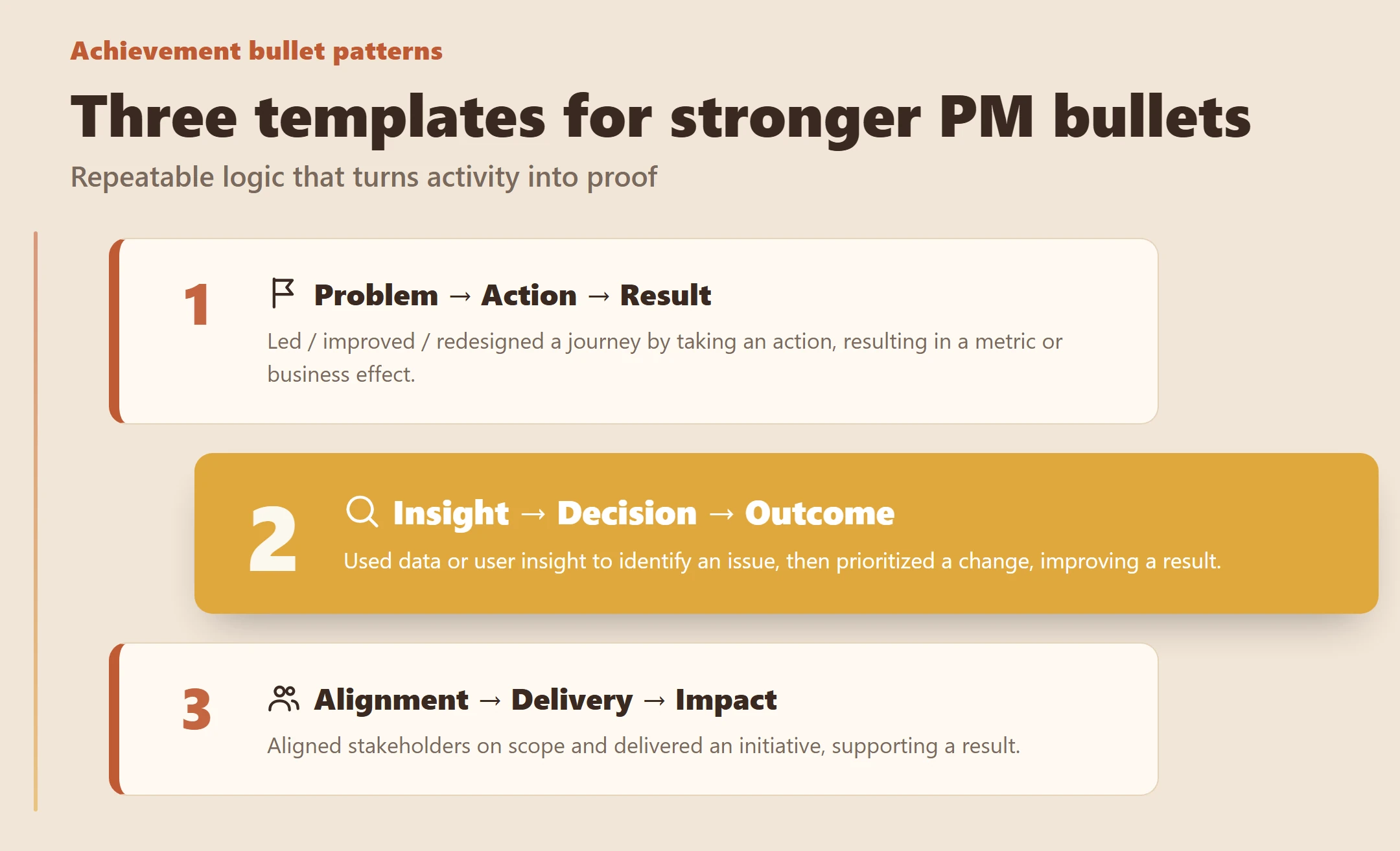
A strong product management CV usually needs repeatable bullet logic.
Template 1: Problem → Action → Result
Led / improved / redesigned [product area or journey] by [action taken], resulting in [metric or business effect].
Filled example:
- Redesigned onboarding flow by simplifying first-session steps and prioritizing activation blockers, resulting in higher completion through the core setup journey.
Template 2: Insight → Decision → Outcome
Used [data/user insight] to identify [issue], then prioritized [change], improving [metric/result].
Filled example:
- Used funnel analysis and user feedback to identify checkout friction, then prioritized form and error-message changes, improving completion rate.
Template 3: Alignment → Delivery → Impact
Aligned [stakeholders] on [scope/priorities] and delivered [initiative], supporting [result].
Filled example:
- Aligned engineering, design, and support on MVP scope for self-service account changes and delivered phased release, supporting faster issue resolution and lower manual handling.
Use strong verbs such as:
- Led
- Prioritized
- Defined
- Redesigned
- Launched
- Improved
- Streamlined
- Aligned
- Validated
- Reduced
Project Portfolio Blocks Recruiters Trust
You do not need attachments to show project quality. Add short project-style blocks inside experience entries when the initiative is strong enough.
High-signal project types include:
Feature launch
- State the user or business problem.
- State adoption or business impact after release.
Example:
- Launched improved wallet top-up flow to reduce failed transactions during checkout. Tracked adoption and completion trends post-release and used early feedback to refine error handling.
Funnel optimization
- Identified activation drop-off in onboarding sequence through journey analysis. Prioritized friction fixes and release order to improve progression to first-value actions.
Requirements and delivery clarity
- Defined PRD and acceptance criteria for a high-dependency feature affecting multiple teams. Reduced ambiguity during build and improved readiness for staged rollout.
UX improvement
- Worked with design and engineering to simplify account recovery flow after user feedback and support trend review. Improved completion quality and reduced repeat issue patterns.
Data-led product decision
- Built KPI review rhythm around activation and retention signals for a core product area. Used dashboard trends and cohort behavior to guide backlog changes.
Tools and Platforms: Mention Them Without Tool Dumping
A product management CV should not read like a software inventory.
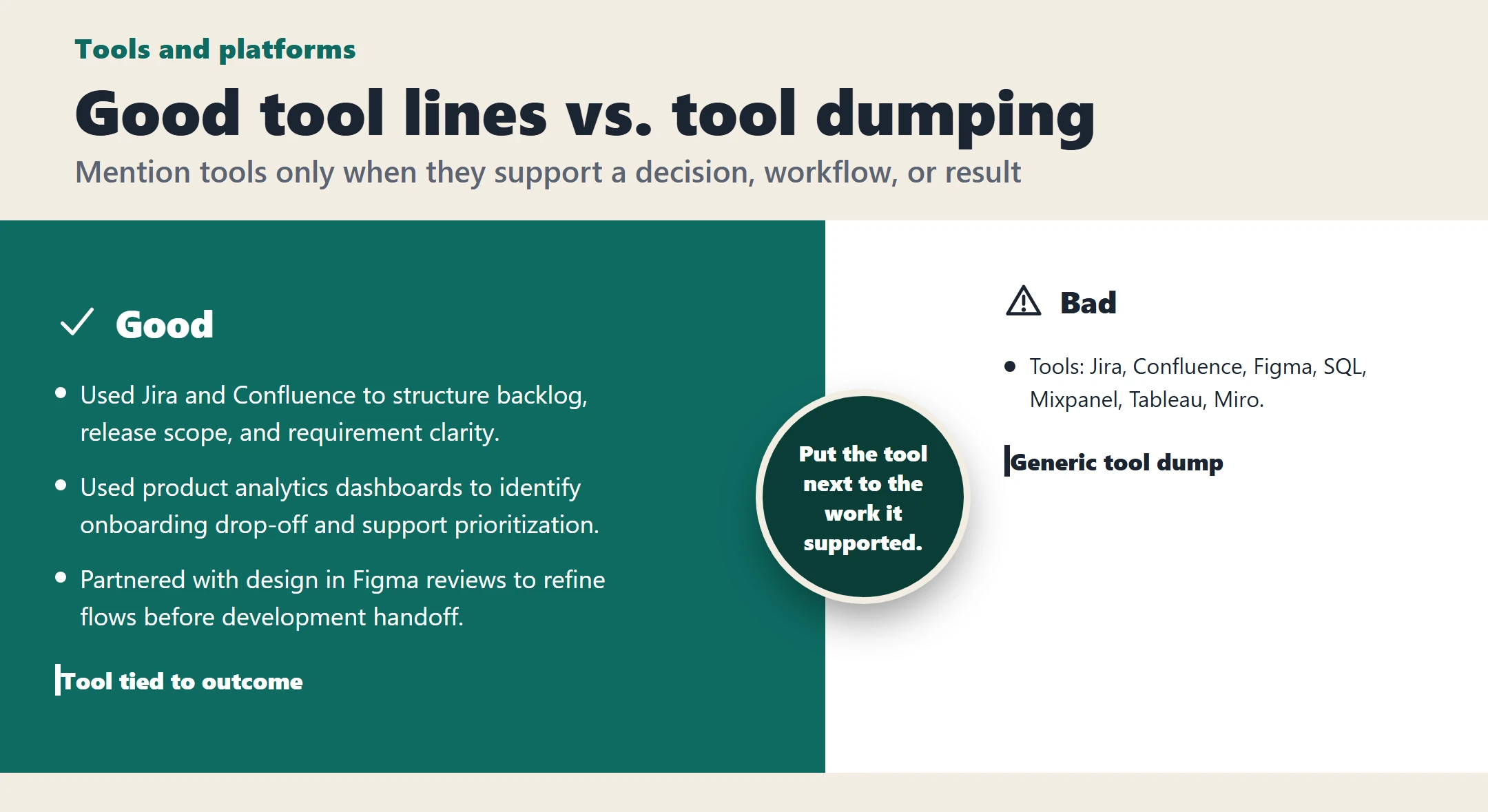
Mention tools only when they support a decision, workflow, or result. This matters both for human review and for ATS readability in markets where employers use screening systems. If you need formatting guidance, review CV formatting rules for ATS before finalizing your document.
Bad vs good tool lines
Bad:
- Tools: Jira, Confluence, Figma, SQL, Mixpanel, Tableau, Miro.
Good:
- Used Jira and Confluence to structure backlog, release scope, and requirement clarity across engineering and design.
- Used product analytics dashboards to identify onboarding drop-off and support prioritization decisions.
- Partnered with design in Figma reviews to refine flows before development handoff.
Simple rules
- Do not list tools with no context.
- Put tools near the work they supported.
- Mention only tools relevant to target roles.
- Avoid long “skills” sections filled with platforms you barely used.
Stakeholder Impact Story: Who You Influenced
Cross-functional influence is one of the clearest signals in a product management CV.
Typical stakeholders include:
- Engineering
- Design
- Data
- Sales
- Operations
- Customer support
- Finance
- Leadership
Useful templates
- Influenced [stakeholder group] to align on [decision], enabling [result].
- Worked across [functions] to resolve [constraint or conflict], supporting [outcome].
- Presented [insight or recommendation] to [leadership/team] and secured alignment for [next step].
Example:
- Worked across engineering, support, and operations to align on release priorities for a service request flow, reducing rollout friction and improving internal readiness.
Scope and Scale Language That Sounds Credible
One weakness in many product management CVs is missing scale.
You do not need to force numbers when they are confidential. Use safe phrasing that still gives context.
Good scope language
- Core customer journey
- High-traffic workflow
- Multi-team initiative
- Regional product scope
- Cross-functional program
- Customer-facing feature
- Internal platform capability
- Priority roadmap item
Safe example phrases
- Led a customer-facing feature launch within a core acquisition journey.
- Managed a multi-stakeholder initiative involving engineering, design, and operations.
- Supported rollout across regional teams, adapting requirements to local process needs.
- Owned prioritization for a high-impact product area with competing stakeholder input.
For ATS strategy and keyword balance in Saudi hiring contexts, it also helps to understand ATS used in Saudi Arabia and what that means for structure.
Proof Artifacts You Can Reference Without Attachments
You can strengthen credibility by lightly referencing proof artifacts inside bullets or project descriptions.
Examples:
- Dashboard reviews
- Cohort analyses
- PRDs
- User research summaries
- Experiment readouts
- Release retrospectives
- Stakeholder updates
- Support trend analyses
Subtle ways to reference them
- Based on dashboard review, identified low completion at the final verification step.
- Defined requirements in a PRD used to align design and engineering on MVP scope.
- Used cohort analysis to compare post-launch behavior across user segments.
- Shared experiment readout with leadership to support phased rollout decision.
Do not overdo it. The goal is to imply evidence, not build a document archive.
Common Mistakes in Product Management CVs
Here are 10 common mistakes and quick fixes.
- Listing responsibilities only
Fix: add outcome, metric, or business effect.
- Confusing shipping with success
Fix: show adoption, quality, or customer impact after launch.
- Using vague verbs like “handled”
Fix: use clearer verbs such as prioritized, defined, improved, aligned, launched.
- No user or business problem stated
Fix: anchor work to a problem worth solving.
- No stakeholder context
Fix: name the functions you influenced.
- Tool dumping
Fix: tie each tool to work and result.
- No scope language
Fix: show whether work was regional, platform-level, customer-facing, or cross-team.
- Too many low-value bullets
Fix: keep the strongest, proof-backed bullets first.
- Weak summary
Fix: write a summary that signals product type, scope, and outcomes.
- Overclaiming results
Fix: use careful phrasing if full attribution is not possible.
Myths vs facts
- Myth: Shipping a feature is enough proof.
Fact: Hiring managers want evidence of adoption, improvement, or learning after release.
- Myth: More tools make you look stronger.
Fact: Relevant tools with context are stronger than long lists.
- Myth: Every bullet needs a percentage.
Fact: Clear directional impact is better than invented precision.
Terminology Map: Words That Signal Competence
A good product management CV uses the right terms in the right places.
Process terms
Use in experience bullets:
- Prioritization
- Discovery
- Roadmap
- Backlog refinement
- MVP
- Release planning
- Experimentation
- Validation
Metrics terms
Use in bullets, summary, and project blocks:
- Activation
- Adoption
- Conversion
- Retention
- Drop-off
- Churn
- Time to value
- Engagement
Tools terms
Use in skills or context lines:
- Jira
- Confluence
- Analytics dashboards
- A/B testing tools
- User research platforms
- SQL
- Figma
The category matters. Process terms show how you work. Metrics show what changed. Tools show how you supported execution.
Quantifying Results Safely
Safe quantification is better than exaggerated precision.
Good patterns
- Improved activation rate after onboarding redesign.
- Reduced drop-off in a key step of the checkout flow.
- Increased adoption of a newly launched feature among target users.
- Shortened delivery cycle for a repeated release process.
- Improved stakeholder alignment and reduced requirement ambiguity before development.
Five compliant examples
- Helped improve activation after simplifying the first-use journey for new users.
- Contributed to reduced checkout friction by prioritizing fixes based on error patterns and feedback.
- Supported higher feature adoption through phased rollout and post-launch monitoring.
- Reduced requirement ambiguity by defining acceptance criteria before build kickoff.
- Improved release readiness across teams by aligning dependencies early.
Caution notes
- Do not invent percentages.
- Do not imply sole ownership if results came from team effort.
- Use “supported,” “contributed to,” or “helped improve” when needed.
- If exact numbers are confidential, use directional language with clear context.
Before-and-After Rewrite Clinic
Weak bullet 1
- Managed product roadmap and worked with engineering.
Rewrite:
- Prioritized roadmap items with engineering and design based on user impact, effort, and dependency risk, improving delivery focus for a core product area.
What changed: scope, decision logic, evidence of prioritization.
Weak bullet 2
- Launched new feature for customers.
Rewrite:
- Led launch of a customer-facing self-service feature, defining MVP scope and post-launch tracking to measure adoption and early friction points.
What changed: clearer scope, delivery role, proof of outcome tracking.
Weak bullet 3
- Analyzed data and made recommendations.
Rewrite:
- Used funnel and behavior data to identify onboarding friction, then recommended flow changes that improved progression toward first-value actions.
What changed: better problem statement, stronger action, clearer result.
Section Ordering for a Product Management CV
For experienced professionals, page 1 matters most.
Recommended order
- Name and contact details
- Professional summary
- Core skills
- Recent experience
- Selected projects if relevant
- Earlier experience
- Education
- Certifications or tools, if useful
What should go on page 1
- Your summary
- Your strongest, most relevant recent role
- Outcome-focused bullets
- Product-specific skills
- Evidence of delivery and stakeholder impact
Simple outline structure
- Header
- Professional Summary
- Core Skills
- Most Recent Role
- Earlier Relevant Roles
- Selected Projects
- Education and Certifications
Keep the top third of page 1 sharp and targeted.
Mapping Responsibilities to Proof Blocks
Use this quick mapping to convert duties into proof.
| Responsibility | Proof block |
|—|—|
| Roadmap ownership | Prioritization logic + result |
| Feature launch | Adoption or user outcome |
| Requirement writing | PRD clarity + delivery readiness |
| Stakeholder alignment | Functions involved + decision made |
| Data analysis | Insight found + action taken |
| UX improvement | Friction removed + behavior change |
| Experimentation | Hypothesis + test outcome |
| Delivery coordination | Scope control + release effect |
This table is also useful when you revise a role for different job ads. Start with the responsibility, then replace it with proof that a hiring manager can scan quickly.
Interview-Ready Story Bank Prompts
Your CV should support interview stories. Prepare these prompts:
- A feature you launched that created measurable adoption.
- A prioritization decision where you said no.
- A cross-functional conflict you resolved.
- A user insight that changed roadmap direction.
- A metric drop you investigated.
- A release that required phased rollout.
- A requirement document that improved execution.
- A product improvement driven by customer feedback.
Mini story outline
For each story, note:
- Situation
- Product problem
- Stakeholders
- Your decision
- What changed
- What you learned
A useful rule is simple: if a bullet is strong enough for your CV, it should also be strong enough to support a two-minute interview answer.
Final Checklist for Product Management CVs
Score each item as pass or fail.
- Summary clearly states product type, seniority, and outcomes
- Bullets show results, not only duties
- Product thinking is visible through prioritization or insight
- Cross-functional leadership appears in multiple bullets
- Metrics are used carefully and credibly
- Feature launches show adoption or impact, not just shipping
- Scope and scale are clear
- Tools are mentioned with context
- Strongest evidence appears on page 1
- Language is tailored to the target role
Pass threshold
- 8/10 or more: strong application-ready base
- 6–7/10: usable, but needs sharper proof
- Below 6/10: rewrite before applying
Next-fix priority logic
If your score is low, fix in this order:
- Summary
- Top three bullets in latest role
- Metrics and scope language
- Stakeholder impact
- Tools and formatting
Get a professionally rewritten CV with stronger delivery proof, clearer positioning, and better role fit for experienced product professionals—start here .