

For experienced operations and supply chain professionals, a strong CV is not a list of duties. It is evidence that you improve flow, reduce waste, protect service levels, and keep execution stable under pressure.
Hiring managers usually scan for one question first: can this person run a reliable operation and improve it without creating new risk?
That is why an operations supply chain CV should lead with operational proof. Your document needs to show how you influenced efficiency, quality, cost, throughput, inventory health, vendor performance, and delivery reliability. If your current CV reads like a job description, you need to convert tasks into evidence-backed achievements .
What Hiring Managers Want: Outcomes and Signals
In operations and supply chain hiring, the strongest candidates signal control, consistency, and measurable improvement.
The most valued outcomes usually include:
- Faster cycle times without service breakdown
- Better on-time performance
- Lower cost with maintained or improved quality
- Higher forecast or planning accuracy
- Better supplier or warehouse reliability
- Stronger SLA adherence across teams and vendors
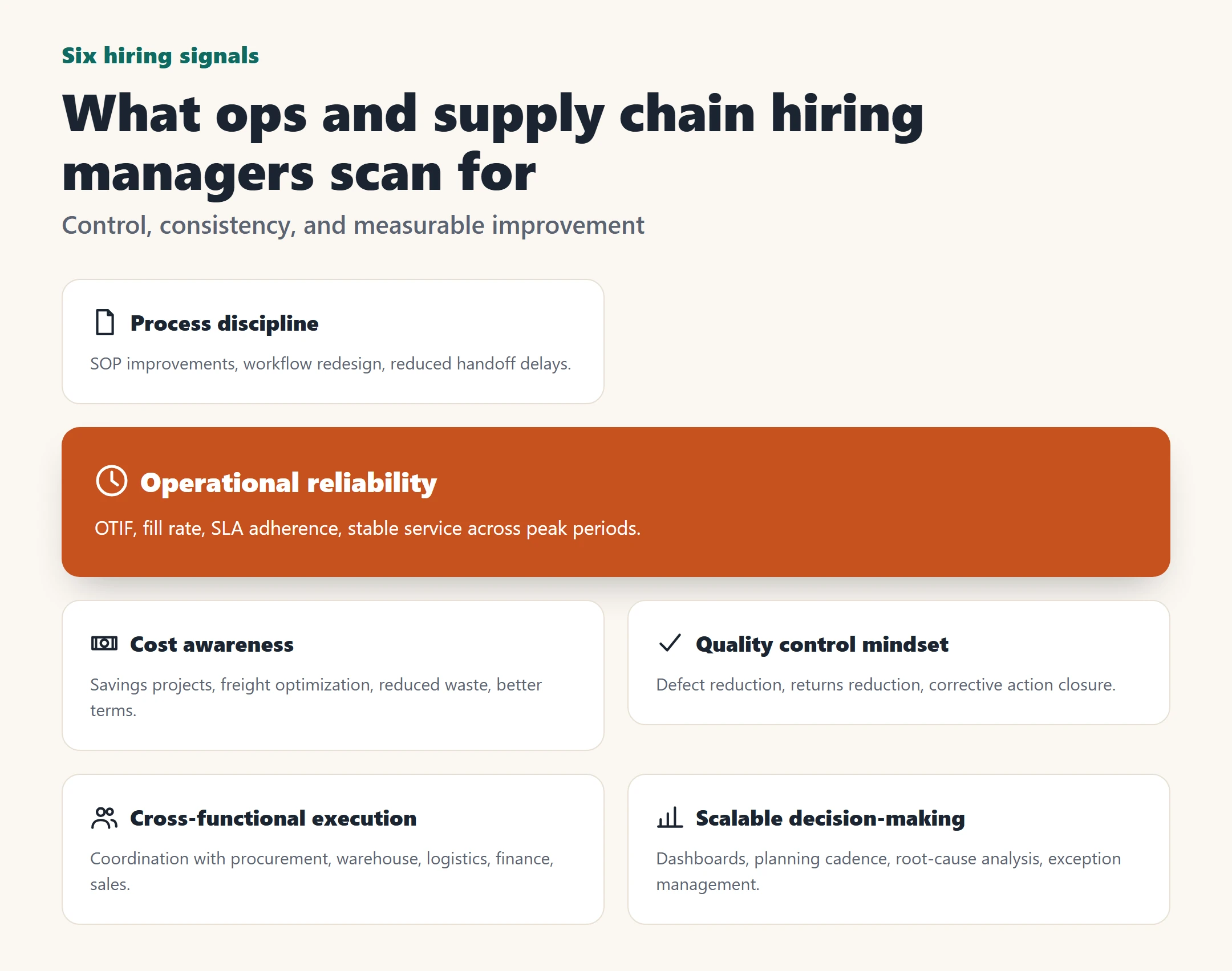
Six hiring signals and the proof behind them
- Process discipline
Proof type: SOP improvements, workflow redesign, reduced handoff delays, documented control steps.
- Operational reliability
Proof type: OTIF, fill rate, SLA adherence, stable service across peak periods.
- Cost awareness
Proof type: savings projects, freight optimization, reduced waste, better supplier terms, improved resource utilization.
- Quality control mindset
Proof type: defect reduction, returns reduction, corrective action closure, audit readiness.
- Cross-functional execution
Proof type: coordination with procurement, warehouse, logistics, finance, sales, and suppliers.
- Scalable decision-making
Proof type: dashboards, planning cadence, root-cause analysis, exception management, reporting rhythm.
A good operations supply chain CV does not merely say “managed operations.” It shows what became faster, cheaper, cleaner, or more dependable because you were there.
Metrics That Matter in Operations and Supply Chain
Your metrics should match the type of operation you manage. Not every role uses the same KPI set, but the logic is consistent: show performance, risk control, and business impact.
Useful KPI categories include:
- Cycle time: process speed and flow efficiency
- OTIF or on-time delivery: execution reliability
- SLA adherence: service consistency
- Forecast accuracy or forecast error: planning quality
- Inventory accuracy: system and warehouse control
- Defect rate or returns rate: quality effectiveness
- Cost per order, cost per shipment, or unit cost: cost discipline
- Supplier lead time or vendor performance: external dependency management
- Stockout rate: demand-planning and replenishment quality
- Capacity utilization: resource balance and productivity
Each metric implies something beyond the number itself:
- Better cycle time suggests process simplification or fewer bottlenecks.
- Higher OTIF suggests stronger scheduling, coordination, and exception handling.
- Lower defects suggest quality controls are working.
- Lower logistics cost suggests route, carrier, or load optimization.
- Better forecast accuracy suggests tighter demand planning and stakeholder alignment.
If you are unsure how to present numbers safely, use a conservative quantification method rather than rough claims .
Common Role Variants and How the CV Should Shift
Operations and supply chain is broad. Your CV should reflect your lane instead of using generic operations language.
Process improvement or continuous improvement
Emphasize:
- Cycle time reduction
- Waste removal
- Standardization
- Throughput gains
- Root-cause analysis
- Process controls
Your bullets should focus on before-and-after process performance.
Demand planning or supply planning
Emphasize:
- Forecast accuracy
- Planning cadence
- Inventory balance
- Service level support
- Cross-functional alignment with sales and procurement
Your bullets should show how planning decisions improved availability while controlling excess stock.
Procurement or sourcing
Emphasize:
- Supplier performance
- Commercial savings
- SLA adherence
- Vendor risk
- Lead time stability
- Category strategy
Your bullets should show both cost and continuity, not savings alone.
Quality operations
Emphasize:
- Defect reduction
- CAPA follow-through
- Audit readiness
- Complaint trends
- Returns control
- Process compliance
Logistics or distribution
Emphasize:
- OTIF
- Freight cost
- Delivery planning
- Carrier performance
- Warehouse-to-customer flow
- Service reliability
A mid-career candidate should tailor the CV to the actual vacancy rather than sending one fixed version to every employer .
A Summary Angle That Works for Operations and Supply Chain Roles
Your summary should establish four things quickly:
- Your level of experience
- Your functional area
- Your scope of responsibility
- The outcomes you are known for
Summary template
Experienced Operations/Supply Chain professional with background in [planning / procurement / logistics / quality / process improvement], managing [process / scope / team / vendor network]. Known for improving [efficiency / SLA adherence / quality / cost control / inventory health] through structured execution, cross-functional coordination, and data-led problem solving.
Example summary
Operations and Supply Chain professional with experience across warehouse operations, vendor coordination, and process improvement in fast-moving environments. Known for improving cycle time, service reliability, and cost control through workflow redesign, KPI tracking, and disciplined stakeholder follow-up.
If you want to sharpen this section further, a stronger professional summary structure can help you signal seniority faster .
Achievement Bullet Patterns Recruiters Trust
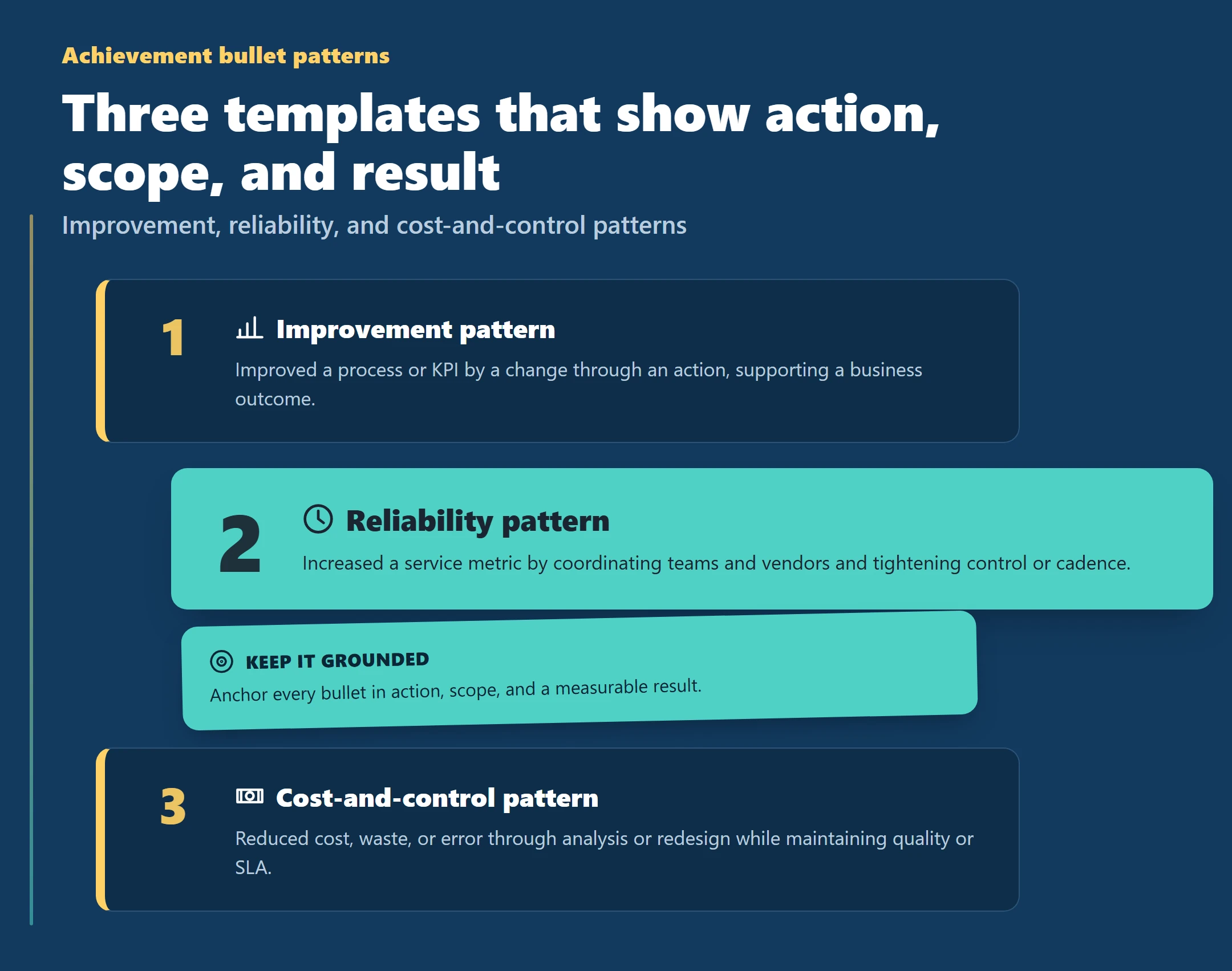
Your bullet points should show action, scope, and result.
Template 1: Improvement pattern
- Improved [process/KPI] by [change] through [action], supporting [business outcome].
Example: Improved order processing cycle time by streamlining approval steps and clarifying handoff ownership, supporting faster dispatch during peak demand periods.
Template 2: Reliability pattern
- Increased [service/reliability metric] by [change] by coordinating [teams/vendors/processes] and tightening [control/cadence].
Example: Increased on-time dispatch consistency by introducing a daily exception review with warehouse and transport teams, reducing delayed shipments during weekly volume spikes.
Template 3: Cost-and-control pattern
- Reduced [cost/waste/error] by [change] through [analysis or redesign] while maintaining [quality/SLA/service level].
Example: Reduced packaging waste through revised material usage controls while maintaining shipment protection standards and minimizing rework.
If your bullets still read like responsibility statements, this is a good point to fix the document before you apply. We help experienced professionals rewrite weak CVs into clearer, stronger, application-ready versions for operations and supply chain roles .
Project Blocks That Add Trust Without Adding Clutter
Recruiters trust project examples when they are short, specific, and tied to measurable outcomes.
High-signal project types include:
- Process redesign
- Warehouse slotting or layout optimization
- Demand-planning cadence improvement
- Supplier performance recovery
- Quality corrective action programs
- Delivery reliability improvement
- Inventory accuracy or reconciliation projects
- Cost-to-serve or freight optimization initiatives
How to present a project in two lines
Use this format:
- Project: what changed and where
- Result: what improved and how you measured it
Example:
- Project: Redesigned warehouse picking flow for high-frequency SKUs across daily dispatch operations.
- Result: Improved movement efficiency and reduced avoidable delays through clearer slotting logic and revised handoff sequencing.
Mention Tools and Systems With Context, Not as a Dump
Tools support credibility only when they are tied to work.
Relevant examples may include:
- ERP systems
- WMS
- TMS
- Excel
- BI dashboards
- Planning tools
- Supplier scorecards
- Quality reporting systems
Bad vs good tool lines
Bad: SAP, Oracle, Excel, Power BI, WMS, TMS.
Good: Used ERP and warehouse data to track inventory discrepancies, prioritize exception handling, and support weekly replenishment reviews.
Bad: Advanced Excel and dashboards.
Good: Built recurring KPI trackers in Excel and dashboard views to monitor OTIF, backlog, and shipment exceptions for operations review meetings.
The same rule also helps with ATS readability. Keep formatting simple and use relevant terms in context rather than dumping keywords, especially if you are applying through systems commonly used by employers in Saudi Arabia .
Show Stakeholder Impact, Not Solo Effort
Operations work is rarely isolated. Your CV should show who you influenced and how that changed outcomes.
Typical stakeholders include:
- Procurement
- Warehouse
- Logistics providers
- Sales
- Finance
- Quality teams
- Planning teams
- Suppliers
- Leadership
Stakeholder impact templates
- Partnered with [team] to resolve [issue], improving [metric/outcome].
- Coordinated across [functions] to stabilize [process/service] during [context].
- Worked with [stakeholders] to implement [change], supporting [result].
Example:
- Coordinated with procurement, warehouse, and transport partners to reduce dispatch bottlenecks and improve service continuity during high-volume periods.
How to Express Scope and Scale Safely
Experienced candidates often undersell scope. You do not need sensitive figures to show scale.
Use safe phrasing such as:
- Managed operations across a multi-site environment
- Supported country-level warehouse and transport coordination
- Oversaw high-volume daily order flow
- Worked with regional suppliers and internal stakeholders
- Managed service delivery against defined SLAs
- Supported peak-period execution across multiple channels
Examples:
- Managed warehouse and transport coordination for high-volume outbound operations.
- Supported supplier and logistics performance across multi-stakeholder service workflows.
- Contributed to planning and execution across a broad SKU base and recurring replenishment cycles.
Proof Artifacts You Can Reference Without Attachments
You do not need to attach reports to make your CV credible. You can reference proof artifacts subtly.
Useful artifacts include:
- KPI dashboards
- Weekly operations reports
- Supplier scorecards
- Audit findings summaries
- Root-cause logs
- SLA review packs
- Inventory reconciliation reports
- Forecast review templates
How to reference them lightly
- Produced weekly OTIF and backlog dashboards to support exception management.
- Maintained supplier performance scorecards for review of lead time, service consistency, and issue closure.
- Used audit and defect trend reporting to prioritize corrective actions.
This suggests real operating discipline without overloading the document.
Common Mistakes in Operations Supply Chain CVs
Here are 10 frequent mistakes and quick fixes:
- Listing duties only
Quick fix: turn each duty into a result-focused bullet.
- Using generic words like “responsible for”
Quick fix: replace with action verbs such as improved, reduced, standardized, coordinated, optimized.
- No operational metrics
Quick fix: include cycle time, SLA, OTIF, cost, quality, or inventory indicators where possible.
- Talking about savings without continuity
Quick fix: show that service or quality was maintained.
- No mention of stakeholders
Quick fix: add who you influenced.
- Tool dumping
Quick fix: mention systems only in relation to outcomes.
- Vague scale
Quick fix: indicate multi-site, high-volume, regional, vendor-facing, or cross-functional scope.
- Over-claiming ownership
Quick fix: use accurate language such as supported, led, coordinated, or contributed.
- Weak summary
Quick fix: state function, scope, and outcome pattern.
- Poor section order
Quick fix: place the strongest proof near the top of page one.
Terminology That Signals Competence
Use clear category-based language so recruiters can quickly place your expertise.
Process terms
- SOPs
- Workflow
- Handoff
- Capacity
- Replenishment
- Exception management
- Root-cause analysis
- Continuous improvement
Best placed in: experience bullets and project descriptions.
Metric terms
- Cycle time
- OTIF
- SLA
- Defect rate
- Stockouts
- Forecast accuracy
- Inventory accuracy
- Cost per shipment
Best placed in: bullets, summary, and selected project lines.
System and tool terms
- ERP
- WMS
- TMS
- Dashboard
- Reporting cadence
- Scorecard
Best placed in: a tools section or experience bullets with context.
How to Quantify Results Safely
Safe quantification means being precise without exaggeration.
Use patterns like:
- Reduced delays in a recurring dispatch workflow
- Improved inventory accuracy across assigned operations scope
- Supported lower defect levels through revised quality checks
- Helped stabilize supplier performance against agreed SLAs
- Contributed to lower processing time in key operational steps
Five compliant examples
- Reduced cycle time in a core operational workflow by removing duplicate approval steps.
- Improved on-time dispatch performance through daily exception review and tighter coordination.
- Supported better forecast adherence by standardizing weekly planning inputs.
- Reduced avoidable rework by clarifying quality checkpoints and escalation paths.
- Improved supplier follow-up rhythm, helping maintain service continuity during demand fluctuations.
Caution notes
- Do not guess exact numbers.
- Do not claim savings you cannot defend.
- Do not present team outcomes as fully individual if they were shared.
- Do not hide uncertainty with inflated wording.
Before-and-After Rewrite Clinic
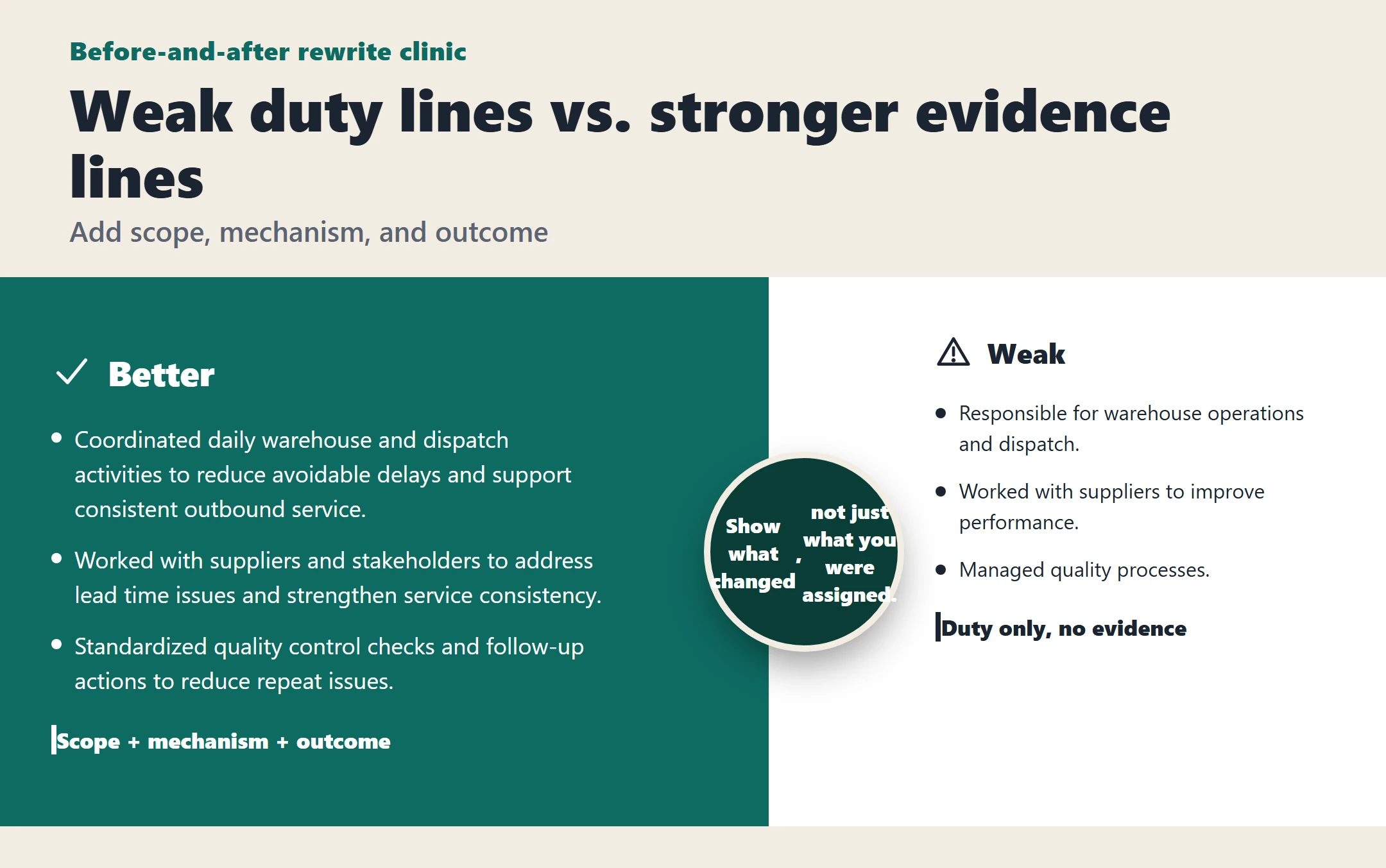
Weak bullet 1
Before: Responsible for warehouse operations and dispatch.
After: Coordinated daily warehouse and dispatch activities to reduce avoidable delays and support more consistent outbound service.
Why it is better: clearer scope, clearer action, stronger outcome.
Weak bullet 2
Before: Worked with suppliers to improve performance.
After: Worked with suppliers and internal stakeholders to address lead time issues and strengthen service consistency against operating requirements.
Why it is better: names the issue, shows collaboration, and signals business relevance.
Weak bullet 3
Before: Managed quality processes.
After: Standardized quality control checks and follow-up actions to reduce repeat issues and improve process discipline across operations.
Why it is better: adds mechanism, result direction, and evidence of system thinking.
Recommended Section Order for Page One
For an experienced operations or supply chain professional, page one should carry the strongest proof first.
Suggested structure
- Contact details
- Professional summary
- Core skills
- Recent experience with achievement-led bullets
- Selected projects if highly relevant
If a project is central to your candidacy, move it higher. If your recent role already contains strong evidence, keep projects embedded under experience instead of splitting attention.
Mapping Responsibilities to Proof Blocks
Use this quick mapping logic:
| Responsibility | Proof to show |
|—|—|
| Process improvement | Cycle time, throughput, reduced bottlenecks |
| Demand planning | Forecast quality, stock availability, planning cadence |
| Procurement | Savings, supplier SLA, lead time stability |
| Logistics | OTIF, freight control, dispatch reliability |
| Warehouse operations | Inventory accuracy, pick/pack flow, turnaround time |
| Quality | Defects, returns, CAPA follow-through |
| Vendor management | Scorecards, issue closure, service consistency |
| Reporting and control | Dashboards, review cadence, exception handling |
Interview-Ready Story Bank Prompts
Your CV should support interview stories. Prepare one short story for each of these prompts:
- A process bottleneck you fixed
- A service failure you stabilized
- A cost issue you addressed without harming quality
- A supplier problem you helped recover
- A planning issue that caused stock risk
- A quality trend you reduced
- A cross-functional conflict you resolved
- A peak-period challenge you managed
Mini story outline
- Situation
- Operational risk
- Your action
- Stakeholders involved
- Measurable or observable result
- What changed permanently
Final Pass/Fail Checklist for Your Operations Supply Chain CV
Score each item as pass or fail.
- Does the summary clearly state your function and scope?
- Are the top bullets achievement-led rather than duty-led?
- Do you show at least 3 outcome areas such as cost, quality, SLA, cycle time, inventory, or delivery?
- Is there clear evidence of reliability and control?
- Do you mention stakeholders and cross-functional coordination?
- Are tools mentioned with context?
- Is scale expressed safely?
- Are claims realistic and supportable?
- Is the page-one order strong?
- Does the CV sound like an experienced operator, not a generic manager?
Pass threshold
- 8–10 passes: strong application-ready CV
- 6–7 passes: usable, but needs targeted strengthening
- Below 6: rewrite before applying
Next-fix priority logic
If your score is low, fix in this order:
- Summary
- Top 5 bullets
- Metrics and proof
- Stakeholder language
- Scope and systems
- Formatting and polish
Get a professional CV rewrite and optimization service for experienced operations and supply chain professionals, including a stronger summary, sharper achievement bullets, and a job-ready document—start here .