

If you’re moving from individual contributor to manager, your CV should stop reading like a list of tasks and start showing ownership.
That shift matters because hiring teams are not only looking for activity. They want signals that you ran a function, led people, managed trade-offs, and improved outcomes over time. A strong manager CV makes those signals easy to spot.
This guide gives you a practical framing system for leadership achievements examples across people, process, and output or resource impact. The goal is simple: present leadership in a way that sounds specific, grounded, and believable.
What Changes From IC to Manager: Signals of Ownership
An individual contributor CV usually focuses on execution. A manager CV should show ownership of outcomes, operating rhythm, and team performance. If you want stronger bullet logic before rewriting your experience, start by learning how to turn tasks into achievements .
Here are the six biggest differences.
1. From doing work to owning results
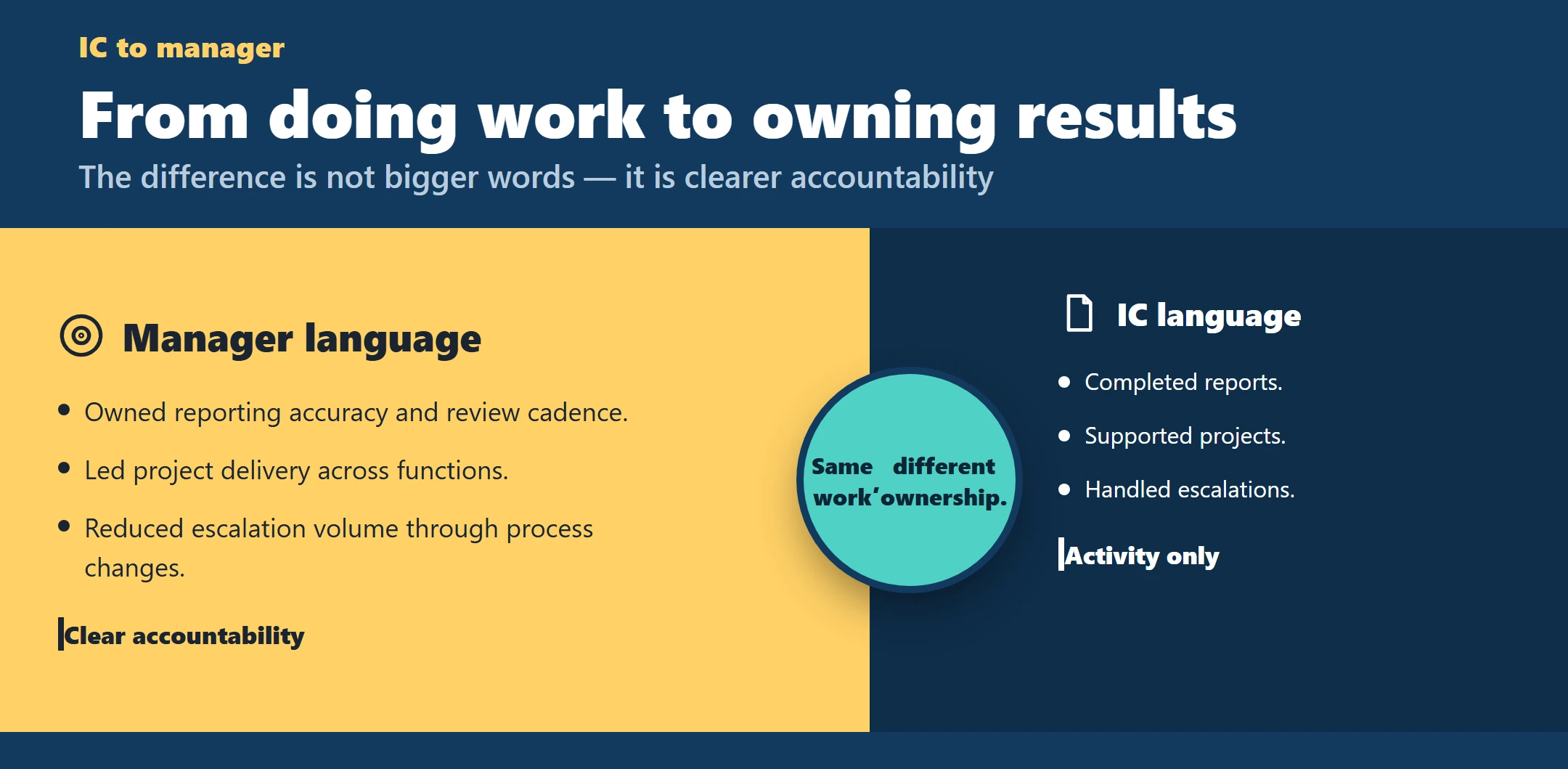
IC language:
- Completed reports
- Supported projects
- Handled escalations
Manager language:
- Owned reporting accuracy and review cadence
- Led project delivery across functions
- Reduced escalation volume through process changes
The difference is not bigger words. It is clearer accountability.
2. From isolated tasks to operating cadence
Managers usually run recurring routines such as:
- Weekly KPI reviews
- Team planning rhythm
- Monthly business reviews
- Performance check-ins
- Forecast and recovery planning
These routines show that you did not just react. You managed the function.
3. From personal output to team output
A manager achievement should often answer:
- Who did you lead?
- What did the team own?
- What changed because of your leadership?
4. From effort to targets
Manager bullets should connect to a target, service level, deadline, quality standard, or cost objective.
5. From support role to decision role
Strong manager bullets show that you made calls, prioritized work, allocated resources, or approved changes.
6. From one-off wins to repeatable systems
Managers are often judged by whether improvements became standard practice. For a broader structure, see how a manager-level CV should present ownership and cadence .
The Operating Cadence Block: How You Ran the Function
One of the fastest ways to sound like a manager is to include an operating cadence block in your summary or experience section.
This block shows how you managed the function week by week, not just what your team handled.
What to include
A useful cadence block may mention:
- Weekly metrics reviewed
- Team meeting rhythm
- Escalation routines
- Forecast cycle
- Performance reviews
- Cross-functional touchpoints
- Improvement priorities
Template paragraph
Managed day-to-day operations through a weekly KPI review, team planning cadence, issue-escalation process, and monthly performance check-ins. Tracked service, quality, and delivery indicators; aligned priorities with partner teams; and adjusted staffing, workflows, or recovery actions when targets were at risk.
That paragraph works because it shows system ownership, not random activity.
People Leadership Proof: Team, Hiring, and Coaching
A manager CV should show team scope clearly but safely. If your exact numbers are confidential or variable, use honest framing instead of inflated claims.
Safe ways to express team scope
- Led a team of X direct reports
- Managed supervisors and frontline staff across shift-based operations
- Oversaw hiring, onboarding, and performance management for a growing team
- Supported capability building across a multi-role team
Leadership achievement examples
- Led a team of 6 direct reports, introducing weekly coaching check-ins and clearer role ownership to improve consistency and reduce avoidable rework.
- Supported hiring and onboarding during team growth, standardizing ramp-up materials and early performance checkpoints.
- Managed performance conversations, development plans, and workload allocation across a mixed-experience team.
- Coached team leads on escalation handling and handoff quality, improving day-to-day decision-making at the front line.
A simple formula
Use this pattern:
Team scope + leadership action + operational effect
Example:
- Led a 10-person operations team, introduced weekly scorecards and coaching sessions, and improved follow-through on service and quality priorities.
If you need help turning this kind of leadership proof into a stronger, application-ready CV, we can rewrite and position your experience for manager roles .
If you want to add metrics without overstating them, review practical ways to quantify CV achievements .
Process Ownership and System Improvements
Managers often create their strongest proof through process wins. The best bullets follow a simple pattern:
Baseline → change → impact
Four process-win templates
- Identified inconsistent handoffs between teams, introduced a standard workflow and ownership map, and improved turnaround reliability.
- Reduced manual reporting steps by redesigning the review process, creating clearer inputs and deadlines for stakeholders.
- Standardized onboarding or training materials, improving ramp-up consistency for new team members.
- Introduced escalation criteria and response routines, helping the team focus faster on higher-risk issues.
Example bullets
- When review quality varied across shifts, created a standard checklist and review rhythm, leading to more consistent execution.
- Reworked the issue-triage process from ad hoc handling to priority-based routing, helping the team resolve critical items faster.
- Built a monthly planning process that aligned workload, staffing, and deadlines, reducing last-minute operational pressure.
- Replaced unclear approval steps with a documented workflow and decision owners, improving speed and accountability.
A good process bullet does not just say you improved something. It shows what was weak before, what you changed, and why the change mattered.
KPI Management: Targets, Forecasts, and Recovery Plans
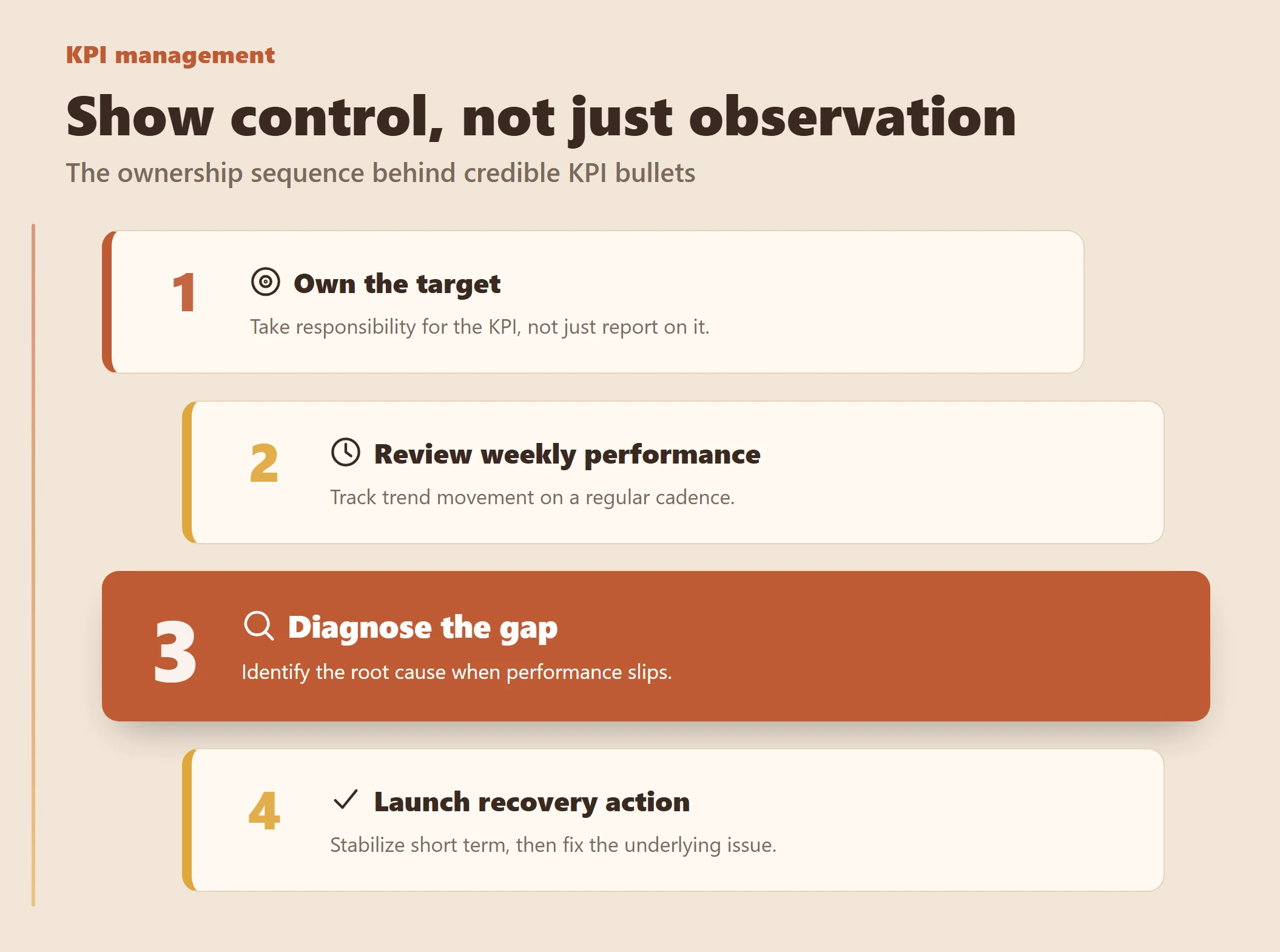
A manager should not only mention metrics. They should show ownership of what happened when metrics moved.
What KPI ownership looks like
A credible manager bullet can show:
- Target ownership
- Forecasting
- Gap analysis
- Corrective action
- Timeframe
Bullet templates
- Owned [KPI] against [target], reviewed performance weekly, and adjusted [staffing/process/priorities] to close gaps.
- Forecast [volume/demand/output] over [timeframe], identified delivery risks early, and launched a recovery plan.
- Managed underperformance in [metric] by diagnosing root causes and implementing a short-term stabilization plan plus longer-term fixes.
Example with timeframe
- Owned weekly service and turnaround KPIs for the team, tracked trend movement over a 12-week period, and launched a recovery plan when performance dipped after workload changes.
This kind of bullet works because it shows control, not just observation.
Cross-Functional Coordination: Stakeholders and Influence
Managers rarely deliver results alone. Your CV should show how you influenced peers and partner teams, not just how you escalated issues.
How to show influence
Use verbs like:
- Aligned
- Coordinated
- Negotiated
- Resolved dependencies with
- Partnered with
- Secured agreement on
Three templates
- Partnered with [team] and [team] to align timelines, clarify handoffs, and reduce delays in delivery.
- Coordinated with stakeholders across [function names] to resolve dependencies and keep priority work on track.
- Worked with [operations/finance/HR/technology] to improve planning, resource use, or policy execution.
Stakeholder outcome examples
- Partnered with HR and operations leaders to improve hiring and onboarding flow, helping the team fill priority gaps more smoothly.
- Coordinated with finance and department heads on headcount planning and workload priorities.
- Worked with technology and process owners to roll out a revised workflow with clearer adoption support.
In many manager roles, especially in larger or fast-moving environments, influence matters as much as direct authority. The CV should make that visible.
Decision-Making and Problem Solving at Manager Level
Manager bullets should make your decision scope visible.
That means showing what you assessed, what you chose, and what happened next.
Use the “decided + shipped” pattern
A strong bullet can follow this structure:
Assessed issue → decided action → implemented change → outcome
Examples
- Reviewed recurring service failures, decided to centralize escalation ownership, and rolled out a revised response workflow.
- Identified planning gaps during peak periods, prioritized staffing adjustments, and implemented a new coverage routine.
- Evaluated process delays across approval steps, removed low-value handoffs, and introduced clearer decision ownership.
These bullets sound more senior because they show judgment, not just activity.
Delegation and Scale: Doing Less, Owning More
As a manager, your CV should not read like you personally completed every operational task.
That creates the wrong signal. It can make you look tactical rather than managerial.
Language that implies delegation
Use phrasing such as:
- Led delivery through team leads
- Set priorities and monitored execution
- Delegated day-to-day follow-up while retaining KPI ownership
- Built team capability to handle first-line decisions
- Established routines that scaled execution across the team
Before and after rewrites
Before: Prepared weekly reports and followed up with staff on open issues.
After: Established a weekly reporting and follow-up cadence, delegating day-to-day tracking while retaining ownership of issue-resolution trends.
Before: Trained new employees on procedures.
After: Standardized onboarding and delegated role-based training delivery, improving consistency across new joiners.
Before: Solved customer escalations.
After: Designed an escalation model, coached team leads on resolution standards, and retained oversight of high-risk cases.
Cautions
Avoid:
- Claiming delegation if you still personally executed everything
- Using “oversaw” without saying what changed
- Sounding distant from delivery
The right balance is simple: you enabled the work, shaped the system, and stayed accountable for results.
Budget and Resource Management, If Applicable
Not every manager owns a formal budget. That is fine.
You can still show resource judgment through staffing, vendor use, scheduling, tool allocation, or cost-efficiency choices.
Safe ways to mention budgets or resources
- Supported departmental budget tracking and spending discipline
- Managed resource allocation across team priorities
- Balanced staffing needs against service requirements
- Improved efficiency through better scheduling, capacity planning, or workflow design
Example bullets
- Managed team capacity across competing priorities, reallocating resources to protect critical delivery timelines.
- Supported cost-conscious planning by improving workflow efficiency and reducing avoidable repeat work.
- Worked with leadership on staffing and resource decisions to maintain service levels during demand changes.
If you do own a budget, mention it only if you can describe it accurately and confidently.
Page 1 Structure for Manager CVs
For manager roles, page 1 needs to establish seniority quickly.
What should appear above the fold
- Name and contact details
- Target title
- Professional summary
- Core leadership areas
- Current or most recent role
- Early proof of scope and outcomes
Recommended section order
- Header
- Professional Summary
- Core Competencies
- Professional Experience
- Education and certifications
On page 1, your first role should quickly show:
- Team scope
- Functional ownership
- Cadence
- KPI or process accountability
- Cross-functional exposure
Summary Template for Manager Roles
Your summary should sound operational and credible, not dramatic.
8–10 line summary template
Manager with experience leading teams, running day-to-day operations, and improving performance across people, process, and output. Owns functional cadence through KPI reviews, team routines, stakeholder coordination, and recovery planning. Known for translating goals into structured execution, coaching teams to stronger consistency, and improving workflows that support delivery, quality, or service. Comfortable managing change, aligning cross-functional partners, and building practical systems that scale. Brings a hands-on but structured leadership style focused on accountability, clarity, and measurable improvement.
Completed example
Operations Manager with experience leading multi-role teams and improving execution through clear operating rhythm, defined ownership, and process discipline. Manages weekly KPI reviews, team planning, escalations, and stakeholder coordination to keep delivery on track. Has led hiring support, onboarding improvements, coaching routines, and performance follow-up across growing teams. Strong at identifying process gaps, simplifying workflows, and launching practical fixes that improve reliability. Combines day-to-day control with continuous improvement and cross-functional collaboration.
Promotions and Progression: Show Growth Over Time
If you were promoted, do not repeat the same bullets under both titles.
Instead, show progression in scope.
Use a progression line
Promoted from Senior Analyst to Team Manager based on strong execution, process ownership, and readiness to lead team performance.
Then split bullets by level:
- Earlier role: execution, analysis, project contribution
- Later role: team ownership, KPI control, cross-functional leadership
That makes growth visible. If your target role is one level above manager, compare your positioning with a director-level CV .
Measuring Leadership Outcomes: People, Process, and Output
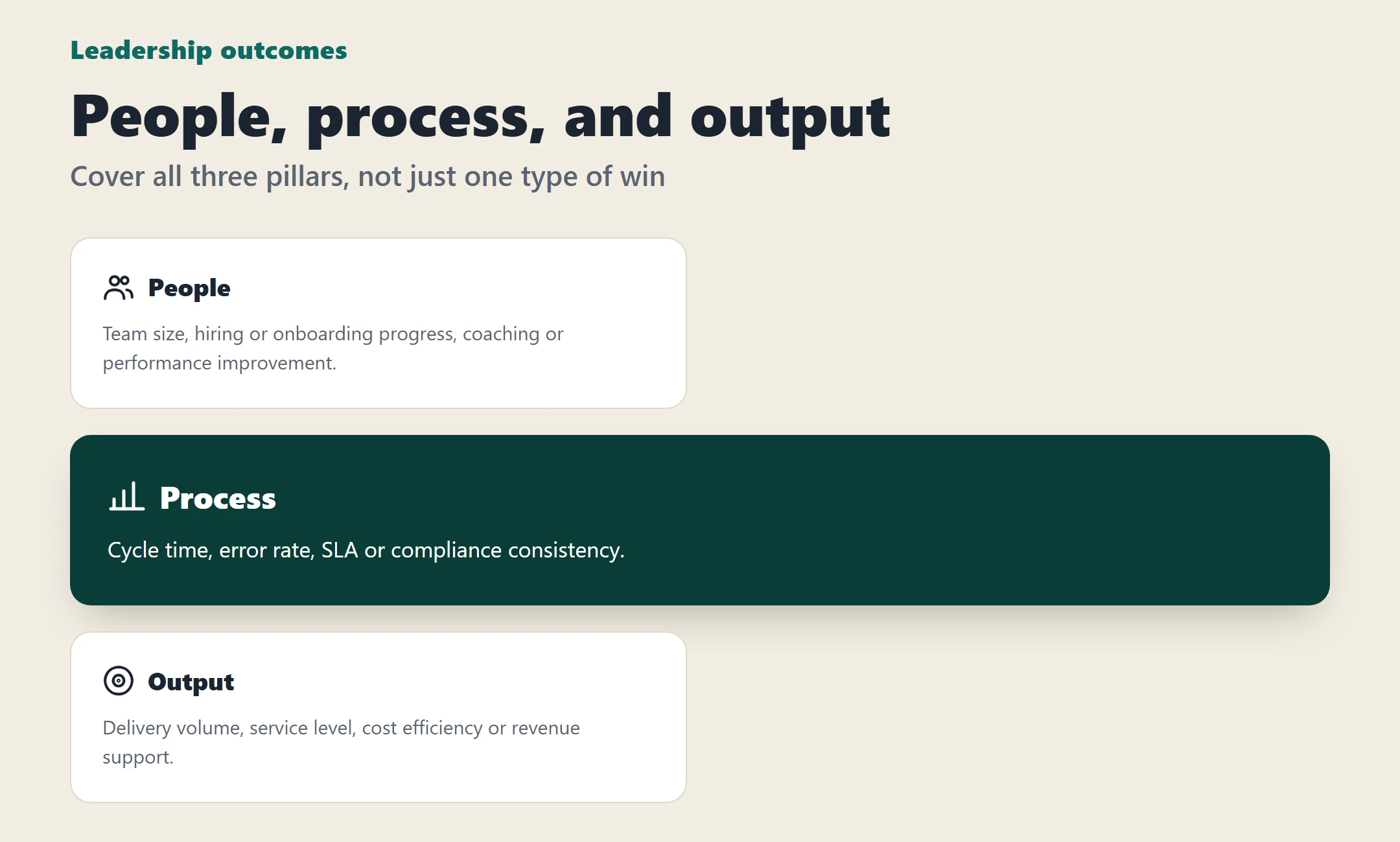
A useful framing model for leadership achievements examples is this triad:
1. People metrics
- Team size
- Hiring or onboarding progress
- Coaching or performance improvement
2. Process metrics
- Cycle time
- Error rate
- SLA or compliance consistency
3. Output metrics
- Delivery volume
- Service level
- Cost efficiency or revenue support
How to cite them
You do not need every bullet to include a metric. But across the role, your CV should show coverage across these three pillars.
Example:
- Led an 8-person team, improved onboarding consistency, and strengthened weekly performance reviews.
- Redesigned the intake workflow, reducing delays and improving handoff clarity.
- Managed weekly service targets and recovery actions during a period of increased demand.
This triad helps you avoid a common problem: too much focus on one type of win and not enough evidence of broader leadership.
Common Manager CV Mistakes
Here are 10 common mistakes and the fix for each.
- Too tactical
Fix: Replace task lists with ownership and outcome language.
- No team scope
Fix: State direct reports, team type, or leadership coverage.
- No KPI ownership
Fix: Mention targets, reviews, forecasts, or recovery plans.
- No cadence
Fix: Add weekly or monthly management routines.
- Only “responsible for” bullets
Fix: Start with action and impact.
- No cross-functional proof
Fix: Show stakeholder coordination and decisions.
- Vague words like “helped” or “assisted”
Fix: Clarify what you owned.
- Inflated claims
Fix: Use safe, supportable language.
- Repeated bullets across roles
Fix: Show progression in scope.
- No systems thinking
Fix: Include process changes that became repeatable.
Rewrite Clinic: IC Bullets to Manager Bullets
Below are three simple transformations.
1. From execution to team ownership
IC version: Managed customer complaints and updated case records.
Manager version: Led complaint-resolution workflow across the team, set handling priorities, and improved escalation visibility for higher-risk cases.
What changed: scope, ownership, system view.
2. From reporting to performance management
IC version: Prepared weekly performance reports for management.
Manager version: Established a weekly performance review cadence, using reporting insights to identify issues, guide team follow-up, and support corrective actions.
What changed: cadence, decision use, leadership application.
3. From training to capability building
IC version: Trained new team members on procedures.
Manager version: Standardized onboarding materials and delegated role-based training delivery, improving consistency and reducing variation in early performance.
What changed: scale, delegation, process design.
The same logic also helps in interviews, where you need concise stories that show ownership and impact when you talk about achievements in interviews .
Final Checklist and Seniority Test
Before you send your CV, run this quick pass/fail test.
Give yourself 1 point for each “yes.”
- Does page 1 clearly show that you led people, process, or targets?
- Do you mention team scope or leadership coverage?
- Do your bullets show ownership, not just participation?
- Do you include at least one operating cadence signal?
- Do you show KPI review, forecasting, or recovery action?
- Do you include one or more process improvements?
- Do you show cross-functional influence?
- Do your bullets imply delegation and scale?
- Do you show progression if you were promoted?
- Does the CV sound credible rather than inflated?
Scoring
- 8–10: Strong manager signal
- 5–7: Good base, but seniority is not yet consistent
- 0–4: Reads closer to IC than manager
Fix priorities
If your score is low, fix in this order:
- Add ownership language
- Add team and scope lines
- Add KPI and cadence proof
- Add process improvements
- Rewrite tactical bullets into manager-level bullets
Get a professionally rewritten CV with stronger leadership positioning, clearer manager-level structure, and credible achievement framing for managers and team leads — start here .