
Experienced professionals often lose interview points for one simple reason: they describe responsibilities, not achievements. Recruiters and hiring managers are not only listening for what your role included. They want proof that you created value, influenced outcomes, and understood why your work mattered.
If you want to talk about achievements in interviews well, focus on concise proof storytelling. That means short, credible stories that show ownership and impact without sounding rehearsed. The goal is not to impress with long detail. The goal is to make it easy for the interviewer to trust your judgment, contribution, and fit.
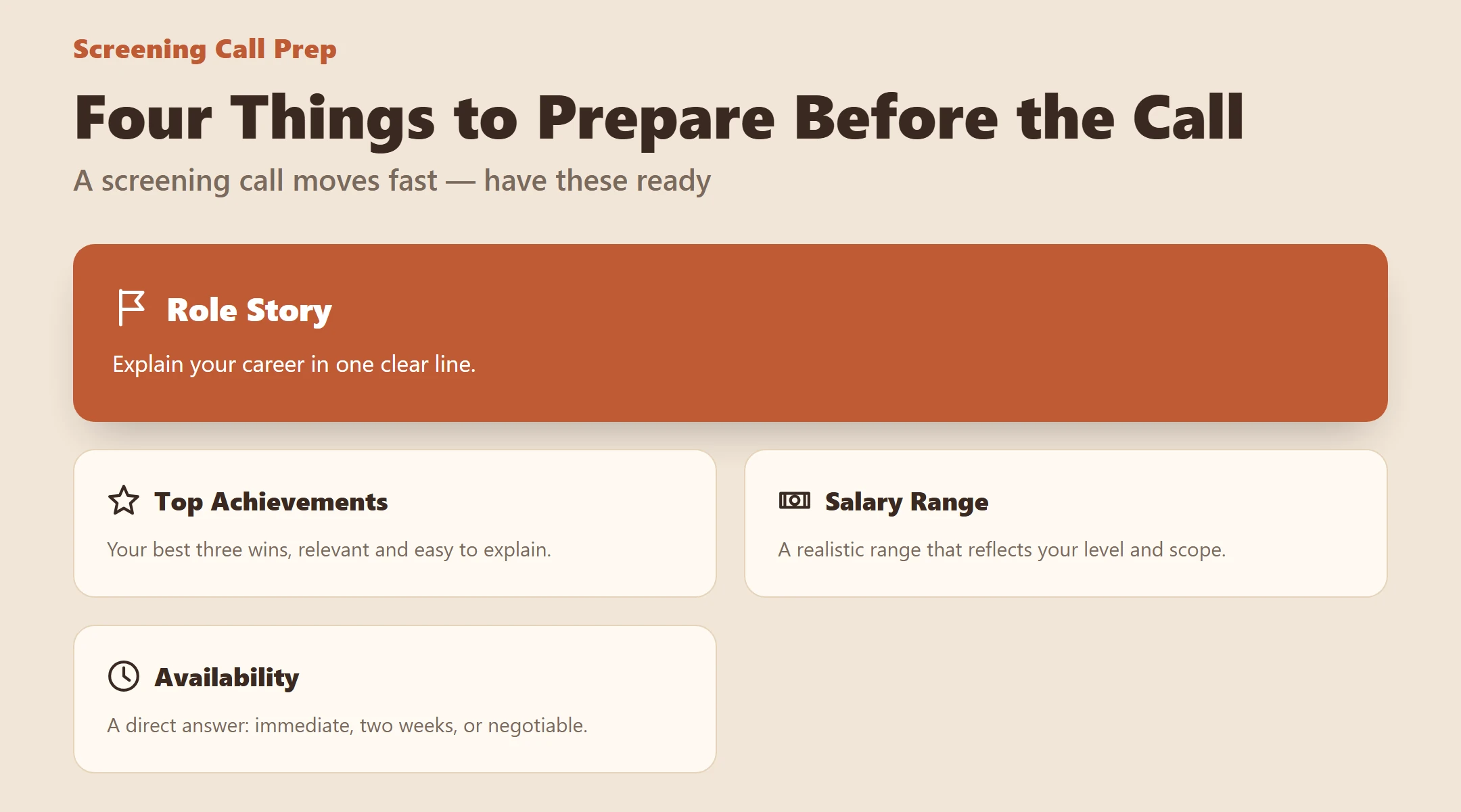
Screening Call Preparation: Role Story, Top Achievements, Salary Range, and Availability
A screening call usually moves quickly. You may only have a few minutes to establish relevance, so prepare four things in advance:
- A clear role story
- Your top achievements
- A realistic salary range
- Your availability
Your role story should explain your career in one line. For example: “I’ve spent the last eight years in operations improvement, mainly helping service teams reduce delays, improve SLA performance, and standardize processes across multiple stakeholders.”
Then prepare your top three achievements. Do not list everything. Pick wins that are relevant to the role and easy to explain. If you struggle to separate tasks from actual outcomes, review how to turn routine work into stronger proof statements .
For salary, stay professional and concise. You do not need a long defense. Give a range that reflects your level, scope, and priorities. If asked very early, you can say you are open to discussing the full package once there is clear alignment on the role.
For availability, be direct:
- Immediate
- Two weeks
- One month
- Negotiable based on transition needs
This matters in many hiring processes, including Saudi-based opportunities where timelines can vary by employer. Clear answers reduce friction.
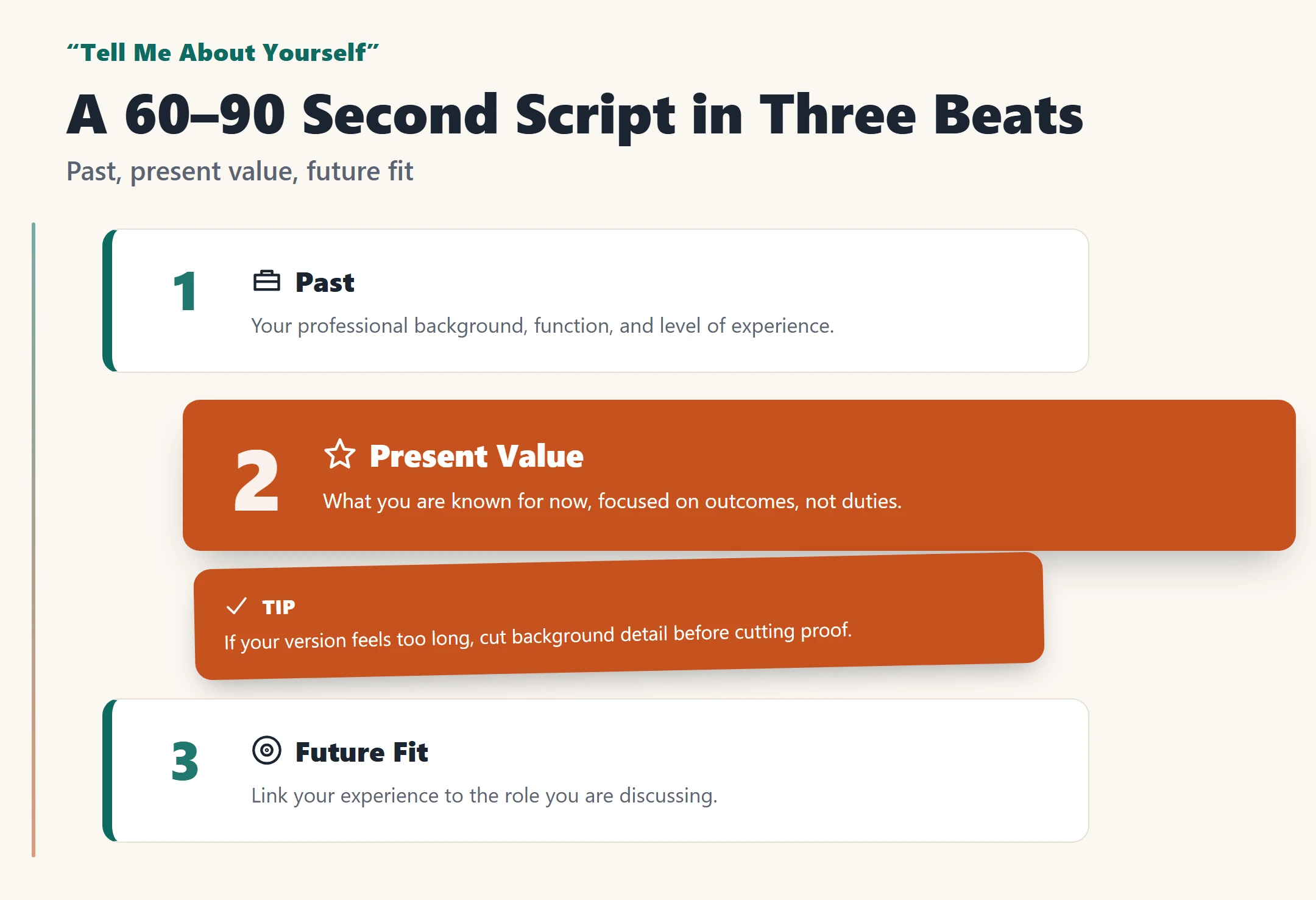
Your “Tell Me About Yourself” Script: Past, Present Value, Future Fit
This answer should usually be 60 to 90 seconds. A simple structure works best:
- Past
- Present value
- Future fit
Start with your professional background, not your life story. Mention your function, level of experience, and the type of environments you have worked in.
Then explain what you are known for now. This is the bridge between your past and the employer’s current need. Focus on outcomes, not a list of duties.
Close by linking your experience to the role you are discussing. Show direction and intention.
Example: 60–90 Second Script
“I’m an operations professional with nine years of experience across service delivery and process improvement roles. Over time, I’ve taken on projects focused on reducing response times, improving reporting accuracy, and aligning cross-functional teams around measurable service goals. In my current role, I’m known for bringing structure to unclear problems and turning them into repeatable processes with visible business impact. What interests me about this opportunity is that it combines operational complexity with stakeholder coordination, which is where I’ve delivered some of my strongest results.”
If your version feels too long, cut background detail before cutting proof. A shorter answer with clear value is stronger than a detailed biography.
Build an Achievement Story Bank: Capture 12–20 Stories and Tag Them Well
Do not prepare for interviews question by question. Prepare by building a story bank.
A strong story bank usually has 12 to 20 examples from your recent career. These should cover different types of proof:
- Revenue or growth
- Cost reduction
- Quality improvement
- Process efficiency
- Stakeholder management
- Problem-solving
- Leadership
- Conflict handling
- Recovery after failure
Tag each story by competency and by metric. For example:
- Ownership
- Teamwork
- Decision-making
- Client management
- Risk reduction
- Time savings
- Accuracy
- Customer satisfaction
If your results are real but hard to express in numbers, use safe and honest ways to quantify impact . The point is not to force numbers into every answer. The point is to make your impact concrete.
A Simple Story Bank Template
For each story, capture:
- Theme
- Business context
- Problem
- Your actions
- Result
- Metric
- Lesson learned
This gives you reusable material for multiple questions. Over time, maintaining an achievement portfolio helps keep your CV, LinkedIn, and interview answers aligned .
Pick Your Best Six Stories for the Role
Once your full bank exists, choose the six strongest stories for the specific interview. Look at the job description and ask:
- Which competencies appear most often?
- Which business problems seem most urgent?
- Which of my stories show the closest match?
- Which stories have the clearest proof?
This helps you avoid bringing your “best” stories when they are not the most relevant stories.
Proof Story Structure: Use a Compact STAR Answer
Most professionals know STAR, but many answers become too long because they over-explain the setup. Keep it tight.
A compact proof story includes:
- Situation: What was happening?
- Task: What needed to change?
- Action: What did you specifically do?
- Result: What happened?
- Learning: What did you improve or apply later?
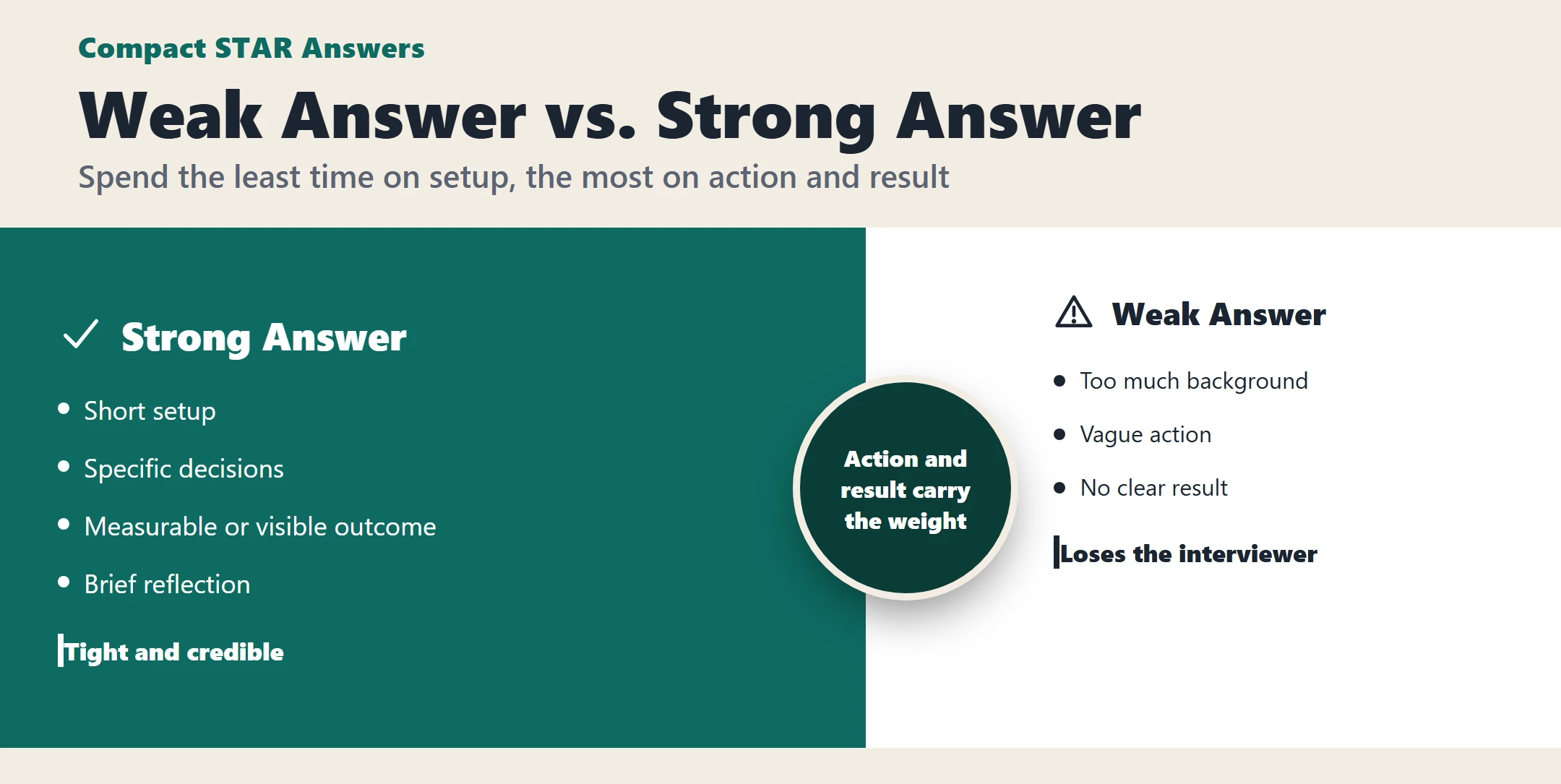
Spend the least time on the situation and the most time on your action and result.
A weak answer usually has:
- Too much background
- Vague action
- No clear result
A strong answer usually has:
- Short setup
- Specific decisions
- Measurable or visible outcome
- Brief reflection
If you want to study stronger STAR method examples, it helps to compare generic stories with high-proof versions .
Example: Compact Achievement Answer
“Customer complaints had increased because response times were inconsistent across handoffs. I was asked to review the workflow and identify the main delay points. I mapped the process, introduced a simple escalation rule, and set a weekly review for unresolved cases. Within the next cycle, response consistency improved and the team had clearer visibility into recurring issues. The main lesson for me was that a small control point can fix a much larger coordination problem.”
What Recruiters Listen For: Ownership, Clarity, Impact, and Fit
When you talk about achievements in interviews, recruiters are usually filtering for four things:
- Ownership
- Clarity
- Impact
- Fit
Ownership
They want to know what you did. Team success matters, but your contribution must be visible.
Use phrases like:
- “I identified”
- “I proposed”
- “I led”
- “I coordinated”
- “I redesigned”
- “I escalated and resolved”
Clarity
Your answer should be easy to follow. If the interviewer has to work hard to understand your role, your proof loses power.
Impact
Results do not always have to be financial. They can include:
- Reduced delays
- Better quality
- Fewer errors
- Faster onboarding
- Smoother stakeholder alignment
- Lower risk
- Better reporting
Fit
Even a strong achievement can fail if it is irrelevant. Choose examples that match the company’s likely business problems.
A useful test is this: after your story, can the interviewer imagine you solving a similar problem in their environment?
If you want support turning your experience into sharper interview proof and a stronger application-ready CV/Resume, we can help you build and refine it professionally .
Answering “Why This Role?” or “Why This Company?”
This question is not really about admiration. It is about judgment.
A strong answer links three things:
- What the company appears to need
- What you have solved before
- Why this match makes sense now
For example:
“What stands out to me is that this role seems to require someone who can improve execution while working across multiple stakeholders. That is a pattern I’ve handled repeatedly in my recent roles, especially where teams had to align around service targets and process discipline. I’m interested because the scope looks practical and high-impact, and I believe I can contribute quickly.”
Show informed interest, but avoid pretending deep inside knowledge if you do not have it. Basic research is enough:
- Business model
- Main function of the role
- Likely priorities
- Signs of growth or change
The Strengths Question: Choose Two Strengths and Prove Them
When asked about strengths, choose two strengths only. More than that usually becomes generic.
The best formula is:
- Name the strength
- Define it briefly
- Prove it with a mini-story
For example:
“One strength is structured problem-solving. In my current role, I often work on issues that involve multiple teams and unclear root causes. In one case, I mapped the full handoff process, identified the main delay points, and introduced a weekly review mechanism that improved turnaround consistency. That strength is useful because it helps me move from confusion to action quickly.”
Your second strength should complement the first. Good combinations include:
- Analytical + collaborative
- Detail-oriented + commercially aware
- Calm under pressure + decisive
- Process-driven + adaptable
Avoid empty labels like “hardworking” unless they are supported by strong proof.
The Weakness Question: Controlled Honesty With Improvement Evidence
A good weakness answer has three parts:
- A real weakness
- A mitigation system
- Evidence of improvement
Choose something true but manageable. Do not choose a weakness that destroys confidence in your fit for the role.
Example: Weakness Without Self-Sabotage
“Earlier in my career, I sometimes spent too long refining work before sharing an initial version. I realized that in fast-moving environments, early alignment matters more than over-polishing. To improve that, I started using draft checkpoints with stakeholders earlier in the process. That has helped me move faster, reduce rework, and get better input sooner.”
This works because it shows self-awareness and behavior change.
Conflict and Failure Questions: Own It and Show Correction
These questions test emotional control and accountability.
For conflict, do not make the other person the problem. Explain:
- What the disagreement was about
- How you reduced tension
- How you aligned people around facts or priorities
- What the outcome was
For failure, do not use a fake failure that is really a success. Pick a real miss, but one you handled responsibly.
A strong failure answer includes:
- What went wrong
- Your part in it
- What you changed
- What improved later
This signals maturity. Senior professionals are not expected to be flawless. They are expected to learn fast and correct well.
If you need a practical way to reuse one strong achievement across several question types, it helps to think in modular proof rather than separate scripts.
Show Leadership Even Without a Formal Title
Many roles require leadership before management title.
Leadership without title usually appears through:
- Taking initiative
- Influencing stakeholders
- Improving systems
- Making decisions under ambiguity
- Driving follow-through
For example, you may not have had direct reports, but you may have led a process change, aligned different teams, or pushed a stalled issue to resolution. That is still leadership.
When describing these stories, avoid underselling yourself with phrases like “I just helped” or “I was only supporting.” If you created movement, say so clearly.
Explaining Technical Work to Non-Technical Interviewers
If your work is technical, your job in the interview is translation.
Do not assume the interviewer values the complexity of the method. Explain:
- The business problem
- The approach
- The outcome
- Why it mattered
Instead of saying:
- “I rebuilt the reporting model using a new logic layer”
Say:
- “I redesigned the reporting workflow so leadership could see delays earlier and act before targets were missed”
The second version is easier to understand because it connects technical effort to business value.
A good test is this: could a non-technical manager repeat your story accurately after hearing it once?
Behavioral Interview Checklist: Ownership, Teamwork, Problem-Solving, Ethics
Before the interview, make sure you have at least one solid story for each of these competencies:
- Ownership
- Teamwork
- Problem-solving
- Ethics or judgment
- Conflict management
- Leadership
- Adaptability
- Pressure handling
For each story, ask:
- Is my role clear?
- Is the challenge clear?
- Is my action specific?
- Is the result visible?
- Is the story under two minutes?
- Can I shorten it to 45 seconds if needed?
This checklist helps you avoid long, unclear answers that hide your strongest proof.
Case or Task Interviews: Clarify, Structure, and Explain Trade-Offs
In case or task interviews, interviewers are not only testing the final answer. They are assessing how you think.
Use this sequence:
- Clarify the goal
- Confirm assumptions
- Break the problem into parts
- Evaluate trade-offs
- Recommend a path
- Explain risks
Keep communicating as you go. Silence can make good thinking invisible.
Strong candidates also say when data is missing and explain what they would need next. That shows practical judgment rather than guesswork.
Final Interview: Executive-Level Framing
In final-stage interviews, especially with senior leaders, shift your framing upward.
Talk less about tasks and more about:
- Outcomes
- Priorities
- Risks
- Decisions
- Trade-offs
- Team alignment
For example, instead of saying:
- “I managed weekly reports and meetings”
Say:
- “I created a reporting rhythm that improved visibility, supported faster decisions, and reduced escalation late in the cycle”
This level of framing shows executive readiness. It tells leaders that you understand what work is for, not just what work is.
For a broader job-search system that helps you manage applications, versions, and follow-ups efficiently, see this guide on how to apply for jobs in Saudi Arabia .
If you want a professionally rewritten CV/Resume with stronger achievement positioning for experienced-level applications, order expert help here .