

For experienced Marketing and Growth professionals, a strong CV is not a list of channels, campaigns, or tools. It is a proof document that shows how your work moved the business.
In the Saudi job market, employers typically want evidence that you can improve acquisition efficiency, conversion, retention, and commercial performance without hiding behind vague activity language. Your CV should show outcomes first, then the signals that make those outcomes credible.
This guide explains how to present hiring signals, KPI choices, role-specific positioning, project proof, and safe quantification for a Marketing & Growth CV.
What hiring managers want: outcomes and six hiring signals
At a high level, hiring managers want to see that you can improve growth outcomes, not just run campaigns. In Marketing & Growth, the core outcomes usually include better customer acquisition, stronger conversion, healthier retention, improved unit economics, and clearer decision-making.
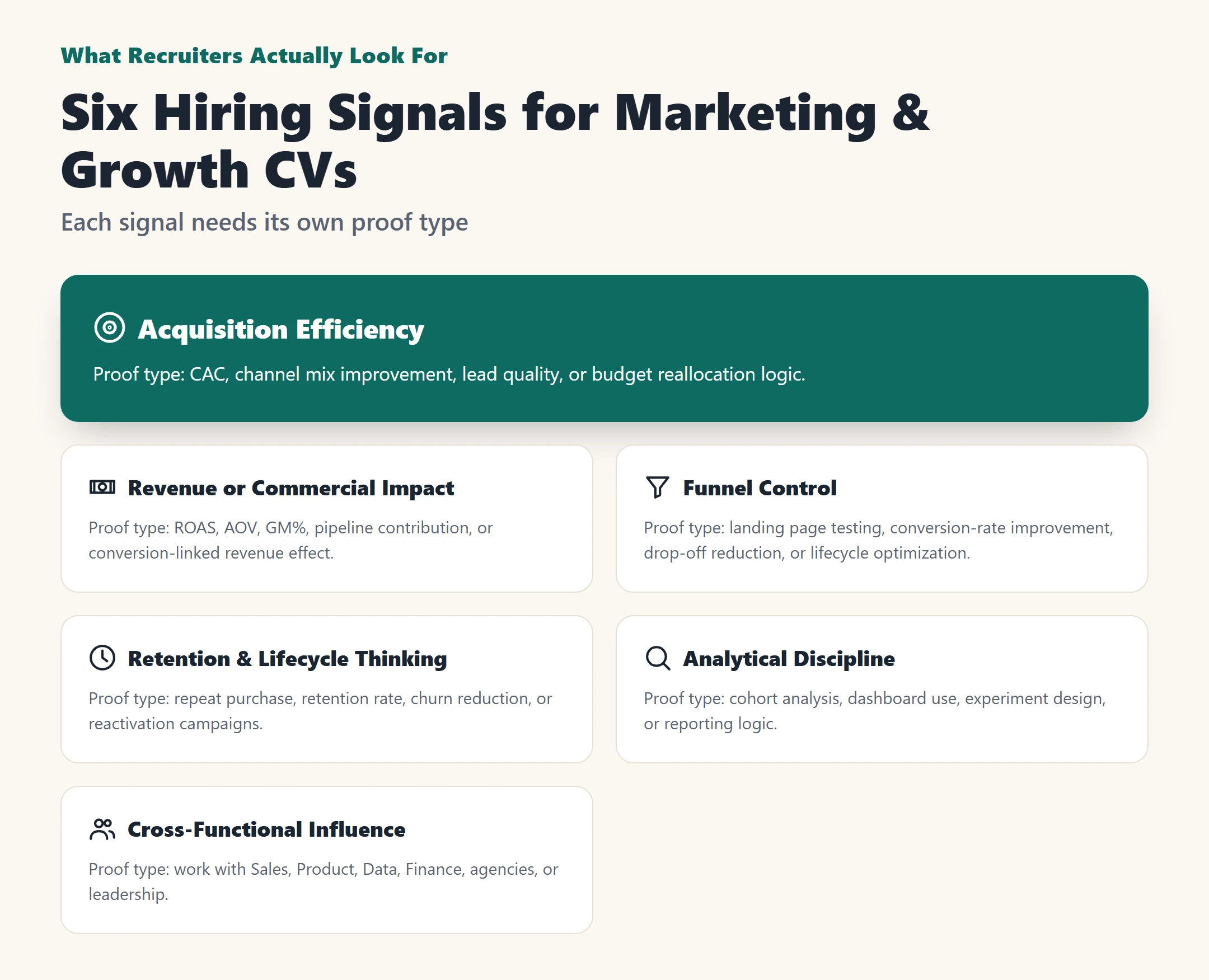
They look for these six signals, and each one should be tied to a proof type in your CV:
- Acquisition efficiency
Proof type: CAC, channel mix improvement, lead quality, or budget reallocation logic.
Example proof: Improved acquisition efficiency by shifting spend toward stronger-performing campaigns.
- Revenue or commercial impact
Proof type: ROAS, AOV, GM%, pipeline contribution, or conversion-linked revenue effect.
Example proof: Increased revenue contribution by improving campaign-to-conversion performance.
- Funnel control
Proof type: landing page testing, conversion-rate improvement, drop-off reduction, or lifecycle optimization.
Example proof: Improved conversion across key funnel stages through testing and journey redesign.
- Retention and lifecycle thinking
Proof type: repeat purchase, retention rate, churn reduction, or reactivation campaigns.
Example proof: Strengthened retention through segmented lifecycle campaigns and audience triggers.
- Analytical discipline
Proof type: cohort analysis, dashboard use, experiment design, or reporting logic.
Example proof: Used cohort reporting to identify weak retention periods and adjust lifecycle messaging.
- Cross-functional influence
Proof type: work with Sales, Product, Data, Finance, agencies, or leadership to move business outcomes.
Example proof: Partnered with Product and Data teams to improve tracking quality and campaign decisions.
If your experience still reads like task lists, start by learning how to turn routine work into stronger proof with .
Metrics that matter in Marketing & Growth
Metrics are not there to decorate your CV. They tell the recruiter what kind of commercial or growth problem you know how to solve.
A practical KPI shortlist includes:
- CAC
Implies how efficiently you acquire customers or leads.
- LTV
Implies whether growth is sustainable beyond first conversion.
- ROAS
Implies how well paid spend turns into revenue.
- Conversion rate
Implies funnel quality, audience fit, and execution strength.
- Retention
Implies customer value preservation and lifecycle effectiveness.
- AOV
Implies basket quality, upsell strength, or offer design impact.
- GM%
Implies commercial quality, not just top-line activity.
Use the KPI that matches your role. A paid growth specialist may lead with CAC, ROAS, and conversion rate. A lifecycle marketer may lead with retention, repeat purchase, and LTV signals. A broader growth manager may combine acquisition, monetization, and retention metrics.
For a safer way to use numbers and place them correctly, review .
Role variants inside Marketing & Growth and how the CV should shift
Marketing & Growth is a broad area. Your CV should reflect the actual sub-role, not a generic marketing identity.
Performance or paid growth roles
Lead with:
- CAC control
- ROAS
- campaign structure
- budget decisions
- landing page and funnel impact
Your bullets should show efficient demand generation and testing discipline.
Lifecycle or CRM roles
Lead with:
- retention
- reactivation
- segmentation
- customer journey design
- repeat purchase or engagement quality
Your bullets should show customer value growth after acquisition.
Product-led or conversion-focused growth roles
Lead with:
- funnel optimization
- activation
- onboarding improvement
- experiment design
- cross-functional problem solving
Your bullets should show how you improved movement through the user journey.
Three example shifts
- A Paid Media Manager should foreground spend efficiency, ROAS, and conversion impact.
- A CRM or Lifecycle Manager should foreground retention, segmentation, and repeat conversion.
- A Growth Manager should foreground cross-functional experimentation, funnel movement, and business outcome alignment.
If you apply to more than one role type, tailor each version to the job instead of using one fixed CV. A quick relevance method can help you .
A weak CV often fails because the role story is too broad. If you want help rewriting it into a sharper, application-ready Marketing & Growth CV, we can help you build a stronger version with clearer metrics, positioning, and proof .
Summary angle for Marketing & Growth roles
Your summary should show role identity, scope, and outcome direction in a few lines. It should not read like a biography.
Use this template:
[Role identity] with experience in [functional area], managing [channels/products/regions/audience scope] to improve [core outcomes]. Known for [2 strengths], with cross-functional experience across [stakeholders] to support [business result].
Example summary
Marketing & Growth professional with experience across acquisition, conversion, and lifecycle performance, supporting measurable improvements in campaign efficiency and customer journey outcomes. Comfortable working across paid channels, analytics, experimentation, and stakeholder coordination to improve growth quality, retention, and commercial visibility. Known for combining structured analysis with practical execution across cross-functional teams.
If your summary feels generic, refine it using a stronger blueprint for .
Achievement bullet patterns for Marketing & Growth
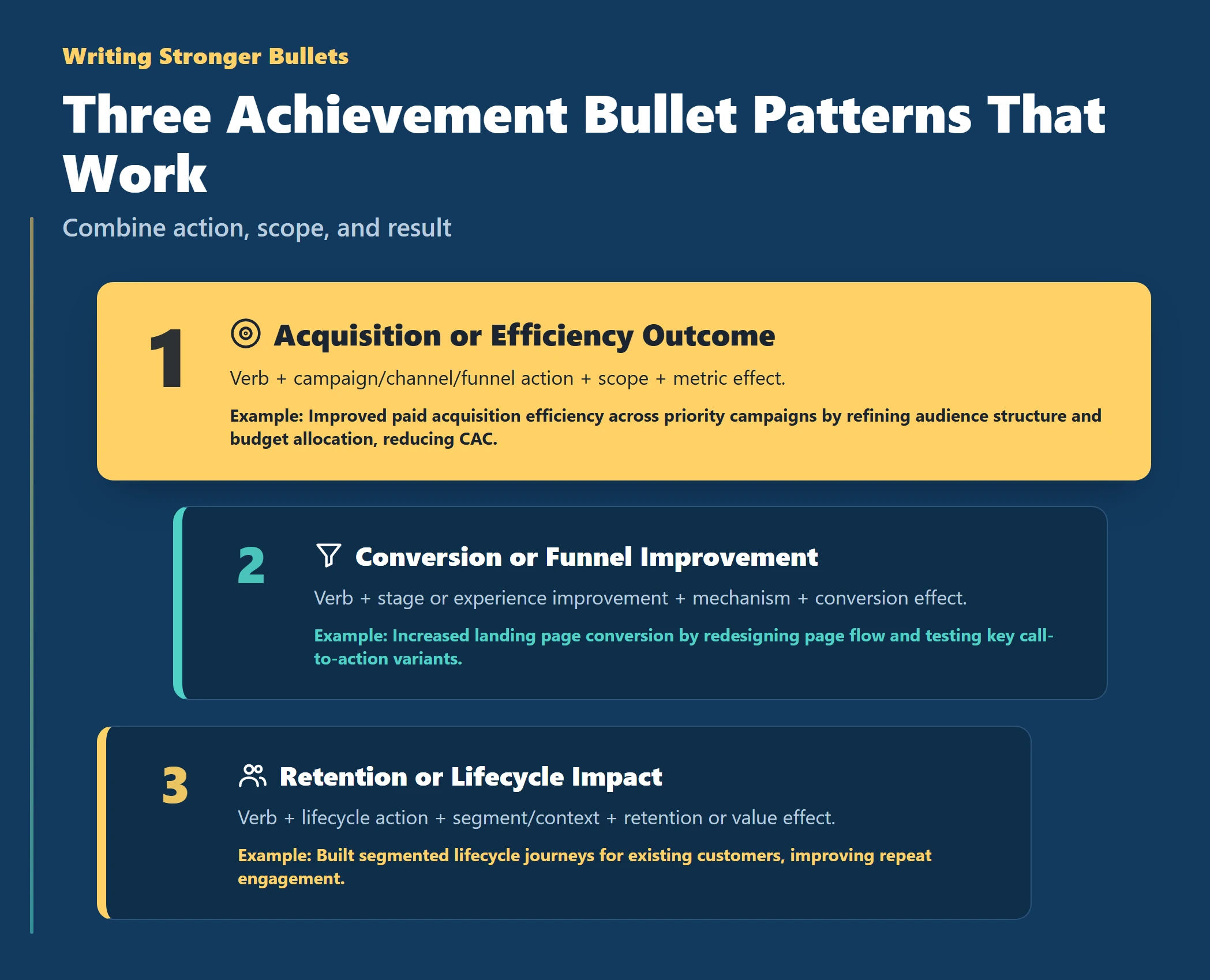
Strong bullets usually combine action, scope, and result.
Template 1: Acquisition or efficiency outcome
Verb + campaign/channel/funnel action + scope + metric effect
Example:
- Improved paid acquisition efficiency across priority campaigns by refining audience structure and budget allocation, reducing CAC while maintaining lead quality.
Template 2: Conversion or funnel improvement
Verb + stage or experience improvement + mechanism + conversion effect
Example:
- Increased landing page conversion by redesigning page flow, tightening message alignment, and testing key call-to-action variants.
Template 3: Retention or lifecycle impact
Verb + lifecycle action + segment/context + retention or value effect
Example:
- Built segmented lifecycle journeys for existing customers, improving repeat engagement and supporting stronger retention performance.
Project portfolio blocks recruiters trust
A good Marketing & Growth CV often includes short project proof, not just role descriptions. High-signal project types include:
- funnel optimization
- pricing tests
- lifecycle campaigns
- landing page experiments
- cohort analysis
Present each in two lines: one line for the project, one line for the method and outcome signal.
- Funnel optimization: Redesigned key funnel steps after identifying drop-off points; clarified traffic source, friction point, and the performance change observed.
- Pricing tests: Ran controlled pricing or offer tests on selected segments; state the business question, test condition, and what it informed.
- Lifecycle campaigns: Built onboarding, retention, or reactivation flows; show the audience, trigger logic, and retention or engagement impact.
- Landing page experiments: Tested page structure, copy, or CTA placement; state the hypothesis and conversion effect.
- Cohort analysis: Analyzed retention or behavior by acquisition period or segment; show the insight and resulting decision.
Tools and platforms: how to mention them without tool dumping
Recruiters do not trust long lists of tools with no context. Mention tools only when they explain your workflow or impact.
Relevant tools and platforms may include:
- GA4
- Google Ads
- Meta Ads
- CRM
- attribution dashboards
- A/B testing tools
Bad vs good tool lines
Bad:
GA4, Google Ads, Meta Ads, CRM, dashboards, A/B testing tools
Good:
Used GA4 and attribution dashboards to identify funnel leakage and redirect budget toward stronger-performing traffic sources.
Bad:
Experienced with CRM and testing platforms
Good:
Worked with CRM segmentation and A/B testing tools to improve lifecycle campaign timing and message relevance.
Formatting still matters when human review and systems both read your CV, so it helps to understand .
Stakeholder impact story: show who you influenced
At experienced level, Marketing & Growth work is rarely isolated. Your CV should show who you influenced and why that mattered.
Typical stakeholders include:
- Sales
- Product
- Data
- Finance
- agencies
- leadership
Use templates like these:
- Partnered with [team] to resolve [tracking/funnel/pricing issue], improving [growth outcome].
- Worked with [stakeholder] to align [offer, reporting, campaign, launch], supporting stronger [conversion, retention, efficiency].
- Coordinated across [functions] to improve [measurement, campaign execution, budget decisions].
A strong stakeholder line tells the reader that you can move outcomes through influence, not just execution.
Scope and scale language for Marketing & Growth
If you want your CV to sound senior and credible, express scale clearly but safely.
Useful scope language includes:
- managed paid spend across multiple campaigns
- supported regional or multi-segment growth activity
- owned a high-volume acquisition funnel
- handled cross-channel lifecycle programs
- worked across multiple product lines or audience groups
- reported on performance at weekly or monthly cadence
Safe phrasing examples
- Managed growth activity across a multi-channel acquisition environment.
- Supported campaign planning and optimization across several audience segments.
- Worked on high-volume conversion journeys with regular testing and reporting cycles.
- Contributed to growth decisions across regional or cross-functional contexts.
Proof artifacts you can reference without attachments
You do not need to attach files to signal analytical credibility. You can reference proof artifacts subtly in your bullets.
Useful artifacts include:
- dashboards
- reports
- audits
- experiment logs
- cohort reviews
- landing page analysis
- budget performance summaries
Subtle reference examples
- Built weekly performance dashboards to monitor CAC, conversion, and retention trends.
- Used audit findings to restructure campaigns and clean up tracking inconsistencies.
- Created cohort review summaries that informed lifecycle messaging changes.
- Maintained experiment logs to compare test conditions and guide rollout decisions.
Common mistakes in Marketing & Growth CVs
Here are 10 common mistakes, why they hurt, and how to fix them quickly:
- Listing channels without outcomes
Why it hurts: tools and channels alone do not prove impact.
Fix: tie each channel to a business result.
- Using vanity metrics only
Why it hurts: impressions or clicks alone do not show value.
Fix: add conversion, CAC, retention, or revenue-linked metrics.
- No funnel language
Why it hurts: recruiters cannot see where you improved performance.
Fix: mention stage, drop-off, test, or conversion change.
- No retention signal
Why it hurts: growth is incomplete if it ignores post-acquisition value.
Fix: include lifecycle or repeat-engagement evidence where relevant.
- Tool dumping
Why it hurts: a long tool list sounds shallow.
Fix: mention tools in context.
- No stakeholder influence
Why it hurts: senior roles require coordination.
Fix: show work with Product, Sales, Data, or Finance.
- No scope or scale
Why it hurts: the reader cannot judge seniority.
Fix: define channel, audience, budget, volume, or regional scope.
- Overclaiming exact numbers
Why it hurts: weakens trust if challenged.
Fix: use safe and defensible quantification.
- Generic summary
Why it hurts: hides role fit.
Fix: define your function, scope, and outcomes clearly.
- Weak page-one ordering
Why it hurts: your best proof is buried.
Fix: lead with summary, key achievements, and relevant metrics.
Terminology map: words that signal competence
A strong Marketing & Growth CV uses terminology intentionally.
Process terms
Best placed in experience bullets:
- audience segmentation
- funnel optimization
- lifecycle design
- attribution review
- experimentation
- cohort analysis
Metric terms
Best placed in summary, achievements, or project proof:
- CAC
- LTV
- ROAS
- conversion rate
- retention
- AOV
- GM%
Tool terms
Best placed in a compact skills section or context-rich bullet:
- GA4
- Google Ads
- Meta Ads
- CRM
- attribution dashboards
- A/B testing tools
Quantifying results safely in Marketing & Growth
Use numbers when you can defend them. If precision is uncertain, keep the phrasing credible and specific enough to be useful.
Safe quantification patterns
- Reduced CAC by X% over time period
- Improved ROAS across channel or campaign type
- Increased conversion rate from A to B
- Improved retention across segment or lifecycle stage
- Raised AOV through offer, pricing, or journey adjustment
Five compliant examples
- Improved CAC efficiency across paid acquisition campaigns through audience refinement and budget reallocation.
- Increased landing page conversion rate by testing page structure and message hierarchy.
- Improved retention among selected customer segments through lifecycle journey redesign.
- Raised AOV by adjusting offer presentation and purchase flow logic.
- Strengthened ROAS visibility by improving attribution reporting and campaign review cadence.
Caution notes
- Do not invent exact values.
- Do not claim sole ownership if the result was shared.
- Keep the metric close to the action that produced it.
- Use “supported,” “contributed to,” or “helped improve” when needed.
- Prefer clarity over inflated precision.
Before-and-after rewrite clinic
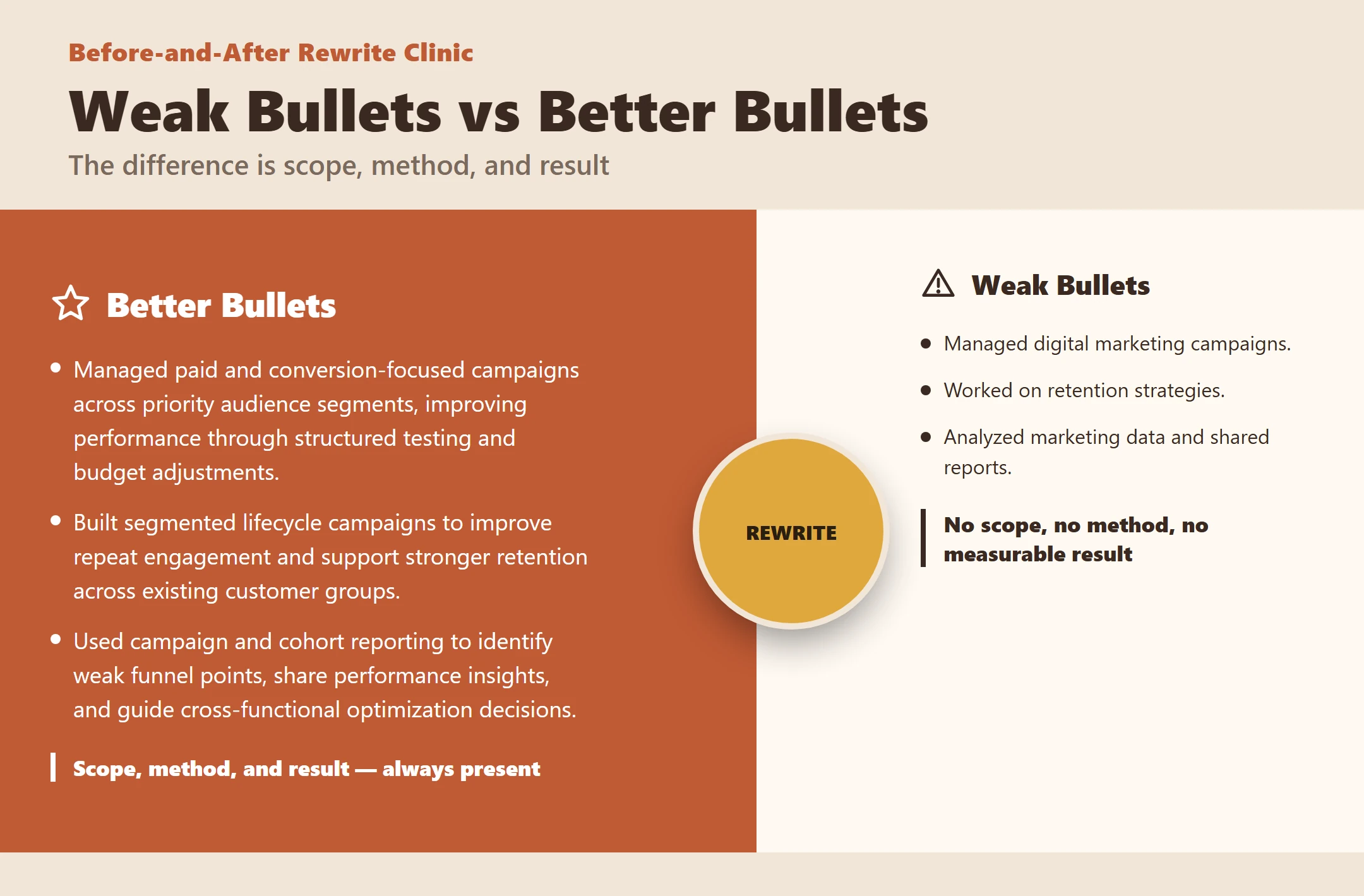
Weak bullets usually fail because they lack scope, result, and evidence.
Example 1
Weak:
Managed digital marketing campaigns.
Better:
Managed paid and conversion-focused campaigns across priority audience segments, improving performance through structured testing and budget adjustments.
What changed: scope, method, and result direction.
Example 2
Weak:
Worked on retention strategies.
Better:
Built segmented lifecycle campaigns to improve repeat engagement and support stronger retention across existing customer groups.
What changed: audience, action, and business outcome.
Example 3
Weak:
Analyzed marketing data and shared reports.
Better:
Used campaign and cohort reporting to identify weak funnel points, share performance insights, and guide cross-functional optimization decisions.
What changed: evidence source, problem identified, and practical impact.
Section ordering for a Marketing & Growth CV
For experienced candidates, page one should answer three questions quickly:
- What type of Marketing & Growth role do you do?
- What business outcomes did you influence?
- What proof makes those claims believable?
Recommended order
- Name and contact details
- Professional summary
- Key achievements
- Experience
- Skills and tools
- Education
- Certifications or additional details if relevant
What belongs on page one
- A summary that defines your function clearly
- Three to five strong achievement bullets
- Outcome-led proof around acquisition, conversion, retention, or efficiency
- Core skills relevant to your sub-role
Mapping responsibilities to proof blocks
Use this responsibility-to-proof map when rewriting your CV:
| Responsibility | Proof block |
|—|—|
| Paid acquisition management | CAC, ROAS, channel mix improvement |
| Funnel optimization | conversion rate, drop-off reduction, test result |
| Lifecycle marketing | retention, repeat engagement, reactivation signal |
| Pricing or offer testing | AOV, conversion effect, decision insight |
| Analytics and reporting | dashboard use, cohort analysis, reporting cadence |
| Cross-functional launches | Product, Sales, or Data coordination evidence |
| Budget management | reallocation logic, efficiency improvement |
| Experimentation | hypothesis, test action, measured effect |
Interview-ready story bank prompts
Your CV should support interview stories. Prepare short examples around these prompts:
- A campaign or funnel problem you diagnosed correctly
- A CAC or ROAS issue you improved
- A landing page or conversion test that changed results
- A lifecycle campaign that improved retention
- A pricing or offer test that informed a business decision
- A dashboard or analysis that changed budget allocation
- A cross-functional project you influenced successfully
- A growth initiative where results came from structured experimentation
Mini story outline
Use this simple structure:
- Situation
- Growth problem
- Action taken
- Metric or observable result
- What it shows about your judgment
Final checklist for a Marketing & Growth CV
Score one point for each “yes”:
- Does the summary clearly define your Marketing & Growth role?
- Are the main outcomes visible: acquisition, conversion, retention, or efficiency?
- Are the right KPIs used for your actual sub-role?
- Is your funnel or lifecycle thinking visible?
- Is stakeholder influence clear?
- Is scope or scale defined safely?
- Are tools mentioned with context?
- Are achievements written as proof, not tasks?
- Are metrics credible and defendable?
- Is page one led by outcomes?
Pass threshold
- 8–10: strong and ready to refine
- 6–7: usable, but needs targeted rewriting
- Below 6: likely underselling your experience
Next-fix priority logic
If your score is low, fix in this order:
- Summary
- Achievement bullets
- KPI and scope language
- Stakeholder impact
- Tools and formatting
Get a professionally rewritten CV with clearer positioning, stronger metrics, and application-ready structure for experienced Marketing & Growth professionals—order here .