
Applying randomly is one of the fastest ways to waste time in a competitive market. If you want to apply for jobs in Saudi Arabia more effectively, you need a system, not just effort.
For expats already in Saudi Arabia, the problem is often not motivation. It is lack of structure. You may be applying often, but to mixed roles, with inconsistent CV versions, weak follow-up, and no tracking. That makes it hard to know what is working and what needs to change.
This guide shows a simple pipeline you can use: define your target, build a shortlist, tailor your CV, keep your data clean, track every stage, and follow up professionally. The goal is not more activity alone. It is better applications that improve your chances of getting screens and interviews.
Define Your Target Role, Level, and Industry
Before you send any application, define three things:
- Your target role
- Your seniority level
- Your target industry or sector
This stops random applications. If you apply at the same time for operations, administration, procurement, customer support, and sales, your CV and messaging become too broad. Employers may struggle to see a clear fit.
A stronger approach is to choose:
- One primary target role
- One backup role that is closely related
For example:
- Primary: Procurement Specialist
- Backup: Supply Chain Coordinator
That is focused enough to keep your story consistent.
If you are unsure about direction, start by mapping what role you want now, what role could come next, and what experience is still missing. This kind of thinking supports stronger career planning and helps you apply strategically instead of emotionally.
Build a Saudi Target Company Shortlist
Once your role target is clear, build a shortlist of companies that look realistic for your profile.
Your list can include:
- Company name
- Sector
- Location
- Target role type
- Why you fit
- Hiring signal
- Referral or contact path
- Application status
Group companies by sector so your applications stay relevant. For example, if you target finance roles, keep banks, fintech companies, and corporate finance employers together. If you work in logistics, group transport, warehousing, retail supply chain, and industrial operations.
Prioritize realistic fits. In most cases, that means:
- Your background overlaps with the role
- Your experience level is close to the requirement
- Your location works for the opportunity
- Your work status can be explained clearly
- You can show proof, not just interest
A shortlist removes daily guesswork. Instead of asking, “Where should I apply today?” you can ask, “Which target company deserves my next best application?”
Think in Funnel Stages, Not Isolated Applications
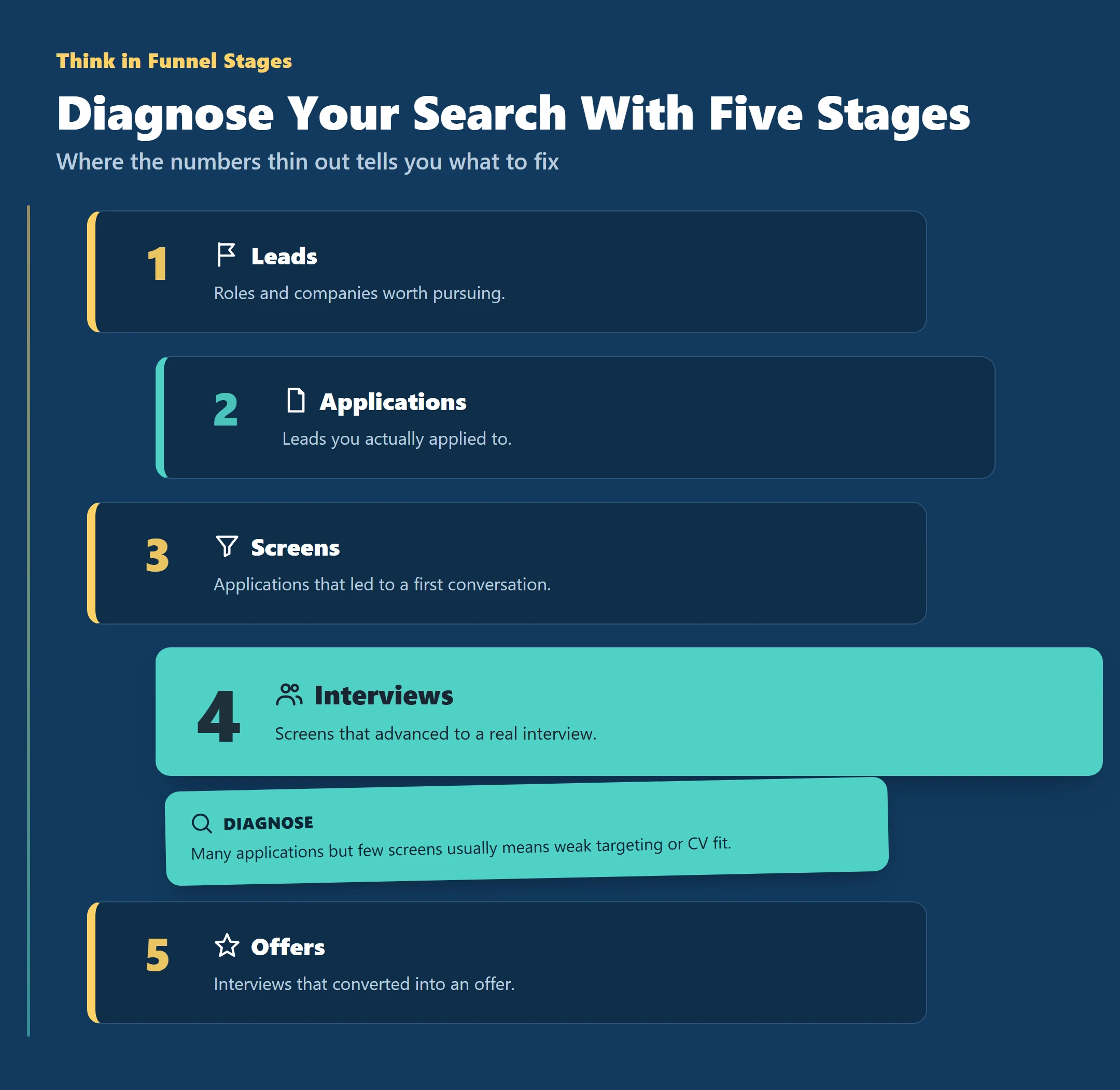
A healthy search works like a funnel:
- Leads
- Applications
- Screens
- Interviews
- Offers
If you only count how many jobs you applied for, you miss the real issue. Funnel thinking helps you diagnose the problem.
For example:
- Many leads but few applications may mean weak execution
- Many applications but few screens may mean weak targeting or CV fit
- Many screens but few interviews may mean weak positioning
- Many interviews but no offers may mean proof, message, or role-fit problems
This is much better than guessing. Your numbers do not need to be perfect. They just need to be tracked consistently.
Set a Weekly Application Cadence
A search usually works better when it becomes a weekly rhythm instead of a daily reaction.
A simple cadence might look like this:
- Monday: Review roles and update your shortlist
- Tuesday: Tailor CV versions for strong-fit roles
- Wednesday: Submit applications
- Thursday: Networking, referrals, and outreach
- Friday: Follow-ups, tracker updates, and interview prep
Set measurable targets that you can maintain. For example:
- 20 leads reviewed
- 6 to 10 strong-fit applications submitted
- 5 outreach messages sent
- 3 follow-ups completed
Protect deep-work blocks. Tailoring a good application needs focus. It is harder to do well when you are distracted or switching between too many tasks.
Use a Mix of Job Sources in Saudi Arabia
Do not depend on one source alone. Roles can appear through several channels, and some opportunities move faster through a referral, recruiter, or direct outreach than through a portal only.
Use a balanced mix of:
- LinkedIn jobs
- Job portals
- Company careers pages
- Recruiters
- Referrals
- Direct messages when relevant
Your visibility also matters. A complete profile, relevant activity, and a stronger network can support your search. This is helpful if you want to improve your professional presence and increase LinkedIn visibility in Saudi Arabia .

Use Referrals Without Making It Awkward
Referral requests work best when they are easy to answer with a simple yes or no.
Do not send a long personal story. Instead, include:
- Brief context
- The exact role
- One proof line
- A respectful ask
For example:
Hi, I hope you are well. I saw a role for Senior Accountant at your company and thought it may align with my background. I currently handle month-end reporting and reconciliation in my role and wanted to ask whether a referral would make sense. No pressure at all.
This works because it is specific and polite. You are not asking someone to find you any job. You are showing fit and keeping the request easy to process.
Know When to Contact Recruiters and When to Contact Hiring Managers
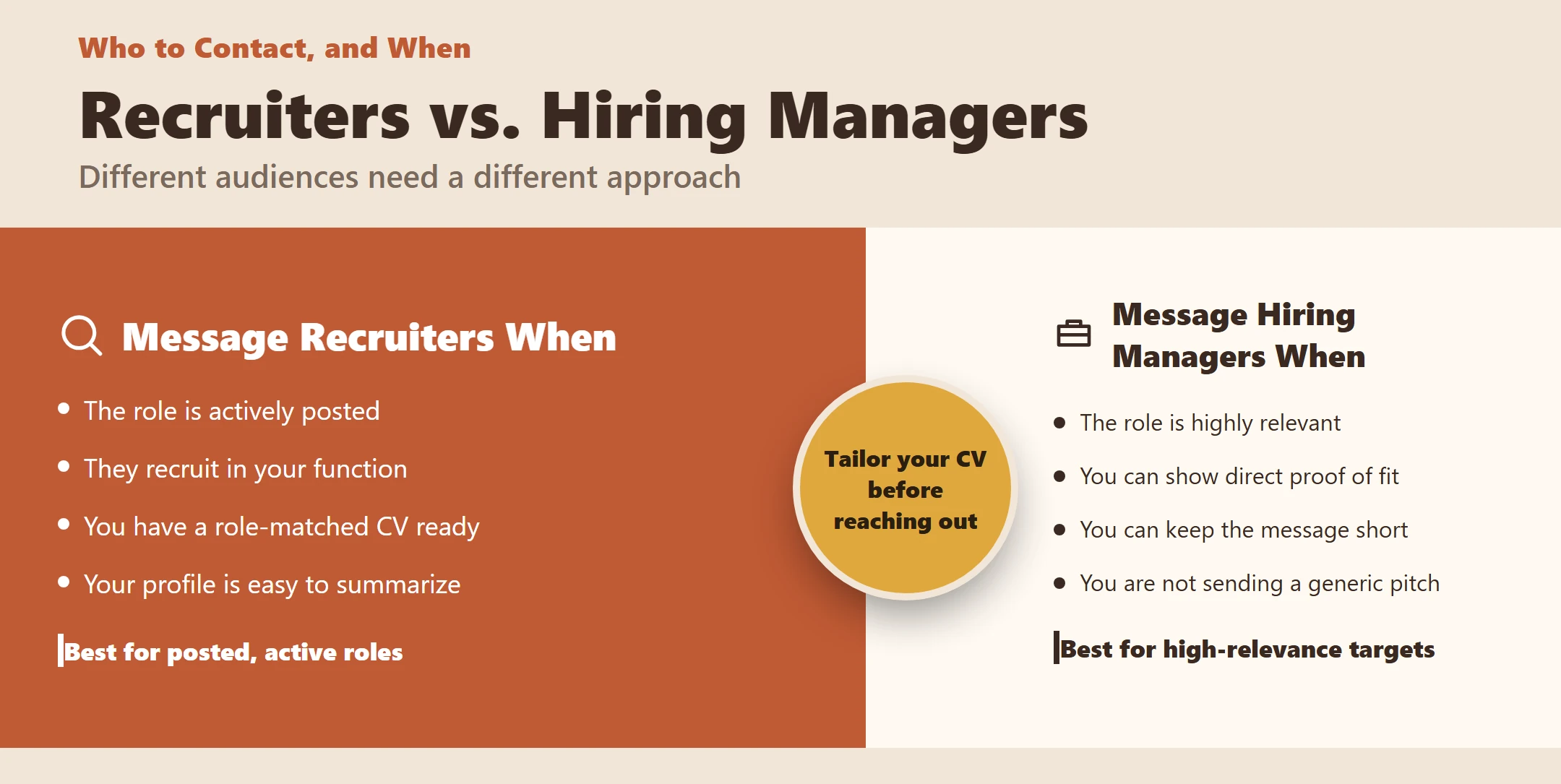
Recruiters and hiring managers are different audiences, so your approach should differ.
Message recruiters when:
- The role is actively posted
- They recruit in your function
- You have a role-matched CV version ready
- Your profile is easy to summarize
Message hiring managers when:
- The role is highly relevant
- You can show direct proof of fit
- You can keep the message short
- You are not sending a generic pitch
In both cases, timing matters. Reach out after you have tailored your CV and understood the role, not before.
Keep One Master CV and Two or Three Targeted Versions
Do not create a new CV from zero for every job. That usually creates confusion and version problems.
A better system is:
- One master CV with your full history and achievement bank
- Two or three targeted versions by role family
- Small edits for each specific application when needed
This gives you control without over-fragmenting your documents. Your titles, proof style, and wording should also feel relevant to local expectations. It helps to understand how to optimize a CV for Saudi employers while keeping it clear and credible.
If your current CV is too generic or weak for the roles you want, we can help you rewrite and optimize it into a stronger application-ready version here:
Use a Job Description Mapping Sheet Before You Apply
Before applying, map the job requirements against your proof.
A simple sheet can include:
- Requirement from the job description
- Your matching experience
- Evidence or result
- Gap, if any
- Substitute strength
Example:
- Requirement: Vendor management
- Your proof: Managed supplier coordination across a monthly purchase cycle
- Result: Improved delivery consistency
- Gap: No direct strategic sourcing ownership
- Substitute: Strong stakeholder coordination and reporting
This process helps you avoid weak applications based only on hope. It also tells you what to highlight in your CV, your message, and later in the interview.
Tailor Without Keyword Stuffing
Tailoring does not mean copying the job description into your CV. It means selecting the most relevant proof.
Good tailoring usually means:
- Replacing weaker bullets with stronger, role-relevant bullets
- Using job language naturally
- Keeping the CV easy to read
- Showing outcomes, not duties only
Poor tailoring usually means:
- Repeating the same keywords too often
- Adding skills you cannot defend
- Making the document sound robotic
- Removing useful context
A human should still be able to read your CV quickly and understand why you fit.
Keep Application Forms Clean and Consistent
Application forms often create trust problems when the information does not match your CV.
Check that the following are consistent across your CV, portal profile, LinkedIn, and any attached documents:
- Job titles
- Employment dates
- Company names
- Locations
- Phone number
- Email address
Small contradictions can create avoidable doubt, especially later during background checks or references.
Include Portfolio Links Only When They Prove Your Work
Not every role needs a portfolio. Include links only when they clearly strengthen your case.
Useful examples include:
- Design samples
- Writing samples
- Public projects
- Git repositories
- Case studies
- Presentations
Keep links stable and professional. If a link is broken, private, or confusing, it can weaken your application rather than help it.
Keep Your Email and Phone Details Professional
Use a simple email address based on your name if possible. Avoid casual usernames.
Your phone number should be active and reachable. Also make sure:
- Your voicemail is clear if you use it
- You answer unknown calls professionally during your job search
- Your messaging apps look appropriate if employers may use them
These small details matter because missed calls and weak contact presentation can slow your pipeline.
Handle Gaps and Short Tenures Honestly
Employment gaps and short tenures do not automatically block opportunities. The real issue is often how they are explained.
Keep explanations short:
- State the reason clearly
- Mention any learning, freelance work, study, or project if relevant
- Bring the focus back to your fit for the role
For short tenures, frame them honestly around progression, mismatch, restructuring, or another real reason. Then reduce concern by showing outcomes and consistency where possible.
Avoid long emotional explanations. Employers usually want a clear answer, not a full life story.
Be Clear About Expat Status, Work Authorization, and Timing
If you are an expat in Saudi Arabia, remove confusion early.
Be ready to explain:
- Your current location
- Your current employment status
- Whether you can attend interviews locally
- Which documents you have ready
- Any timing constraints for joining or transfer
It also helps to keep a high-level understanding of mobility and timing issues. Do not rely on rumors. Confirm process details with the employer or official sources when needed, especially near offer stage or resignation stage.
Track the Full Interview Pipeline With Discipline
Use one tracker for the entire process. A useful tracker includes:
- Company
- Role
- Source
- CV version used
- Date applied
- Contact person
- Current stage
- Last action taken
- Next follow-up date
- Outcome
- Notes
You can also tag each role as:
- Strong fit
- Moderate fit
- Stretch
- Referral-led
- Recruiter-led
This helps you review your search weekly and see where progress is slowing.
Follow Up After Applying, But Do Not Spam
Follow-up can help when you are a close fit, but timing and tone matter.
A practical approach is:
- Wait a reasonable period after applying
- Send one short follow-up
- Mention the exact role
- Add one proof point
- Ask politely about fit or next steps
- Log the follow-up in your tracker
If there is still no response, one later close-out follow-up may be reasonable. Do not keep sending repeated messages with no new value.
A simple format is:
Hello, I recently applied for the Operations Analyst role and wanted to follow up briefly. My current work includes reporting and process coordination that align closely with the role. I would appreciate any update on fit or next steps when convenient.
Use a Short Hiring Manager Outreach Message
A strong cold message to a hiring manager is usually one short paragraph.
Include:
- Why you are reaching out
- Why the role looks relevant
- One proof point
- A respectful question
For example:
Hello, I came across the Operations Analyst role and it appears closely aligned with my recent work in reporting and process coordination. In my current role, I support performance tracking and improve reporting accuracy across weekly reviews. I have applied and wanted to ask whether my background appears relevant for your team.
That is enough. No long pitch and no unnecessary attachment overload.
Run Quality Control Before Every Application
Before you submit, check:
- Does the role match your target?
- Did you use the correct CV version?
- Are the strongest relevant bullets near the top?
- Are dates and titles consistent?
- Is the file name professional?
- Do your links work?
- Did you remove typos?
- Did you complete the form consistently?
This final review takes only a few minutes and can prevent avoidable rejection.
Avoid Duplicate Applications and Handle Assessments Efficiently
Do not apply to the same role repeatedly through multiple channels unless you have a clear reason and you can track it.
Instead:
- Log every submission
- Record where you applied
- Note which CV version was used
- Update the status before re-engaging
If an employer sends an assessment, respond with structure:
- Check the deadline
- Timebox preparation
- Practice the basics
- Complete it carefully
- Log the result in your tracker
For interviews, batch scheduling where possible, protect deep-work time, and confirm the time zone clearly.
Prepare References, Offer Review, and Background Check Details Early
Late-stage delays often come from documentation problems, not interview performance.
Prepare in advance:
- Reference names and contact details
- Correct employment dates and titles
- Supporting documents
- A notice-period plan
- Key questions for offer review
At offer stage, review terms carefully before taking action. Think through practical points such as contract terms, notice period, visa-related timing, probation, housing, and end-of-service details where relevant to your situation.
If compensation discussion becomes relevant, prepare your position calmly and professionally. It helps to understand how to negotiate salary in Saudi Arabia without damaging trust.
Watch for Red Flags and Ask Better Questions
Not every process is worth continuing. Pay attention to warning signs such as:
- Vague role scope
- No clear success metrics
- Confusing reporting lines
- Weak communication
- Pressure to decide too quickly
Ask useful questions about:
- Priorities in the first months
- How success is measured
- Team structure
- Manager expectations
- Decision process and timeline
When answering their questions, keep your examples short and proof-based. This makes it easier to talk about achievements in interviews in a way that sounds credible rather than exaggerated.
Build a Rejection Debrief Routine
Rejection is part of the process, but it should produce learning.
After a rejection, capture:
- Stage reached
- Likely reason
- Objection patterns
- Questions that were hard to answer
- Whether the role was truly a fit
- What should change next time
Over time, patterns become visible. Maybe your CV gets views but not calls. Maybe screens happen, but interviews do not move forward. That tells you what to fix instead of starting over blindly.
Final Takeaway: Treat Your Job Search Like a Managed Pipeline
If you want to apply for jobs in Saudi Arabia with better results, stop treating each application like a separate event. Treat the whole search as one managed pipeline.
Choose a clear role target. Build a shortlist. Use a small number of strong CV versions. Map requirements before applying. Track every stage. Follow up professionally. Review your results every week and adjust based on evidence.
Get a professionally rewritten and optimized CV for expats targeting roles in Saudi Arabia, and take the next step here: