

If you want to optimize CV for Saudi employers, do not start by changing everything. Start by improving fit perception.
In many Saudi hiring contexts, employers respond well to CVs that feel clear, credible, role-matched, and professionally localized. That does not mean forcing Arabic into every line or using heavy local jargon. It means showing the right signals in a format that is easy to trust.
This guide explains how to do that safely and professionally.
What Saudi Employers Prioritize and How to Turn It Into CV Proof
A strong Saudi-fit CV usually signals five things quickly:
- clear job function
- appropriate seniority level
- evidence of reliable execution
- professional communication
- relevant business context
These signals matter because recruiters often make fast judgment calls based on familiar patterns. If you want to understand that screening logic better, review what recruiters look for .
Turn signals into proof blocks
Avoid broad claims such as “hardworking professional” or “excellent team player.” Instead, convert each signal into proof.
For example:
- Function fit: “Procurement Specialist with experience in vendor coordination, purchase orders, and delivery tracking”
- Level fit: “Handled monthly reporting and cross-team follow-up” instead of “led enterprise transformation” for a mid-level role
- Reliability: “Maintained documentation accuracy and reporting timelines”
- Business relevance: “Supported operations in retail, logistics, or corporate services environments”
A simple rule helps: support each important claim with at least one of these:
- scope
- outcome
- responsibility
- stakeholder type
- process ownership
Localizing Job Titles With the Right English and Arabic Balance
Your title is one of the first things a recruiter sees. If it is vague, inflated, or unclear, fit drops immediately.
Use English as the main title when the role is commonly advertised in English, but add Arabic clarity if that makes the function easier to understand.
Three safe formatting options
Option 1: English title only
Best when the title is standard and widely understood.
Example: Senior Accountant
Option 2: English title with Arabic clarification
Best when the English title may be broad or interpreted differently.
Example: Operations Coordinator | منسق عمليات
Option 3: English title plus function descriptor
Best when your official title is unclear.
Example: Administrative Officer | HR & Government Relations Support
How to choose the best option
Use the version that answers this question fastest: “What job does this person actually do?”
Avoid:
- internal company-only titles
- creative titles
- inflated titles
- direct translation that sounds unnatural
If your title is clear but the introduction below it is weak, improve the professional summary for CV so your level and value are obvious within a few lines.
Credibility Cues Recruiters in Saudi Contexts Often Notice
Credibility is not built through dramatic language. It is built through reassuring detail.
Useful credibility cues include:
- team or department scope
- process discipline
- continuity or stability
- stakeholder coordination
- compliance awareness
- reporting responsibility
How to embed these cues naturally
Instead of this:
- Responsible for many important tasks across the company
Write this:
- Coordinated weekly reporting with finance, operations, and admin teams
- Maintained records and supported process compliance across routine workflows
- Assisted managers with documentation, scheduling, and follow-up
These lines sound more grounded because they show structure and responsibility.
Four cue types to include
Scope
Show the size or type of work you handled.
Example: “Supported branch-level administration and reporting.”
Stability
Show consistency over time.
Example: “Managed recurring monthly documentation and approval workflows.”
Compliance
Show accuracy, discipline, and process respect.
Example: “Prepared records in line with internal process requirements.”
Stakeholder work
Show that you work well in structured environments.
Example: “Coordinated with suppliers, supervisors, and internal support teams.”

Proof Types That Increase Trust in the Saudi Context
In Saudi contexts, trust often rises when your CV includes proof that feels practical and easy to verify.
Strong proof types
- named responsibilities
- repeated process ownership
- documented outputs
- training or certifications
- system usage
- stakeholder-facing work
- measurable improvements when available
Examples of trust-building proof
Instead of saying “improved efficiency,” say:
- Reduced follow-up delays by organizing status tracking in a shared report
- Improved document readiness by standardizing file naming and review steps
- Supported onboarding records and compliance documentation for new hires
These examples work because they sound real, even without dramatic numbers.
What counts as a proof artifact
You can reference:
- reports
- dashboards
- schedules
- audit-ready files
- logs
- training records
- meeting coordination
- approval workflows
The goal is not to overload the CV. The goal is to make your work easier to picture.
If your document still feels generic, we can help you rewrite a weak CV into a clearer, Saudi-ready version that is easier to trust and easier to shortlist .
Choosing Between Arabic, English, or Bilingual CV Language
Language choice should match the role, company style, and your own writing fluency.
A simple decision matrix
Use mostly English when:
- the job ad is in English
- the function is commonly handled in English
- your experience is already documented professionally in English
Use bilingual elements when:
- the role involves local coordination
- your title benefits from Arabic clarity
- you expect both Arabic and English readers
Use mostly Arabic when:
- the role clearly requires Arabic-first communication
- the employer context strongly suggests Arabic preference
- you can write professionally and consistently in Arabic
Safe rules for bilingual use
- Keep the main structure in one language
- Use bilingual titles, not bilingual every bullet
- Do not mix languages randomly in the same sentence
- Keep date formatting and section labels consistent
- Use Arabic only where it improves clarity
A bilingual CV helps only when it improves readability. If it creates clutter, it weakens the document.
Aligning Your CV to Saudi Corporate Role Structures
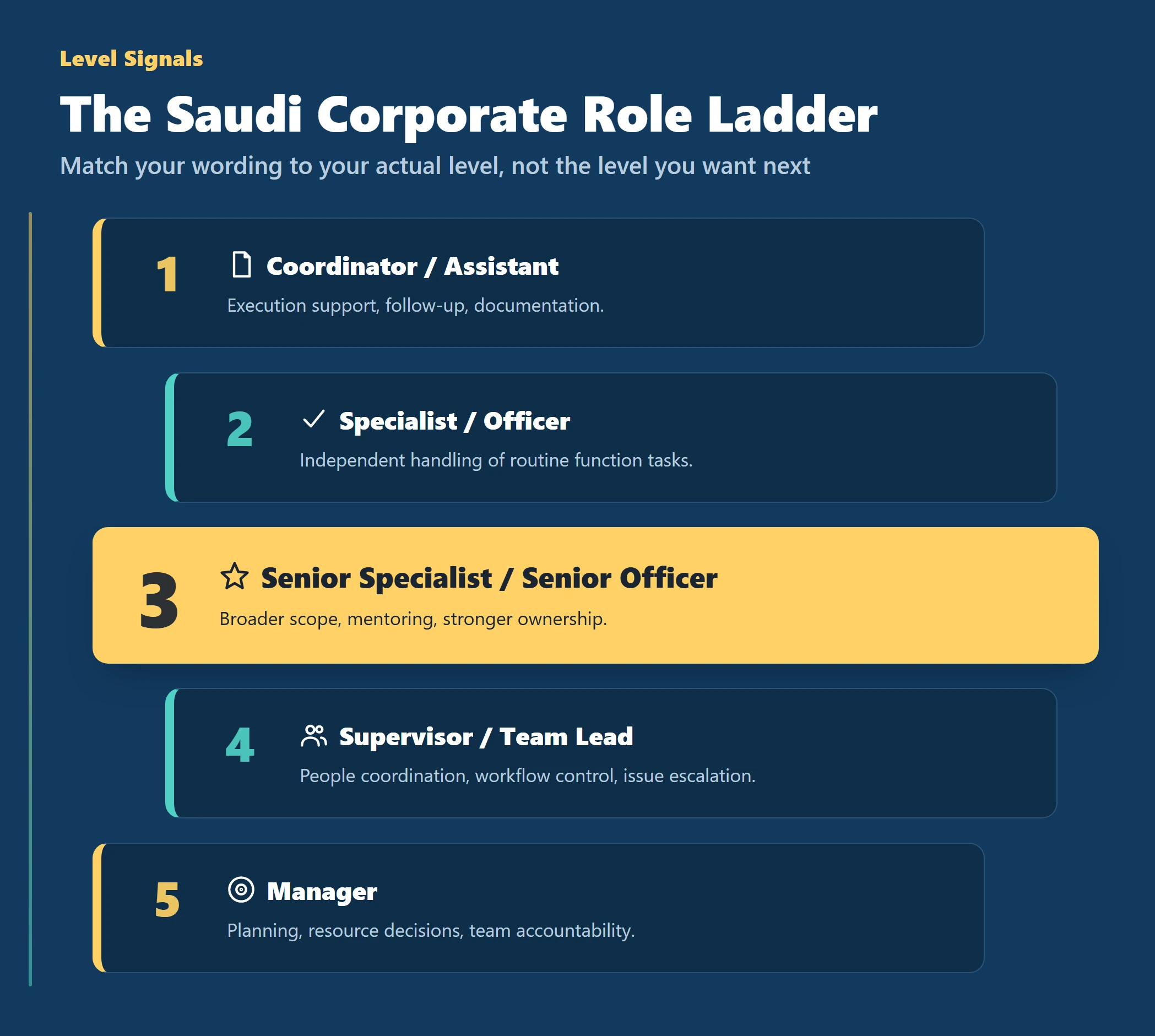
One common mistake is presenting yourself at the wrong level. A recruiter may reject a CV not because the candidate is weak, but because the level signals do not match the target role.
Common ladder cues
Most role structures expect signs of progression such as:
- Coordinator or Assistant: execution support, follow-up, documentation
- Specialist or Officer: independent handling of routine function tasks
- Senior Specialist or Senior Officer: broader scope, mentoring, stronger ownership
- Supervisor or Team Lead: people coordination, workflow control, issue escalation
- Manager: planning, resource decisions, team accountability
Match your wording to your actual level
If you are applying for a specialist-level role, phrases like “led enterprise strategy” may sound inflated.
Better wording includes:
- Managed daily function tasks and cross-team coordination
- Owned reporting, documentation, and process follow-up
- Supported manager decisions with accurate operational input
This becomes even more important when companies use ATS used in Saudi Arabia alongside human review. Your wording should be clear enough for both.
Handling Nationality, Relocation, and Availability Professionally
These details should be handled carefully and briefly.
Safe phrasing examples
- Based in Riyadh and available for in-person interviews
- Open to relocation within Saudi Arabia
- Available to join after notice period
- Eligible to work in the target market
- Nationality details available upon request, if needed
What to avoid
- emotional relocation statements
- long explanations about visa or personal circumstances
- defensive wording
- unclear availability
- headline-style declarations that distract from qualifications
Keep these details in the contact area or as a short note, not as the center of the CV.
Saudi-Friendly Achievement Phrasing That Sounds Professional
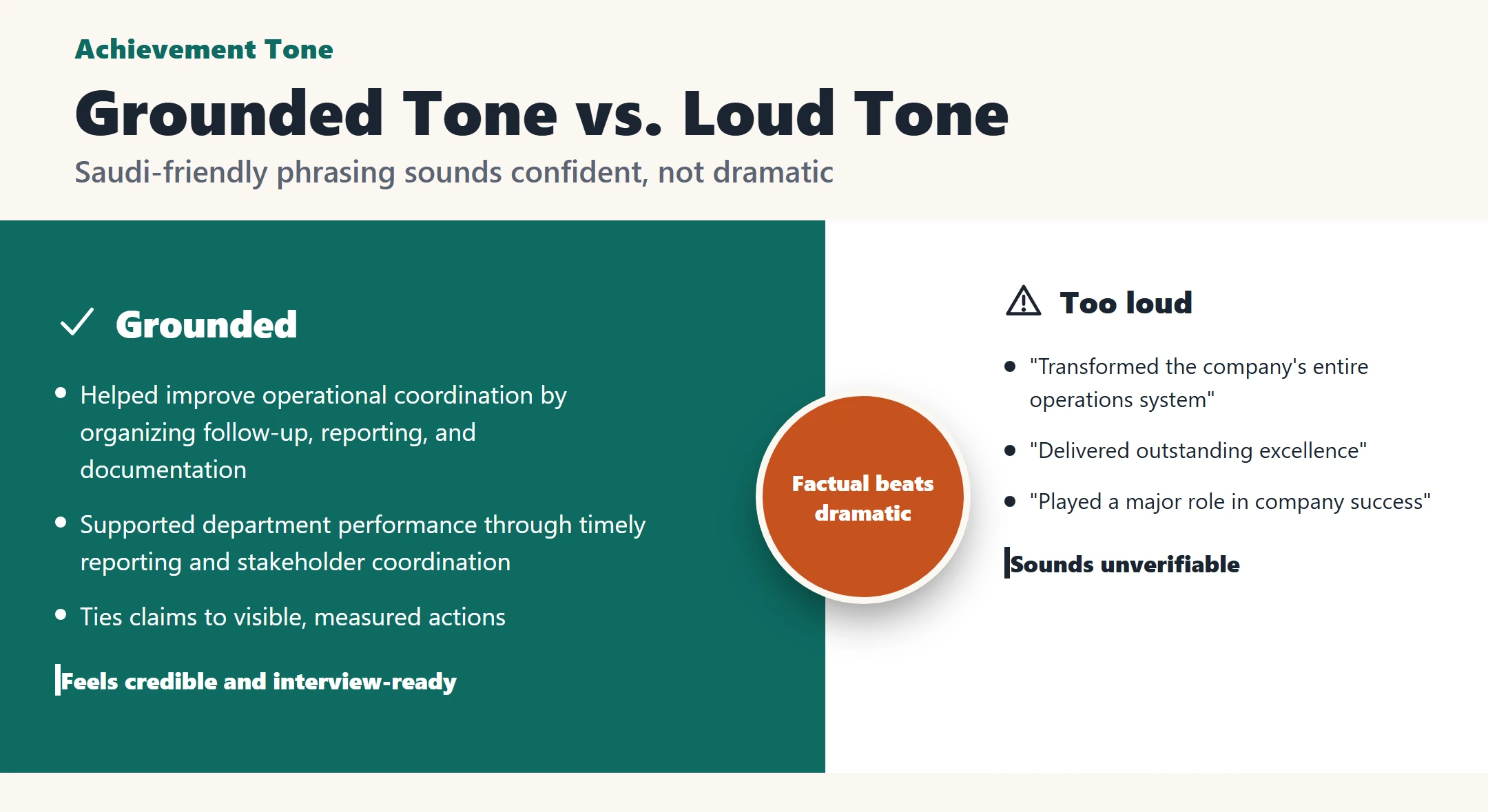
The right tone is confident, but not loud.
Tone rules
- prefer factual wording over dramatic wording
- show contribution without exaggeration
- use measured verbs
- avoid “best,” “world-class,” or “unmatched”
- tie claims to visible actions
Rewrite examples
Too loud:
Transformed the company’s entire operations system and delivered outstanding excellence.
Better:
Helped improve operational coordination by organizing follow-up, reporting, and documentation processes.
Too vague:
Played a major role in company success.
Better:
Supported department performance through timely reporting, stakeholder coordination, and process follow-up.
This tone feels more credible and more aligned with formal hiring expectations in Saudi settings.
Keywords for Saudi Employers: Think Human Review First
Keywords matter, but not only for software. Human reviewers also scan for familiar terms that quickly confirm role fit.
Useful keyword categories
- job title
- function terms
- tools or systems
- industry context
- reporting tasks
- stakeholder types
- process terms
- language capability
Placement rules
Put important keywords in:
- title
- summary
- recent experience bullets
- skills section
Do not:
- repeat the same term unnaturally
- stuff a keyword list into the footer
- use terms you cannot explain in an interview
Example keyword use
Instead of a generic bullet like “Handled daily tasks,” write:
- Supported procurement documentation, vendor follow-up, and purchase tracking
- Managed admin coordination, meeting scheduling, and reporting support
- Prepared customer service records and issue follow-up logs
Mentioning Industry Context Without Overclaiming
You do not need to sound like an industry authority if you are not one. You only need to show that your work happened in a recognizable business setting.
Safe template lines
- Experience supporting operations in a structured corporate environment within the retail sector
- Administrative background in service-oriented business settings
- Finance support experience in multi-department office operations
This gives context without pretending deep sector expertise.
A CV Structure That Fits Common Saudi Hiring Behaviors
A Saudi-friendly CV is usually easiest to review when it is direct, ordered, and practical.
Recommended structure
- Name and contact details
- Target job title
- Short professional summary
- Core skills
- Work experience
- Education
- Certifications or training
- Languages
- References if appropriate
Why this order works
This order helps a recruiter answer three questions quickly:
- What role does this person want?
- Do they fit the function?
- Is the profile stable and credible?
Sample outline
- Ahmed Al____
- Riyadh | Phone | Email | LinkedIn
- Operations Coordinator | منسق عمليات
- Summary: 4–6 lines focused on operations support, reporting, and coordination
- Skills: Reporting, documentation, stakeholder coordination, MS Office, scheduling
- Experience: reverse chronological, clear bullets
- Education
- Certifications
- Languages: Arabic, English
- References: Available upon request
If you are applying actively, keep separate versions and track them carefully as you apply for jobs in Saudi Arabia .
Common Localization Mistakes and How to Fix Them
Here are 10 frequent mistakes:
- Using a title that is too global or too vague
Fix: Replace it with a common market-facing title.
- Mixing Arabic and English randomly
Fix: Use one primary language and add selective bilingual clarity.
- Overstating seniority
Fix: Match wording to actual scope.
- Writing long personal statements
Fix: Use a short professional summary.
- Listing duties without proof
Fix: Add scope, stakeholders, or outcomes.
- Cluttered formatting
Fix: Use clean spacing and short bullets.
- Informal wording or slang
Fix: Keep language formal and plain.
- Missing availability information
Fix: Add a short, professional note if relevant.
- Including salary expectations in the CV
Fix: Remove them from the document.
- Adding references with too much personal detail
Fix: Use a simple reference line or provide details on request.
Salary Expectations: How to Avoid Implying Them
Salary positioning matters, but the CV is usually not the place for it.
Why salary talk belongs elsewhere
A CV should answer fit, not compensation. When salary appears too early, it distracts from your value and may create the wrong impression.
Do and do not
Do:
- focus on role fit
- show scope and credibility
- keep compensation discussion for later stages
Do not:
- write expected salary in the header
- hint at high compensation through status language
- use phrases like “seeking a role matching my salary expectations”
When the time comes, negotiate salary in Saudi Arabia in the proper setting rather than inside the CV.
References and Endorsements: When to Mention Them
References can help, but they should be handled carefully.
Safe formats
- References available upon request
- Professional references can be provided at the appropriate stage
- Endorsements available from previous supervisors if needed
When to include them
Include a reference note when:
- the employer may expect it
- you have solid professional referees
- the CV still remains clean and concise
Do not include:
- excessive personal details
- informal references
- praise statements with no context
Three Mini Case Examples of Saudi-Fit Optimization
Case 1: Operations candidate with an unclear title
Before:
Business Support Executive
After:
Operations Coordinator | منسق عمليات
Why it works:
The revised title is easier to map to real openings. The Arabic clarification adds local clarity without changing the whole CV.
Case 2: Finance support candidate with weak trust signals
Before:
Responsible for accounting tasks and many reports.
After:
Supported invoice tracking, monthly reporting, and documentation accuracy for finance operations.
Why it works:
This version adds scope, routine responsibility, and process discipline.
Case 3: Bilingual candidate with cluttered language use
Before:
Mixed Arabic and English inside every section and bullet.
After:
English main structure, bilingual title, Arabic only where role clarity improves.
Why it works:
The CV becomes easier to scan and looks more professionally controlled.
Self-Audit Checklist for Saudi Fit
Score each item from 0 to 2:
- My target title is clear and market-friendly
- My seniority level matches my wording
- My summary explains function and value quickly
- My bullets include proof, not only duties
- My CV shows structure, stability, or process discipline
- My language choice is consistent
- My formatting looks clean and formal
- My availability note is brief and professional
- I removed salary references
- I included industry context safely
Score guide
- 16–20: strong Saudi-fit foundation
- 11–15: usable, but needs improvement
- 0–10: revise before applying
Fix priorities
If your score is low, fix in this order:
- title
- summary
- recent experience bullets
- language consistency
- formatting and extras
Five Quick Wins You Can Do in 15 Minutes
1. Replace your title
Before: Project Hero
After: Project Coordinator
2. Add Arabic clarity to the title if useful
Before: Administrative Officer
After: Administrative Officer | مسؤول إداري
3. Rewrite one vague bullet with proof
Before: Assisted with operations
After: Assisted with reporting, document control, and daily operations follow-up
4. Remove salary language
Before: Seeking a role with suitable salary package
After: Remove it entirely
5. Add a clean availability line
Before: Available anytime, anywhere
After: Available to join after notice period
If your CV has experience but still does not feel aligned, the issue is often presentation rather than background.
Get a professionally rewritten, application-ready CV for Saudi job seekers who need stronger positioning, clearer proof, and better localization—start here