

Experienced professionals rarely struggle because they lack ambition. More often, they struggle because their plans stay too general: “move into leadership,” “get a better role,” or “switch functions.” Those are goals, but they are not yet a roadmap.
Practical career planning in Saudi Arabia starts with a simple shift: treat career growth as a system. A system has inputs, outputs, checkpoints, and decisions. It helps you move from hoping for progress to building evidence for it.
This article shows how to turn broad goals into a trackable plan using role ladders, timelines, skill priorities, proof artifacts, and review points. The aim is not to predict your whole future. It is to make your next 12 months clearer, more measurable, and easier to adjust.
Build a Career Growth System Around Inputs and Outputs
Career growth is easier to manage when you stop seeing it as a series of isolated events. A promotion, job move, or internal transfer is usually the output of a system that has been running for months.
The main inputs are:
- Skills you can actually use
- Proof of impact from real work
- Visibility with decision-makers
- Access to the right opportunities
The outputs are easier to recognize:
- Broader scope
- Stronger title or level
- More strategic projects
- Internal mobility
- External interviews and offers
Many professionals lose momentum because one input is missing. They invest in learning, but not in proof. Or they do strong work, but not in visibility. Or they become visible without a clear target role.
A better model is to ask four questions every quarter:
- What skills am I strengthening?
- What proof am I creating?
- Who can see this work?
- Which opportunities does this position me for next?
If one of these is weak, your growth system slows down. Certificates without project evidence often create low-conviction progress. Strong delivery without stakeholder visibility can delay recognition. Good relationships without clear capability can create interest, but not trust.
Set a 12-Month Career Objective With a Measurable Outcome
A useful 12-month objective is specific enough to guide decisions and flexible enough to survive changes in the market.
A strong objective usually includes:
- Target role
- Target level
- Preferred company type
- One measurable outcome
For example, instead of saying, “I want to grow in operations,” say: “Within 12 months, I want to move into a senior operations role in a growth-stage company, with documented ownership of one process improvement initiative and one cross-functional KPI.”
That objective is stronger because it defines both direction and evidence.
Use a simple objective formula
Use this format:
In 12 months, I want to be in [role] at [level] in [company type], with proof of [measurable outcome].
Examples:
- In 12 months, I want to move from senior analyst to team lead in a larger organization, with proof that I improved reporting quality and influenced decisions.
- In 12 months, I want to shift from finance operations into FP&A-focused work without taking a junior step backward.
- In 12 months, I want to become promotion-ready for a manager role with visible ownership of cross-functional work.
Your objective should create decision pressure. If a course, project, or networking effort does not support that target, it becomes easier to say no.
Map the Next 2–3 Roles With a Role Ladder
Once your 12-month objective is clear, map the next two or three roles beyond your current one. This creates a role ladder and helps you understand what must change over time.
A simple ladder might look like this:
- Current role: Senior Specialist
- Next role: Lead or Principal
- Following role: Manager
Or:
- Current role: Manager
- Next role: Senior Manager
- Following role: Director
The purpose is not to lock yourself into one path forever. It is to understand what each level expects in scope, decision-making, and proof.
What to map for each role
For every step on the ladder, define:
- Main responsibilities
- Typical scope of ownership
- Stakeholder level
- Required competencies
- Evidence needed to be credible
An individual contributor usually needs proof of execution quality and reliable delivery. A lead usually needs proof of influence, coordination, and judgment. A manager needs proof of team outcomes, prioritization, and operating through others.
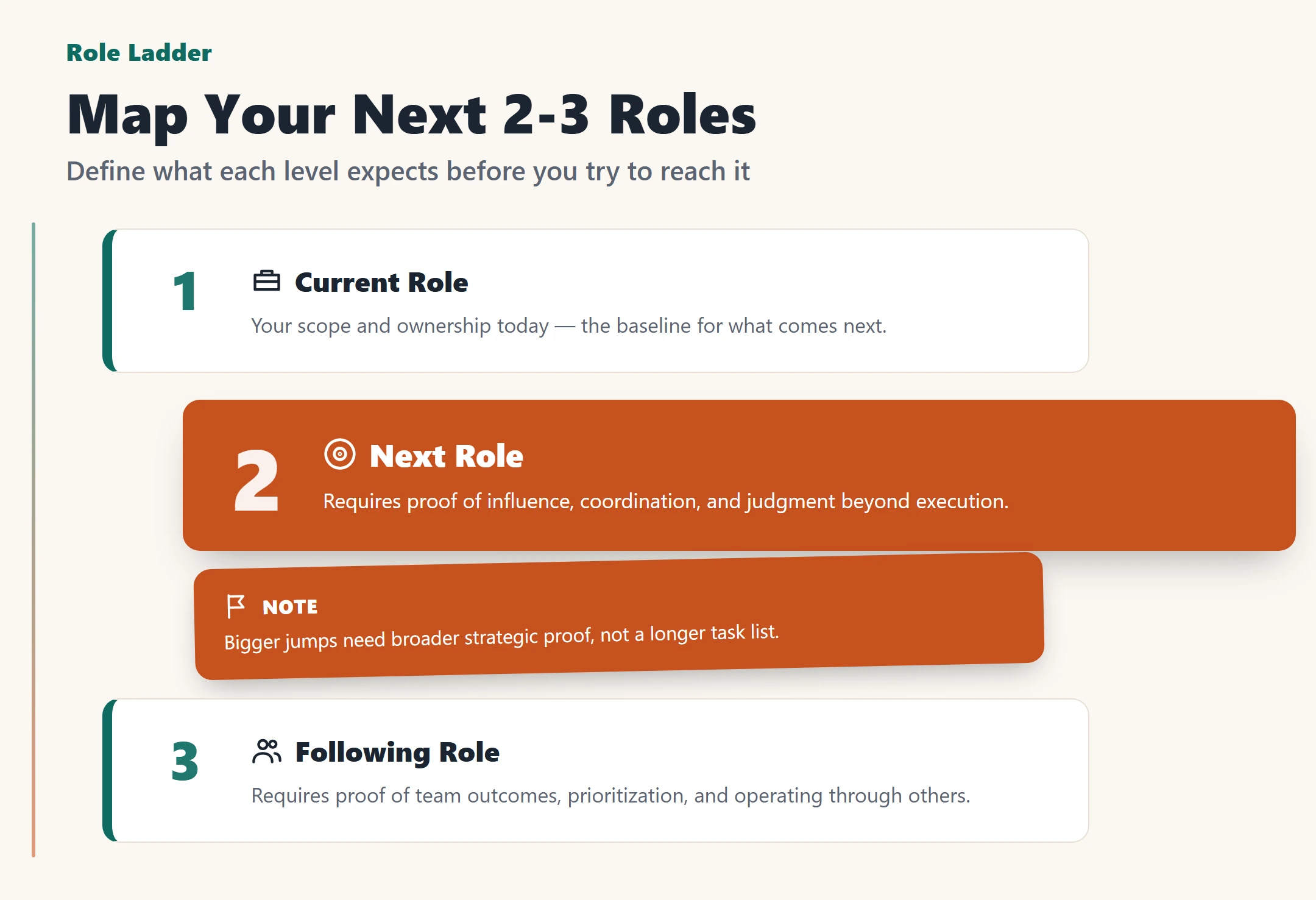
If you are targeting a larger jump, your documents and story must evolve as well. A move toward more senior leadership usually requires broader strategic proof and stronger framing, not just a longer list of tasks. That is why many professionals benefit from understanding how a manager-to-director CV must change in scope, proof, and narrative.
Choose a Core Theme for Your Career Narrative
Many experienced professionals have broad experience but weak positioning. They can do many things, but they are not known for a consistent pattern of value.
Your core theme is that pattern. It answers one question: What kind of problem do I reliably solve?
Common themes include:
- Growth
- Operations
- Finance
- Product
- Transformation
- Customer experience
- Commercial execution
A core theme does not limit you. It organizes your experience so people can understand it quickly.
How to identify your theme
Look back at your strongest work and ask:
- What type of problems kept appearing?
- Where did I create the clearest business value?
- What kind of work gave me stronger credibility?
- Which examples can I explain with confidence?
You may find that your real theme is not your department name. Someone in operations may really be strongest in process scaling. Someone in finance may be best at decision support. Someone in project management may be strongest in cross-functional execution.
This theme should stay consistent across your CV, LinkedIn, interviews, and project choices. That consistency becomes especially important if you later want to switch careers without starting over .
Run a Market Reality Check for the Saudi Context
A roadmap must fit the market. In Saudi Arabia, that means balancing ambition with real demand, competition, and role fit without assuming that every target is equally realistic right now.
You do not need perfect market data to make better decisions. You need a disciplined reality check.
Ask these practical questions:
- Are employers actively hiring for this role type?
- Is the role common enough, or too narrow?
- Is my target level realistic in 12 months?
- Am I competing with candidates who already show stronger proof?
- Would a slight role adjustment improve my odds?
For example, if your target role is attractive but crowded, your roadmap may need stronger proof and clearer differentiation. If the role appears more often in larger employers, your applications and networking should reflect that. If level expectations and your current evidence do not match, adjust the target instead of forcing the story.
Once your roadmap becomes external, execution matters. A structured process for tracking versions, applications, and follow-ups is more effective than random effort when you start to apply for jobs in Saudi Arabia .
Create a Skill Matrix and Pick the Top Gaps
A career plan becomes actionable when you turn vague gaps into a visible skill matrix.
Create a table with these columns:
- Competency
- Importance for target role
- Current level
- Evidence I already have
- Gap size
- Next action
You can score importance and current level from 1 to 5. Keep it simple. The goal is comparison, not perfection.
Competency categories to include
Your matrix can cover:
- Technical or functional skills
- Business judgment
- Communication
- Stakeholder management
- Leadership or influence
- Data and decision-making
- Planning and execution
Then identify your top three gaps. Not ten. Not everything. Just the gaps with the highest leverage.
A useful rule is to prioritize skills that improve both performance now and credibility for the next role.
Learn in a Proof-First Way, Not a Certificate-Only Way
Learning matters, but proof matters more.
A certificate can support your profile, but it does not replace evidence that you can apply knowledge in real work. The strongest progress usually comes from proof-first learning: learn something, use it, document the result, and turn it into a clear artifact.
Examples of proof artifacts include:
- A process redesign summary
- A dashboard you built or improved
- A business case you contributed to
- A project retrospective
- A presentation for leadership
- A KPI improvement summary
- A cross-functional initiative write-up
This habit compounds over time. Instead of rebuilding your story before every review, promotion discussion, or application, you maintain a current evidence base. That makes it much easier to build an achievement portfolio .
If you want paid help turning your experience into a stronger CV or Resume, we can rewrite and optimize it for your next applications with clearer proof, stronger positioning, and sharper role fit .
Plan Career Progress in 90-Day Sprints
A year-long roadmap is useful, but execution happens in shorter cycles. That is why 90-day sprints work well.
Each sprint should include:
- One main career goal
- Two or three supporting milestones
- Specific proof artifacts to ship
- One visibility action
- One checkpoint date
Example 90-day sprint
Main goal: Become promotion-ready for a lead role.
Milestones:
- Own one cross-functional initiative
- Improve one measurable team process
- Present outcomes to a senior stakeholder
Proof artifacts:
- Project summary
- Before-and-after KPI note
- Stakeholder presentation
- Updated achievement bullets
This approach helps you avoid passive waiting. You are not just “working hard.” You are producing visible evidence tied to your target.
Use Decision Filters to Choose the Right Projects
Not all projects are equal for career growth. Some are busy but invisible. Some are visible but low learning. Some are educational but disconnected from your target path.
Use three filters before saying yes:
- Visibility: Will the right people see this work?
- Impact: Does it affect a meaningful business outcome?
- Learning: Will it build a skill that matters for my next role?
The best projects score well on all three. If a project only gives one of these, be more selective.
A quick scoring method
Rate each project from 1 to 5 on:
- Visibility
- Impact
- Learning
- Fit with target role
- Speed of proof creation
Then compare the totals.
This prevents random effort. It also helps if you are preparing for an internal move between departments, because your project choices should show readiness, not just interest.
Build Skill Depth First, Then Add Breadth
Many experienced professionals weaken their positioning by collecting shallow skills. Their profile becomes broad but not compelling.
In most cases, depth should come first. That means:
- Build strong capability in one core area
- Gain repeated proof in that area
- Then add adjacent skills that expand your range
For example, a professional in operations may first build depth in process improvement and cross-functional execution. Later, that person can expand into analytics, budgeting, or transformation work. A finance professional may build depth in planning and performance analysis first, then extend into strategy support.
Breadth becomes valuable when it sits on top of real depth. Without that base, your profile can look scattered.

Avoid Career Drift With Quarterly Checkpoints
Career drift happens when your calendar becomes full, but your direction becomes unclear.
It often sounds like this:
- “I have been busy all year, but I am not closer to my target.”
- “I learned a lot, but I cannot show what changed.”
- “I said yes to too many things.”
- “My profile is stronger, but not more focused.”
The solution is a quarterly checkpoint.
Questions to review every quarter
- What moved me closer to my 12-month objective?
- Which projects created strong proof?
- Which efforts were low return?
- What skill gap still matters most?
- What should I stop doing next quarter?
This is also a good moment to prepare for internal evaluation points. If you document impact before review season, you avoid relying on memory and vague claims later. That discipline strengthens your performance review preparation .
Use a Career Roadmap Template for the Full Year
Use this compact roadmap template to organize the year.
Year goal
- Target role
- Target level
- Target company type
- Main measurable outcome
Quarter 1
- Primary focus
- Top skill gap
- Proof artifact to create
- Visibility action
- Checkpoint decision
Quarter 2
- Primary focus
- Bigger responsibility to own
- Stakeholders to influence
- Proof artifact to create
- Checkpoint decision
Quarter 3
- Primary focus
- Market test or internal conversation
- Skill proof to strengthen
- Proof artifact to create
- Checkpoint decision
Quarter 4
- Primary focus
- Promotion or move readiness
- Documents to update
- Applications or discussions to start
- Checkpoint decision
This works because it combines direction, execution, and evidence.
Turn Your Skill Gaps Into a Ranked Backlog
Once you know your gaps, turn them into a ranked backlog.
For each gap, define:
- Why it matters
- What “good enough” looks like
- How you will practice it
- What proof will show progress
Example backlog
1. Stakeholder communication
- Why it matters: Needed for lead-level credibility
- Practice: Present monthly project updates
- Proof: One concise leadership-facing summary
2. Business case thinking
- Why it matters: Needed for broader decision influence
- Practice: Support one improvement proposal
- Proof: Written case with options and recommendation
3. Delegation or coordination
- Why it matters: Needed for management readiness
- Practice: Lead one small workstream through others
- Proof: Delivery summary showing team contribution
This keeps development practical. Learning is no longer abstract. It becomes scheduled, observed, and documented.
Run a Quarterly Retro and Make Better Next Bets
At the end of each quarter, run a simple retrospective.
What worked
List:
- Projects that created visible proof
- Skills that improved through use
- Relationships that increased your visibility
- Decisions that saved time or improved focus
What did not work
List:
- Activities that looked useful but produced no proof
- Learning that stayed theoretical
- Projects that added workload without career value
- Targets that were too ambitious or too vague
What changes next quarter
Decide:
- What to continue
- What to stop
- What to double down on
- What to test next
Next-quarter bets
Choose no more than three:
- One proof bet
- One skill bet
- One visibility bet
Example: A 2-Year Career Roadmap in Saudi Context
Imagine a senior operations professional who wants to move into a broader business role over two years.
Year 1: Strengthen operational leadership
- Own one process improvement project
- Improve one measurable KPI
- Build stronger stakeholder communication
- Document outcomes quarterly
Year 2: Expand into broader planning and team leadership
- Lead a cross-functional initiative
- Present recommendations to senior leaders
- Supervise or coordinate a small team or workstream
- Update the career story around scale, decision-making, and business impact
That roadmap is stronger than a vague goal like “move into management.” It defines what must change in capability and proof before the title change becomes believable.
Example: IC to Lead to Manager and How Proof Changes
What changes across this ladder is not only responsibility. It is the nature of proof.
IC level proof
- Quality of execution
- Reliability
- Strong individual contribution
Lead level proof
- Coordination across people or teams
- Better prioritization
- Influence without formal authority
Manager level proof
- Outcomes through others
- Resource decisions
- Team performance and operating rhythm
This distinction matters. Many professionals target the next level but still present proof from the current one.

Example: Choose a Specialization With a Decision Matrix
If you are choosing between two possible paths, score each on:
- Market demand
- Transferability
- Speed of proof creation
- Enjoyment
- Fit with past experience
For example, if Path A is exciting but requires a full reset, and Path B uses your current strengths while opening a strong adjacent move, Path B may be the smarter next step.
This is especially useful if your goal is a pivot without losing seniority.
Take the Next Step With a Clearer Career Roadmap
A strong career roadmap does not need to be complicated. It needs to be visible, specific, and evidence-based. Set a 12-month objective, map the next roles, choose a core theme, rank your skill gaps, and review progress every quarter.
Get a professionally written CV or Resume designed for experienced professionals who need stronger positioning, clearer proof, and application-ready documents—start here