

A strong executive resume for a manager should not read like an individual contributor document with a bigger title. It should show that you owned outcomes, ran a function, led people, and made decisions through systems, cadence, and priorities.
For manager-level hiring, employers usually look past task lists quickly. They want evidence of operating control, leadership judgment, and measurable contribution. If you want to understand the broader signals behind interview-worthy documents, it helps to review what recruiters notice first .
In this guide, you will learn how to rewrite your manager resume so it sounds more senior, more credible, and more aligned with enterprise expectations.
What changes from individual contributor to manager
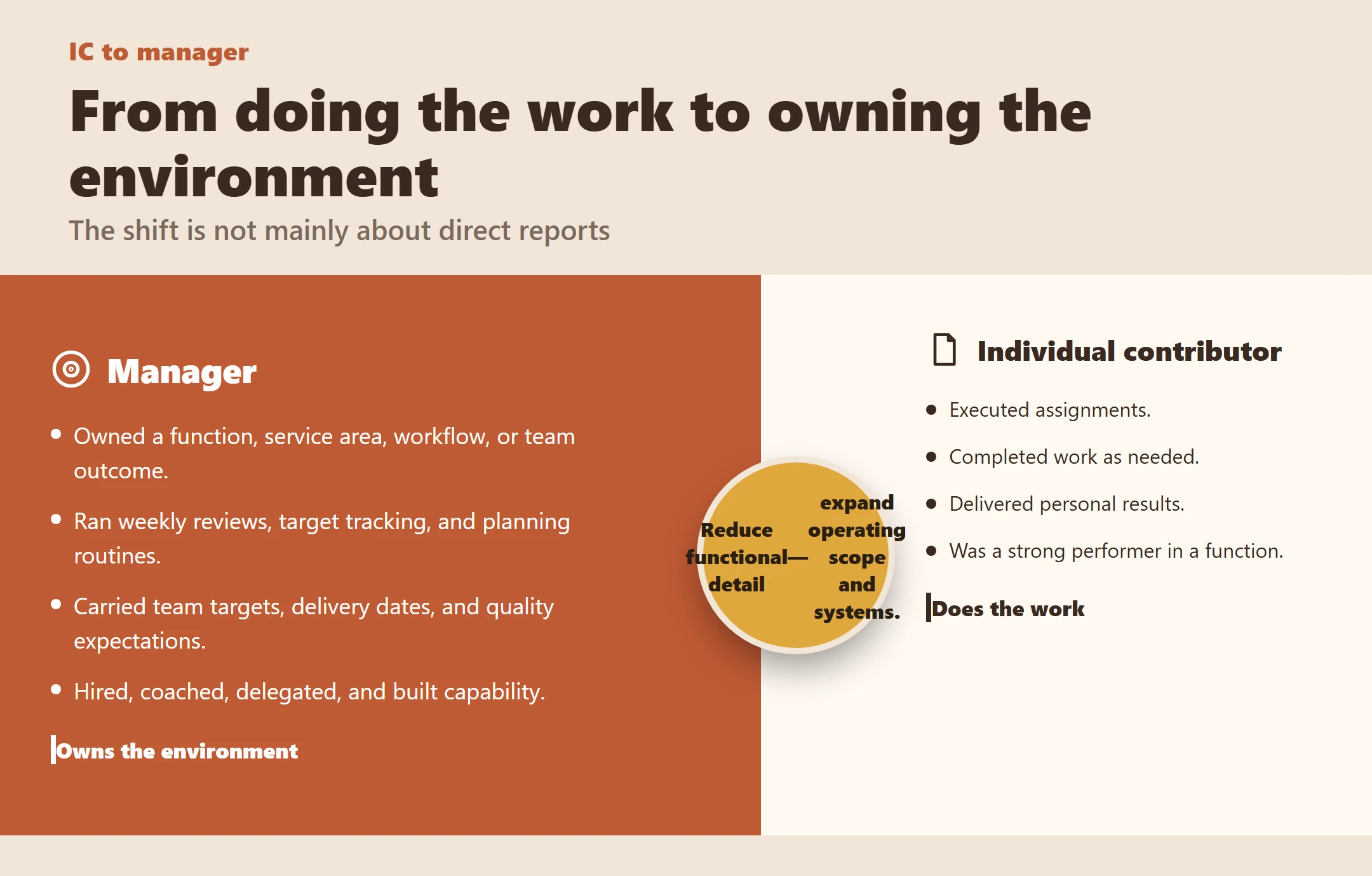
The shift from individual contributor to manager is not mainly about having direct reports. It is about moving from doing the work to owning the environment in which the work gets done.
Here are the top six differences between IC and manager CVs:
- Tasks become ownership
- IC: executed assignments
- Manager: owned a function, service area, workflow, or team outcome
- Activity becomes cadence
- IC: completed work as needed
- Manager: ran weekly reviews, target tracking, issue escalation, and planning routines
- Output becomes accountability
- IC: delivered personal results
- Manager: carried team targets, delivery dates, service levels, or quality expectations
- Skill becomes leadership proof
- IC: strong performer in a function
- Manager: hired, coached, delegated, corrected performance, and built capability
- Support work becomes process ownership
- IC: followed process
- Manager: improved process, removed friction, and standardized execution
- Collaboration becomes influence
- IC: worked with others
- Manager: aligned stakeholders, negotiated trade-offs, and moved work forward across functions
A manager CV should reduce functional detail aggressively. Keep enough detail to show domain credibility, but give more space to operating scope, team leadership, KPIs, and systems.
The operating cadence block: how you ran the function
One of the clearest manager signals is an operating cadence block. This is a short paragraph or cluster of bullets that shows how you ran the business area week to week.
Typical cadence elements include:
- Weekly KPI review
- Team planning sessions
- Monthly business review
- Performance tracking
- Escalation and issue resolution routines
- Forecast updates
- Stakeholder check-ins
- Risk and recovery follow-up
This matters because it tells the reader that you did not just react to work. You managed a rhythm.
Template paragraph
Use a short paragraph like this under a manager role:
Ran weekly operating cadence across team priorities, KPI tracking, issue escalation, and delivery reviews. Led routine planning sessions, monitored target performance, coordinated recovery actions where needed, and aligned stakeholders on priorities, risks, and execution progress.
You can tailor this by function. In operations, the focus may be throughput, service, and exceptions. In commercial roles, it may be pipeline, conversion, and forecast quality. In structured corporate environments, clear cadence language also signals discipline and governance.
People leadership proof: team, hiring, and coaching
Many manager resumes claim leadership but do not prove it. Proof comes from scope and actions.
How to express team scope
Use safe, clear language such as:
- Led a team of 6 across operations and customer support
- Managed supervisors and individual contributors across two service lines
- Oversaw a growing team and supported hiring, onboarding, and capability development
- Directed day-to-day execution through team leads and cross-functional partners
If exact numbers are sensitive or unclear, use general but credible phrasing:
- small team
- mid-sized team
- multi-site team
- cross-functional team
- direct and indirect team structure
Examples of leadership proof
- Hired and onboarded new team members to support service expansion
- Coached team leads on prioritization, reporting quality, and issue escalation
- Managed performance discussions and improvement plans where required
- Built role clarity, handoff standards, and review routines to improve consistency
Do not stop at “managed a team.” Show what leadership looked like in practice and how the team performed because of it.
Process ownership and system improvements
A manager is expected to improve execution, not just maintain it. A strong resume shows process wins using a simple structure:
Baseline → change → impact
Four process-win templates
- Fragmented process
- Identified inconsistent handoffs across teams, introduced a standard workflow and ownership checkpoints, improving execution visibility and reducing rework.
- Slow turnaround
- Reviewed turnaround delays, redesigned approval steps, and clarified escalation paths, resulting in faster decision flow over the following quarter.
- Low reporting quality
- Standardized reporting templates and review routines, improving data consistency and making weekly decision-making more reliable.
- Reactive operations
- Replaced ad hoc follow-up with recurring KPI reviews and exception tracking, helping the team detect issues earlier and act before targets slipped.
Example
Instead of writing:
- Improved process efficiency
Write:
- Reviewed recurring service delays, introduced a clearer triage workflow and weekly exception review, which improved response discipline and reduced operational friction.
KPI management: targets, forecasts, and recovery plans
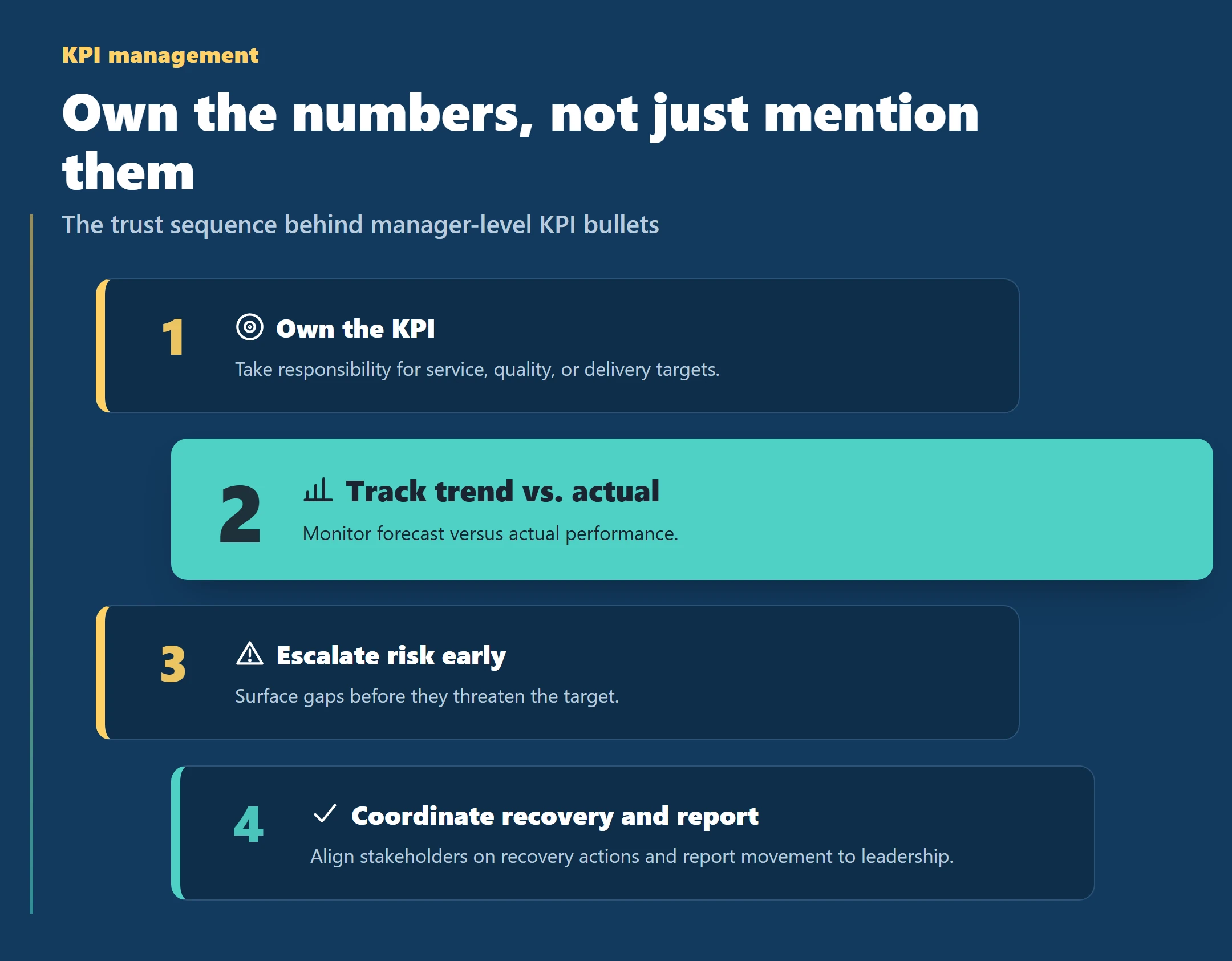
Managers are trusted to own numbers, not just mention them. Your resume should show that you tracked targets, understood trends, and acted when performance moved off plan.
Bullet templates for KPI ownership
- Owned monthly performance against service, quality, or delivery KPIs; tracked trends and led corrective actions when gaps emerged.
- Monitored forecast versus actual performance, escalated risks early, and coordinated recovery plans across stakeholders.
- Managed team execution against defined targets, using weekly reviews to reset priorities and maintain progress.
- Reported KPI movement to leadership with clear actions, dependencies, and expected next-step impact.
Example with timeframe
- Led weekly KPI reviews across Q2 to address missed service targets, introduced recovery actions on staffing, prioritization, and escalation handling, and improved execution stability by quarter end.
If you are preparing for a broader next-step narrative, compare your current framing with a stronger manager to director CV approach .
If your current resume still feels too tactical, we can help rewrite it into a stronger, application-ready management CV with clearer scope, sharper positioning, and better leadership proof .
Cross-functional coordination: stakeholders and influence
Manager roles often sit in the middle of execution. That means your value is partly in how you influence teams you do not directly control.
Avoid vague phrases like “worked cross-functionally.” Show who, why, and what changed.
Three templates
- Alignment template
- Coordinated with finance, HR, and operations to align staffing plans with delivery requirements and reduce execution gaps.
- Trade-off template
- Partnered with product and commercial teams to reset priorities, manage dependencies, and support more realistic delivery planning.
- Escalation template
- Worked with senior stakeholders to surface operational risks, agree recovery actions, and maintain progress on critical initiatives.
Stakeholder outcome examples
- Improved handoff clarity between sales and operations
- Reduced delays caused by approval bottlenecks
- Increased reporting consistency for leadership reviews
- Supported smoother rollout of process changes across functions
For larger multi-team scope, the expectations move closer to a director-level CV narrative .
Decision-making and problem solving at manager level
A manager resume should show decisions within a clear scope. Not every decision must be strategic, but it should show judgment, prioritization, and action.
What decision scope looks like
You may have decided:
- how work was prioritized
- how resources were deployed
- when to escalate
- which process changes to test
- how recovery plans were structured
- how targets were monitored and corrected
How to write “decided + shipped” bullets
Use this formula:
Assessed issue + decided course of action + implemented change + observed impact
Examples:
- Identified recurring delays in internal approvals, decided to streamline review ownership, implemented a simpler escalation path, and improved turnaround discipline.
- Reviewed team workload patterns, shifted resource allocation across priorities, and stabilized delivery during a high-demand period.
- Detected KPI slippage early, launched a structured recovery plan, and improved control over weekly execution.
The key is to show that you were not just present during the problem. You interpreted the issue, chose a response, and drove execution.
Delegation and scale: doing less, owning more
Many manager resumes still sound too hands-on. That weakens the seniority signal.
Your bullets should imply that you led through people, systems, and reviews.
Before and after bullet rewrites
Before
- Prepared weekly reports and followed up with team members on pending tasks
After
- Established weekly reporting routines, reviewed execution gaps with team leads, and drove follow-up through clear ownership.
Before
- Solved customer escalation issues and supported daily operations
After
- Oversaw escalation handling through defined response paths, enabling the team to resolve issues consistently while maintaining service continuity.
Before
- Trained staff on new procedures
After
- Rolled out new operating procedures through team coaching, manager reinforcement, and review checkpoints.
Cautions
Do not overstate delegation if your role was still highly operational. The goal is not to sound detached. The goal is to sound accountable at the right level.
Good manager language includes:
- oversaw
- led
- directed
- coordinated
- established
- monitored
- implemented through the team
- owned execution across
Budget and resource management, if applicable
Not every manager owns a budget, but many influence resource use. If you do, mention it safely and clearly.
Safe ways to mention budgets
- Managed departmental budget planning and spend monitoring
- Supported budget allocation decisions across operational priorities
- Oversaw resource deployment to match demand and service requirements
- Balanced headcount, vendor, or tool usage against delivery needs
How to frame resource allocation and efficiency wins
Good examples include:
- Reallocated team capacity to higher-priority work during peak demand periods
- Reviewed spend and resource use to improve operating efficiency
- Balanced staffing and workload distribution to support target performance
- Supported more effective use of tools, vendors, or internal resources
If exact figures are confidential, focus on the decision and effect rather than the amount. This keeps the claim credible while still showing managerial ownership.
Page 1 structure for manager CVs
The first page should communicate seniority fast. It must show ownership, scope, and performance above the fold.
Recommended page-1 outline
- Name and contact details
- Professional headline
- Executive summary
- Core leadership areas
- Selected achievements
- Current or most recent role with scope lines
- Early bullets showing ownership, KPIs, and team leadership
What must appear above the fold
- Current level and function
- Summary that sounds managerial, not tactical
- Scope clues: team, process, function, geography, stakeholders, or reporting line
- At least 2–3 strong outcome-led bullets
- Clean visual hierarchy
For readability and senior presentation, a modern corporate CV layout helps reinforce credibility .
Summary template for manager roles
Your summary should usually stay within 8 to 10 lines. It should combine function, scope, leadership style, and business impact.
Template
Manager with experience leading day-to-day operations across [function/team/process]. Known for owning targets, improving execution routines, and coordinating cross-functional stakeholders to deliver stable results. Strong track record in team leadership, performance management, KPI review, and process improvement. Comfortable operating in fast-paced, structured environments where service quality, delivery discipline, and reporting accuracy matter. Brings a practical leadership style focused on accountability, clarity, and continuous improvement.
For a stronger opening section, review a practical professional summary for CV blueprint .
Completed example
Operations Manager with experience leading service delivery, team performance, and process control across a multi-stakeholder business environment. Known for building weekly operating cadence, tracking KPIs, and improving execution through clearer workflows and stronger accountability. Led hiring, coaching, and performance follow-up while maintaining focus on delivery quality and issue resolution. Brings a disciplined management approach centered on planning, escalation control, and continuous process improvement.
Promotions and progression: showing growth over time
If you were promoted, make it visible. Promotions are strong evidence of trust and increased scope.
Progression line format
Company Name — Operations Coordinator → Senior Operations Specialist → Operations Manager
This format quickly signals advancement without repeating company details.
How to avoid repeating bullets
For earlier roles, focus on:
- functional execution
- specialist contribution
- early improvement work
For the manager role, focus on:
- ownership
- team scope
- targets
- systems
- cross-functional influence
Each stage should show a bigger circle of responsibility. If the next move you want is above manager level, your story should begin to reflect broader scope, portfolio thinking, and stronger business ownership.
Measuring leadership outcomes: people, process, and output
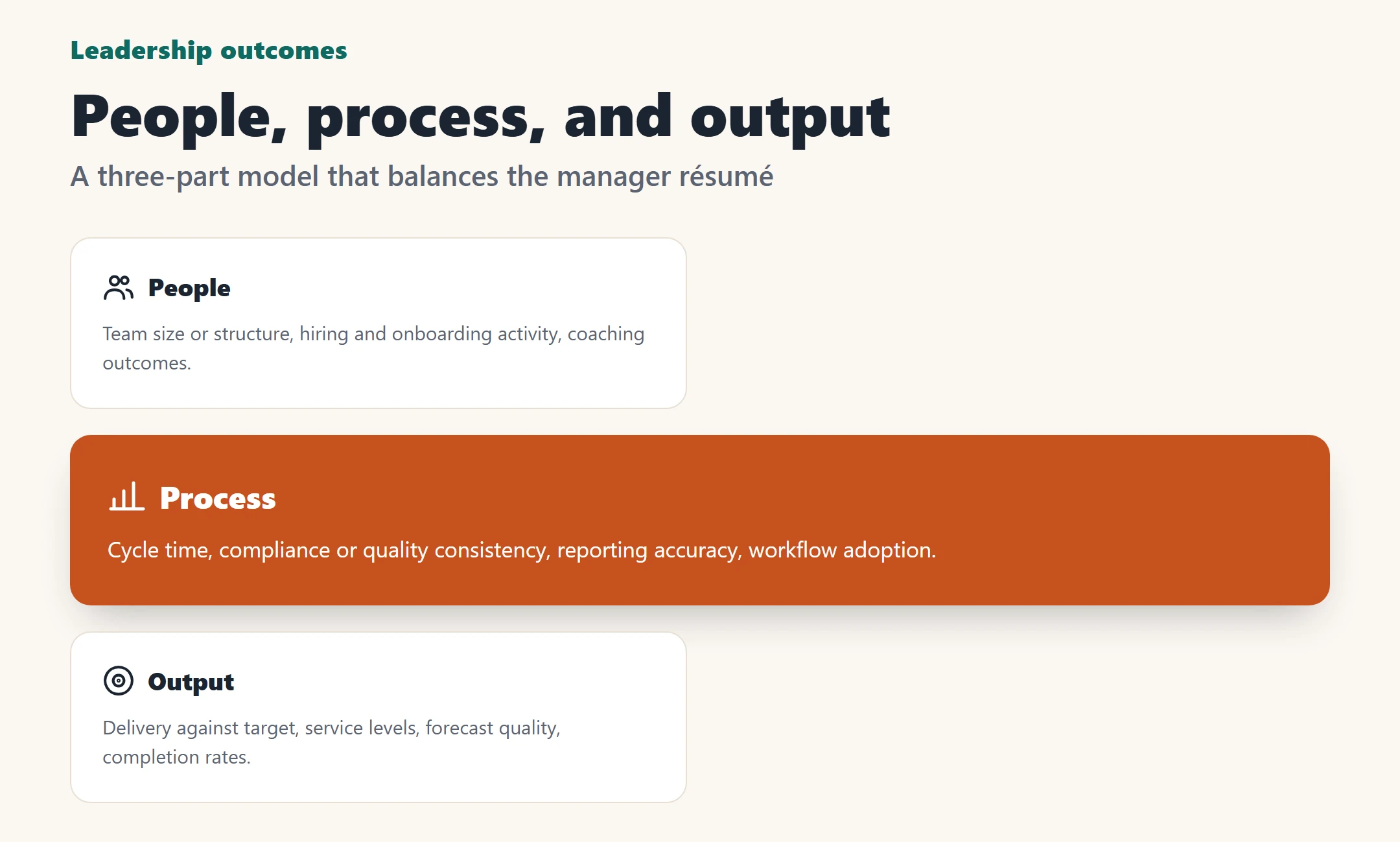
A simple way to strengthen your manager resume is to use a three-part model.
1. People metrics
- team size or structure
- hiring and onboarding activity
- coaching or performance improvement outcomes
2. Process metrics
- cycle time
- compliance or quality consistency
- reporting accuracy
- workflow adoption
3. Output metrics
- delivery against target
- service levels
- forecast quality
- completion rates
- recovery against missed plans
How to cite them
Use direct, simple language:
- Led a team of 8 with regular coaching and performance follow-up
- Standardized reporting and review routines to improve execution consistency
- Owned monthly target tracking and recovery planning during a high-pressure delivery period
This model helps your CV sound managerial because it balances people, systems, and results.
Common manager CV mistakes
Here are 10 common mistakes and how to fix them:
- Too tactical
- Fix: reduce tool-level and task-level detail
- No team scope
- Fix: mention direct, indirect, or cross-functional leadership
- No KPI ownership
- Fix: show targets, tracking, forecasts, or recovery plans
- No cadence
- Fix: include weekly or monthly operating routines
- No process improvement
- Fix: add one or two baseline-to-change examples
- Weak verbs
- Fix: replace “helped” with led, owned, established, coordinated
- No stakeholder influence
- Fix: name the functions you aligned with and the outcome
- Promotion not visible
- Fix: show progression clearly
- Too much execution detail
- Fix: keep only the detail that proves business relevance
- Summary sounds generic
- Fix: write for your level, function, and management scope
A useful test is simple: if most bullets describe what you personally did with your own hands, the document still reads too junior.
Rewrite clinic: IC bullets to manager bullets
Below are three transformations that show the shift from execution to ownership.
Transformation 1
IC version
- Created weekly reports and updated the team on status
Manager version
- Established weekly reporting cadence, reviewed performance trends with the team, and used updates to drive accountability and follow-up.
What changed
- Added cadence
- Added ownership
- Added management use of reporting
Transformation 2
IC version
- Worked with other departments to solve delays
Manager version
- Coordinated with operations, finance, and support teams to resolve recurring delays, align priorities, and improve execution flow.
What changed
- Named stakeholders
- Added influence
- Added system-level outcome
Transformation 3
IC version
- Trained new hires and answered questions
Manager version
- Supported team capability building through onboarding, coaching, and role clarity, helping new hires ramp more consistently.
What changed
- Shifted from ad hoc support to leadership
- Added people-development signal
- Added operating impact
Final checklist and seniority test
Use this pass/fail test before sending your CV.
Score yourself: 1 point for each “yes”
- Does page 1 show clear manager-level ownership?
- Does your summary sound like a manager, not a specialist?
- Did you include team scope?
- Did you include KPI ownership?
- Did you show operating cadence?
- Did you show at least one process improvement?
- Did you include stakeholder influence?
- Do your bullets imply delegation and oversight?
- Is progression visible?
- Does the overall document feel clean, structured, and senior?
Score guide
- 8–10: Strong manager signal
- 5–7: Good base, but credibility gaps remain
- 0–4: Still reads too much like an individual contributor CV
Fix priorities if your score is low
- Rewrite the summary
- Add team and KPI scope
- Replace tactical bullets with ownership bullets
- Add process and stakeholder examples
- Improve page-1 structure
Get a paid CV rewrite with stronger positioning, clearer leadership scope, and sharper first-page impact for managers and senior professionals—start here .