

Who This Guide Is For and the Risks It Helps You Avoid
This guide is for expats working in Saudi Arabia who want to avoid preventable legal and financial problems at work.
If you are worried about salary delays, unclear contract terms, notice period confusion, leave records, or what happens when you resign or get terminated, this article is written for you.
The goal is simple: help you avoid the traps that create the biggest risk for expats, especially where work status, payroll, and contract language can affect your money and future options.
Common risk areas include:
- visa or status problems caused by poor timing
- payroll disputes with weak evidence
- contract misunderstandings because of language or assumptions
- settlement shortfalls at the end of employment
- avoidable mistakes during resignation, notice, or termination
This is not about memorizing legal theory. It is about knowing what to check, what to save, and what to ask before a small issue becomes an expensive one.
The Employment Relationship Map
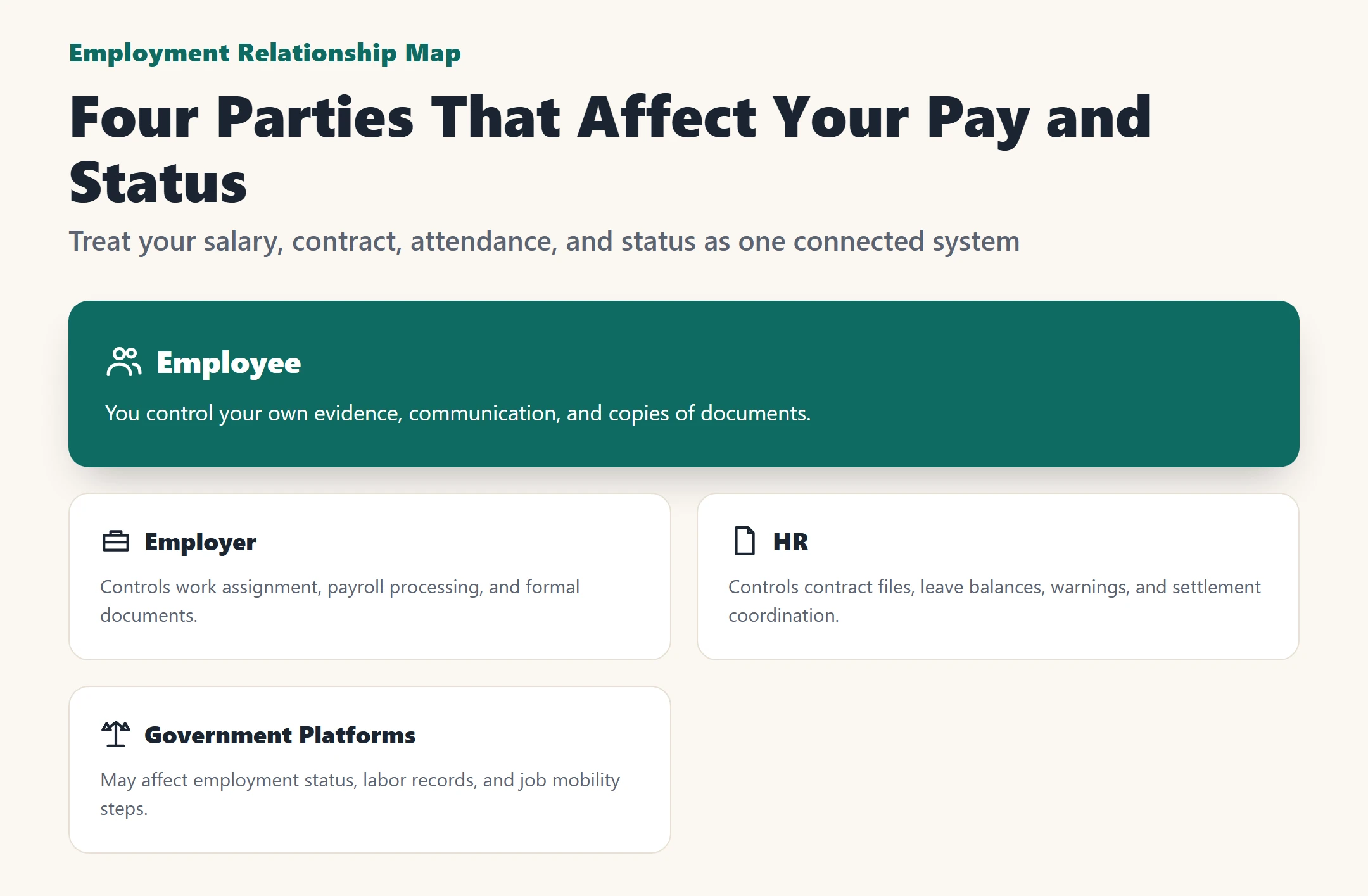
Many expats think the employment relationship is only between the employee and the manager. In practice, several parties affect your pay, records, and status.
Employee
You control your own evidence, communication, attendance discipline, and copies of documents. That matters more than many people realize. If you do not keep records, you may struggle later even when you are right.
Employer
The employer controls work assignment, payroll processing, internal policy, approvals, and many formal employment documents. In real life, what the employer records internally often shapes how a dispute begins.
HR
HR usually controls contract files, leave balances, warnings, policy interpretation, end-of-service paperwork, and settlement coordination. HR is often the first place to ask for clarification in writing.
Government Platforms and Official Records
Government systems and formal records may affect employment status, labor records, and job mobility steps. Do not rely only on verbal statements about your status. If your next move depends on process timing, understand the operational side of an Iqama transfer .
A safe mindset is this: your salary, your contract, your attendance, and your status are connected. Treat them as one system, not separate issues.
Key Terms Glossary in Plain English
Use this as a quick reference when reading your contract or speaking with HR.
- Fixed-term contract: a contract for a defined period.
- Open-ended contract: a contract without a fixed end date.
- Probation: an early employment period with special rules and higher risk if you assume too much.
- Notice period: the advance notice required before ending employment in normal cases.
- EOSB: end-of-service benefits; money that may become due at the end of employment depending on the situation and service period.
- Final settlement: the full closing payment calculation, which may include salary, unused leave, EOSB, and deductions.
- Absence: missing work without accepted approval or valid documentation.
- Authorized leave: approved time away from work under policy or applicable rules.
- Penalty: a disciplinary or financial consequence applied under policy or procedure.
If one term is unclear, ask for the company’s written meaning and the basis they are relying on. Clarity early is cheaper than correction later.
Fixed-Term vs Open-Ended Contracts and Why the Difference Matters
Your contract type affects how termination, notice, and settlement expectations are framed.
A fixed-term contract usually makes the contract duration itself a central issue. An open-ended contract usually makes the notice clause more central. In either case, do not assume your verbal understanding matches the document.
What to Verify in Your Contract
Check these points carefully:
- contract type stated clearly
- start date and end date, if any
- probation wording
- notice clause wording
- renewal language
- salary components
- deductions language
- leave accrual and payout wording
- training repayment clauses
- non-compete or confidentiality clauses
If you are still within your early employment phase, review Saudi probation period rules before assuming normal exit rules apply.
Salary Structure Basics and What Counts
One of the biggest expat mistakes is treating salary as one number.
In practice, salary may include:
- basic salary
- allowances
- variable pay, such as incentives or commissions
- occasional reimbursements or one-off payments
Why does this matter? Because disputes and final settlement calculations often depend on what part of your pay is treated as the base and what part is treated as separate.
If your offer letter, contract, payslip, and bank transfer description do not align, you may face confusion later over:
- leave payout
- EOSB expectations
- deduction disputes
- underpayment claims
- notice-related calculations
Example: Payslip Does Not Match Bank Transfer
Use this reconciliation checklist:
- Compare the payslip total to the bank transfer amount.
- Separate basic salary, allowances, deductions, and variable items.
- Check whether any deduction is named and documented.
- Save both the payslip and bank proof for the same month.
- Ask HR for an itemized explanation in writing.
A safe message is: “Please share the breakdown for this month’s salary transfer against the payslip items so I can reconcile my records.”
That wording asks for clarity without making an accusation.
Payslip and Bank Proof: How to Build Evidence
If you keep only screenshots in random places, you do not have a real evidence system.
Build a simple monthly folder. It should take only a few minutes each month.
Minimal Evidence Folder System
Create one main folder with subfolders by month.
Suggested structure:
- 2026-01
- 2026-02
- 2026-03
Inside each month, save:
- payslip
- bank transfer proof
- attendance summary if available
- overtime approval if relevant
- leave approval if relevant
- warning letters or HR emails if relevant
Naming Convention That Stays Useful Later
Use clear file names such as:
- 2026-01 Payslip
- 2026-01 Bank Transfer
- 2026-01 Overtime Approval
- 2026-01 Leave Approval
- HR-Notice-Confirmation
This matters because speed matters during disputes. A clean evidence folder helps you answer HR quickly and accurately.
Wage Delays and Non-Payment: Early Warning Signals
Salary problems often worsen in stages. The earlier you document the issue, the better your position.
Common Warning Signals
Watch for patterns such as:
- salary arrives later than usual
- HR says “tomorrow” repeatedly without written confirmation
- partial salary is paid without explanation
- payslip is delayed or missing
- unusual deduction appears without supporting detail
- managers ask employees to “wait quietly”
Lowest-Friction Escalation Sequence
Keep your approach calm and structured:
- Confirm the delay and save bank proof.
- Ask payroll or HR for the expected payment date in writing.
- Request the itemized breakdown if the amount is short.
- Keep all responses in one email thread if possible.
- Continue documenting each date, promise, and payment event.
Wage Delay Early-Warning Timeline
Week 1: Salary is late. Save your bank screenshot and ask for the expected payment date.
Week 2: HR promises payment soon. Save the message and ask for confirmation of amount and date.
Week 3: Partial salary arrives. Save the transfer proof, compare it to the payslip, and ask what remains outstanding.
Week 4: Silence or vague answers continue. Prepare a clean summary: month affected, amount received, amount missing, and all message dates.
Do not turn a payroll issue into an emotional argument. Calm documentation is stronger than repeated verbal complaints.

Working Hours Basics and What Counts as Work
Employees often lose money because they do not track what actually counted as work in practice.
Areas That Commonly Create Confusion
- shift start and end times
- unpaid or paid breaks
- attendance system records
- pre-shift instructions
- post-shift handover time
- travel between sites
- standby expectations
Not every extra minute becomes payable work automatically. But if your employer expects your presence, output, or availability, you should track the facts.
What to Track
Use a simple checklist:
- scheduled shift
- actual start and finish time
- break time
- manager instruction for extra time
- location if working across sites
- handover time
- unusual delays caused by work demands
A weekly work log is often enough. Record deliverables, approvals, hours, and blockers in one place.
Overtime: Practical Proof and Calculation Inputs
Overtime disputes are rarely won by memory alone. You need evidence that the extra work happened and that it was real work, not just staying late casually.
The Minimal Overtime Proof Pack
These six items make an overtime claim more credible:
- work roster or schedule
- manager approval or instruction
- attendance record
- messages showing extra work request
- deliverable or task evidence
- payslip or payroll record for the period
Inputs You Need for Any Calculation Review
Before discussing entitlement, gather:
- date of overtime work
- number of extra hours
- whether it was a normal day, rest day, or holiday
- approval evidence
- salary structure relevant to the calculation
- whether any overtime was already paid
If you want to estimate how end-of-service benefits may fit into your final money picture, review end of service benefits Saudi Arabia .
If you are planning your next move and need a stronger CV or Resume for real applications, we can help you rewrite or optimize it into a clearer, job-ready version .
Weekly Rest Day and Public Holiday Basics
Rest days and public holidays create confusion when rosters are busy or operations run continuously.
What to Check
If you worked on a rest day or holiday, verify:
- your roster for that week
- the company’s written policy
- any prior approval or work instruction
- attendance evidence
- how the payroll record reflects that day
Public Holiday vs Rest Day Confusion
A common problem is assuming both are treated the same without checking the roster and policy record. If you were scheduled to work on a public holiday or a weekly rest day, keep the roster, approval message, attendance proof, and pay record together.
Common Employer-Side Mistakes
These are common sources of confusion:
- treating all non-standard workdays the same
- changing the roster informally without written record
- failing to align scheduling with payroll records
- assuming employees will not check holiday treatment
The safest habit is to compare roster, attendance, and payslip while the month is still fresh.
Annual Leave: What You Are Entitled To Operationally
Annual leave becomes a legal and financial issue when the process is messy.
Safe Leave Workflow
Follow this sequence:
- Submit the request in writing.
- Keep the approval proof.
- Save the dates approved.
- Track the leave used against your records.
- Check your balance regularly.
- Keep any cancellation or rescheduling message.
Unused leave may affect your final settlement. That is why leave records should be treated as money records, not just calendar notes.
Sick Leave: Documentation That Protects You
When you are sick, your biggest risk is being treated as absent without proper justification because your documentation was late, incomplete, or informal.
Do
- notify the employer promptly
- follow the company reporting channel
- keep medical documentation
- save messages, emails, or case references
- confirm that HR recorded it correctly
Do Not
- rely only on a verbal message to your manager
- submit documents late without explanation
- assume HR updated the record correctly
- ignore attendance deductions after returning
If attendance and salary records conflict after a medical absence, address it immediately while the evidence is easy to collect.
Other Leaves You Should Recognize
Expats often focus only on annual leave and sick leave, but other leave categories may appear in policy or practice.
When reviewing any leave type, ask HR:
- what qualifies
- what approval is required
- what document proves eligibility
- whether it is paid or unpaid
- how it appears on the payslip or leave balance
- whether it affects final settlement
The exact label matters less than the record. Save the approval and supporting document every time.
Absence vs Authorized Leave: The Difference That Costs Money
This is one of the most expensive misunderstandings in employment records.
An absence is usually treated as a failure to attend work properly. Authorized leave is approved or properly documented time away. If the company mislabels one as the other, deductions and disciplinary issues can follow.
Mini-Checklist to Prevent Silent Deductions
- request leave through the formal channel
- save approval proof
- keep any medical or supporting record
- check the payslip after the period
- question any unexplained deduction immediately
- ask HR to confirm the attendance code used
Never assume that because your manager said “okay,” the payroll system says the same.
Where Notice Rules Come From: Law and Contract Together
Notice disputes often happen because employees rely on habit, rumors, or verbal promises instead of the actual clause.
Your notice rules usually come from a combination of the law and your contract wording. That means you must read both carefully before resigning, negotiating an exit, or responding to termination.
Verify the Clause Checklist
Check:
- exact notice length
- whether the wording differs by contract type
- when notice starts
- whether probation changes the rule
- whether payment instead of notice is addressed
- any conditions tied to resignation or termination
For common confusion around one month versus two months and similar issues, review Saudi notice period rules .
Employer Terminates Without Notice: What to Collect
If your employer terminates you without notice, do not rely on memory later. Build the file immediately.
Evidence Checklist
Collect:
- termination letter or message
- stated reason
- termination date
- contract copy
- payslips
- bank proof
- leave balance records
- warning letters, if any
- relevant manager or HR messages
- attendance records if the reason relates to absence or conduct
Two Sample Dispute Angles
Angle 1: The reason is vague or unsupported.
Your focus becomes the gap between the allegation and the documents.
Angle 2: The process happened, but the money does not match.
Your focus becomes missing settlement items, unexplained deductions, or unpaid balances.
Handover Packet to Protect Your Reputation
A strong handover is not only professional. It also reduces retaliation risk and later claims that you caused disruption.
What Your Handover Packet Should Include
- tasks list
- status of each task
- pending deadlines
- file locations
- stakeholder names
- access or dependency notes
- unresolved issues
- recommended next steps
Send it in a clear written format and save a copy. If someone later claims you left chaos behind, your handover packet becomes valuable evidence.
Non-Compete and Confidentiality Clauses: Basic Risk Questions
These clauses usually try to limit how you use information or where you work after leaving.
Do not panic when you see them. But do not ignore them either.
Risk Questions to Ask
- What activity is restricted?
- For how long?
- In what geographic scope?
- Does it target a role, an industry, or named competitors?
- Is the clause specific or overly broad?
- What confidential information is actually covered?
The more vague the clause, the more important it is to ask for clarification before signing or resigning.
Training Cost Repayment Clauses
Some contracts include repayment language for training costs. This can become a surprise deduction issue later.
Verification Checklist Before You Agree
- what training is covered
- whether costs are itemized
- whether repayment reduces over time
- what event triggers repayment
- whether the clause applies if the employer initiates termination
- what proof of actual training cost will exist
If the wording is broad, request examples in writing.
How to Ask HR the Right Questions Fast
When asking HR, short and precise is better than emotional and broad.
Copy-and-Paste Question Bank
“Please confirm my notice period under my current contract.”
- “Please confirm which salary components are used as the base for EOSB.”
- “Please confirm my current annual leave balance.”
- “Please share the itemized final settlement breakdown.”
- “Please confirm the expected settlement timing after my last working day.”
- “Please explain any deductions applied this month.”
- “Please confirm whether this absence is recorded as approved leave or absence.”
- “Please confirm whether my probation period has ended.”
- “Please confirm how unused leave is treated in final settlement.”
- “Please confirm whether overtime for these dates was approved and recorded.”
- “Please confirm whether any training repayment applies to my case.”
- “Please confirm whether any non-compete restriction is recorded in my file.”
These prompts create a written trail without sounding aggressive.
Common Myths Expats Believe
Myth vs Correct Framing
- Myth: “If my manager agreed verbally, that is enough.”
Correct framing: Get written proof.
- Myth: “My payslip total is all that matters.”
Correct framing: Components matter.
- Myth: “I can resign first and sort out records later.”
Correct framing: Audit records before acting.
- Myth: “If salary is only a little late, I should ignore it.”
Correct framing: Document patterns early.
- Myth: “A warning letter must be signed without comment.”
Correct framing: You can acknowledge receipt without admitting allegations.
- Myth: “If HR says something informally, I do not need the clause.”
Correct framing: Verify the document and ask for written confirmation.
Practical Scenarios: Notice Period Confusion
Scenario 1: Verbal Notice, No Written Notice
Facts: You told your manager you plan to leave, but no formal notice was submitted.
Correct interpretation: Verbal discussion may not be enough.
Action steps: Send formal notice in writing, ask HR to confirm receipt, save the thread.
What to document: notice email, HR reply, last working day calculation.
Scenario 2: Contract Clause Seems Different from What HR Says
Facts: HR states one notice period, but your contract wording seems different.
Correct interpretation: You need written clarification tied to the clause.
Action steps: Quote the clause and ask HR to confirm the company’s interpretation.
What to document: contract copy, clause screenshot, HR response.
Scenario 3: Employer Asks You to Leave Early
Facts: You resign, then the employer says not to complete the full notice period.
Correct interpretation: The money and notice consequences should be clarified in writing.
Action steps: Ask whether this is employer waiver, mutual agreement, or another arrangement.
What to document: message requesting early release, response, settlement breakdown.
Practical Scenario: Salary Delay and Threats
A common high-risk scenario is this: salary is delayed, then someone warns employees not to “cause trouble.”
Keep Calm, Document, Escalate
- Save all bank and payslip evidence.
- Keep communication factual.
- Ask for payment date and amount in writing.
- Do not make threats or accusations.
- Build a timeline of delay, promises, and payments.
What Not to Say
Avoid statements like:
- “You are stealing my salary.”
- “I will destroy the company online.”
- “I refuse all work until paid.”
Those responses create new risks for you. Stay professional and evidence-focused.
One-Page Expat Rights Snapshot
Use this quick recap as a practical memory aid.
Pay
- track payslips and bank proof
- question unexplained deductions
- document delays early
Time
- track shifts, approvals, and extra hours
- keep rosters and attendance records
Notice
- verify the clause before acting
- use written notice, not verbal notice alone
Probation
- know whether probation still applies
- do not assume normal rules apply during probation
EOSB
- ask what salary base is used
- estimate early, not only at exit
Disputes
- facts first
- documents first
- calm written communication first
Before You Resign: Legal Hygiene Only
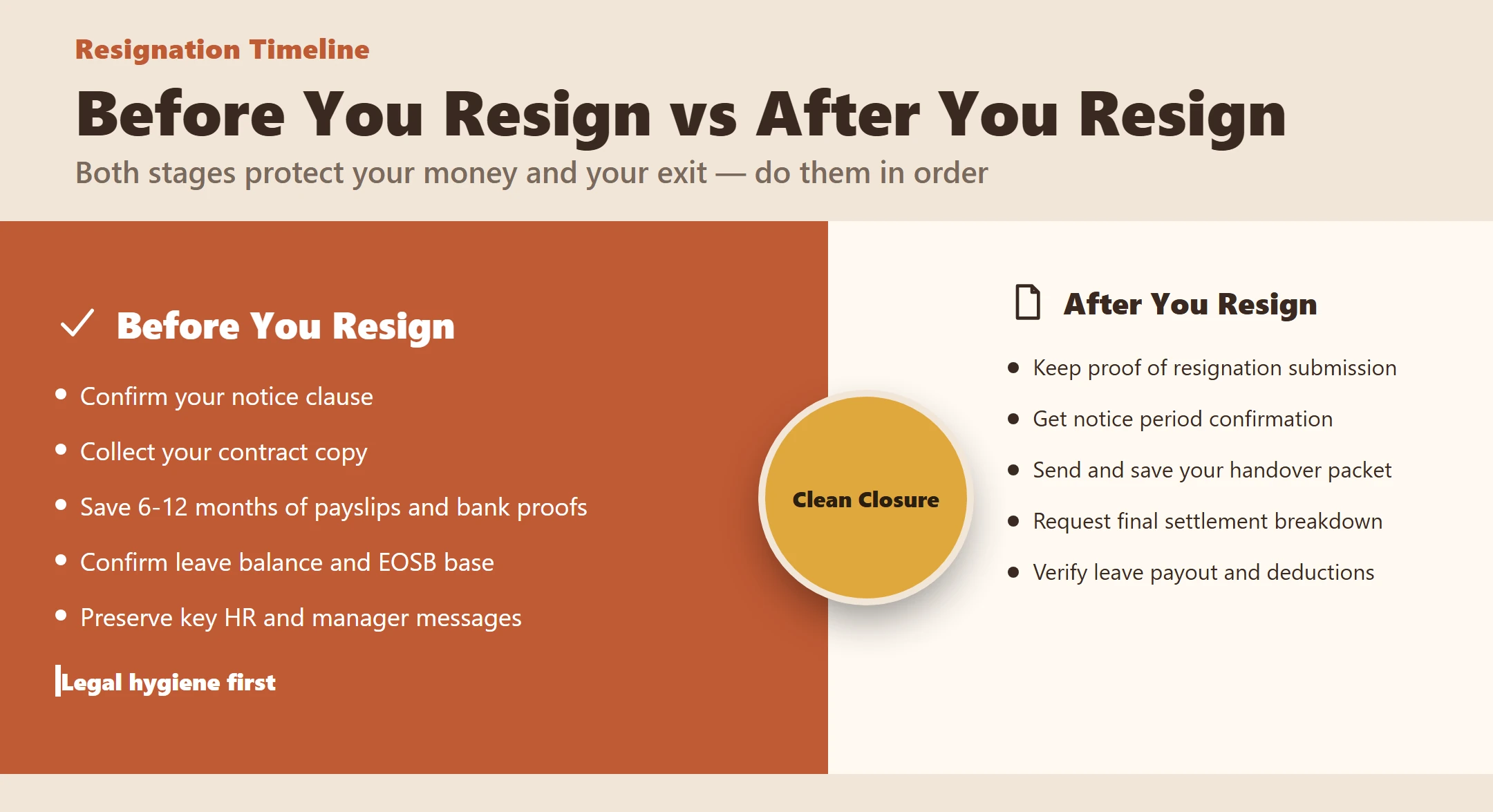
Before resigning, do these checks first:
- confirm your notice clause
- collect your contract copy
- save the last 6 to 12 months of payslips and bank proofs
- confirm leave balance
- ask for EOSB base clarification
- save handover-ready records
- check for non-compete or training repayment clauses
- preserve key HR and manager messages
Do not resign blind. For a wider risk checklist before resigning in Saudi Arabia , review your timing and records before you act.
After You Resign: Settlement-Focused Checklist
Once resignation is submitted, focus on clean closure.
Post-Resignation Checklist
- keep proof of resignation submission
- get notice period confirmation
- send your handover packet
- save handover acknowledgment
- request final settlement breakdown
- verify leave payout
- audit EOSB assumptions
- check deductions carefully
- save your final payslip and transfer proof
If you expect to move to another employer, it helps to understand how to change jobs legally Saudi Arabia mobility so you do not rely on rumors.
Mistakes That Cost Expats Money
These mistakes are common and expensive:
- undocumented overtime
- leaving before notice issues are clarified
- signing warnings blindly
- keeping no evidence pack
- ignoring small salary mismatches
- failing to check leave balances
- relying on verbal approvals only
The Fix
Use one rule for all of them: if it affects pay, time, discipline, or exit, save proof immediately.
FAQ Bank: Contracts and Pay
1. If my contract and offer letter differ, what should I verify?
Verify which document HR treats as controlling and ask for written clarification.
2. Does my full monthly package always count the same way in settlement?
Not always. Verify the salary components used as the base.
3. What if my payslip shows deductions I do not understand?
Ask for an itemized breakdown and save the response.
4. If salary is late once, should I worry?
Do not panic, but document it and watch for repetition.
5. What if I never received a payslip?
Request it in writing and keep proof of the request.
6. Can unused leave affect my final money?
Yes. Verify your leave balance and payout treatment.
7. Should I keep bank screenshots if the company pays normally?
Yes. Routine proof becomes valuable when something changes.
8. What if my title in practice differs from my title in records?
Ask HR to confirm the official recorded title and save the answer.
9. Should I worry about company status before planning a move?
Yes, it is sensible to understand company-side stability signals such as Nitaqat explained .
FAQ Bank: Notice and Resignation
1. Is verbal notice enough?
Usually, written notice is safer. Verify your company process.
2. When does notice start?
Verify whether it starts from submission, acknowledgment, or another defined point.
3. Can HR change my last working day?
Ask for the basis and get any change confirmed in writing.
4. If I am asked not to work the full notice, what should I do?
Ask how that affects payment and settlement.
5. Should I send notice to my manager or HR?
Follow policy, but ensure HR receives it in writing.
6. What if my employer terminates me during notice?
Collect all documents immediately and request settlement details.
7. Can I resign before checking my records?
You can, but it is risky. Verify first wherever possible.
8. What if I signed a warning earlier?
Get a copy and keep it with your employment records.
Checklist: Audit Your Current Job Situation
Give yourself one point for each “yes.”
Pay Reliability
- I have the last 6 months of payslips.
- I have the last 6 months of bank proofs.
- My payslips and bank records broadly match.
Contract Clarity
- I have a copy of my contract.
- I know whether it is fixed-term or open-ended.
- I know my notice clause.
- I know whether probation has ended.
Evidence Readiness
- I keep leave approvals.
- I keep overtime approvals.
- I save HR and manager emails on key issues.
Warning Signals
- No recent unexplained salary delays.
- No repeated vague payroll promises.
- No unexplained deductions.
- No unsigned or unclear disciplinary record hanging over me.
Risk Score
- 10–13 yes: relatively organized, keep maintaining records.
- 6–9 yes: moderate risk, tighten documentation now.
- 0–5 yes: high risk, build your evidence file urgently.
Glossary: Arabic Terms You Will See
These meanings are simplified for practical understanding and to reduce misreading of HR records.
- Iqama: residence permit or legal residency record
- Aqd: contract
- Rاتب: salary
- بدل: allowance
- إجازة: leave
- غياب: absence
- إنذار: warning
- مخالصة / تسوية نهائية: final settlement
- مكافأة نهاية الخدمة: end-of-service benefits
- مباشرة: reporting for duty or starting work
If any Arabic term appears in a document you do not fully understand, ask for the English explanation in writing before signing.
What To Do If: Troubleshooting Index
If Salary Is Delayed
- save bank proof
- request payment date in writing
- compare with payslip
- build a timeline
If Termination Is Threatened
- save messages
- request written reasons
- keep contract and payslips ready
- avoid emotional responses
If You Feel Forced to Resign
- do not rush
- ask for written clarification
- preserve all messages
- review notice and settlement records first
If Your Contract Copy Is Missing
- request it from HR in writing
- save the request
- collect related offer and amendment documents meanwhile
Summary: The 10 Rules That Keep You Safe
- Keep your contract copy.
- Save every payslip and bank proof.
- Treat leave records like money records.
- Do not rely on verbal approvals.
- Verify your notice clause before acting.
- Track overtime with evidence, not memory.
- Question deductions quickly and calmly.
- Build a clean handover packet before exit.
- Audit EOSB and settlement assumptions early.
- Never sign blindly if you do not understand the record.
Get a professionally written CV or Resume that is built for expats ready to apply with more confidence; if you want stronger positioning, clearer achievements, and a job-ready final version, order here .