

Your LinkedIn experience section should not copy your CV word for word.
It has a different job: help recruiters scan fast, understand your level, and trust your claims without working hard to interpret them. For experienced professionals, that usually means translating dense CV bullets into shorter, proof-based LinkedIn entries.
If your headline and summary are already aligned, your experience section should reinforce that positioning. If not, fix your profile foundation first with a strong LinkedIn bio that supports the roles you want.
Turn Your Experience Section Into a Mini-CV
Think of each role entry as a mini-CV inside your profile.
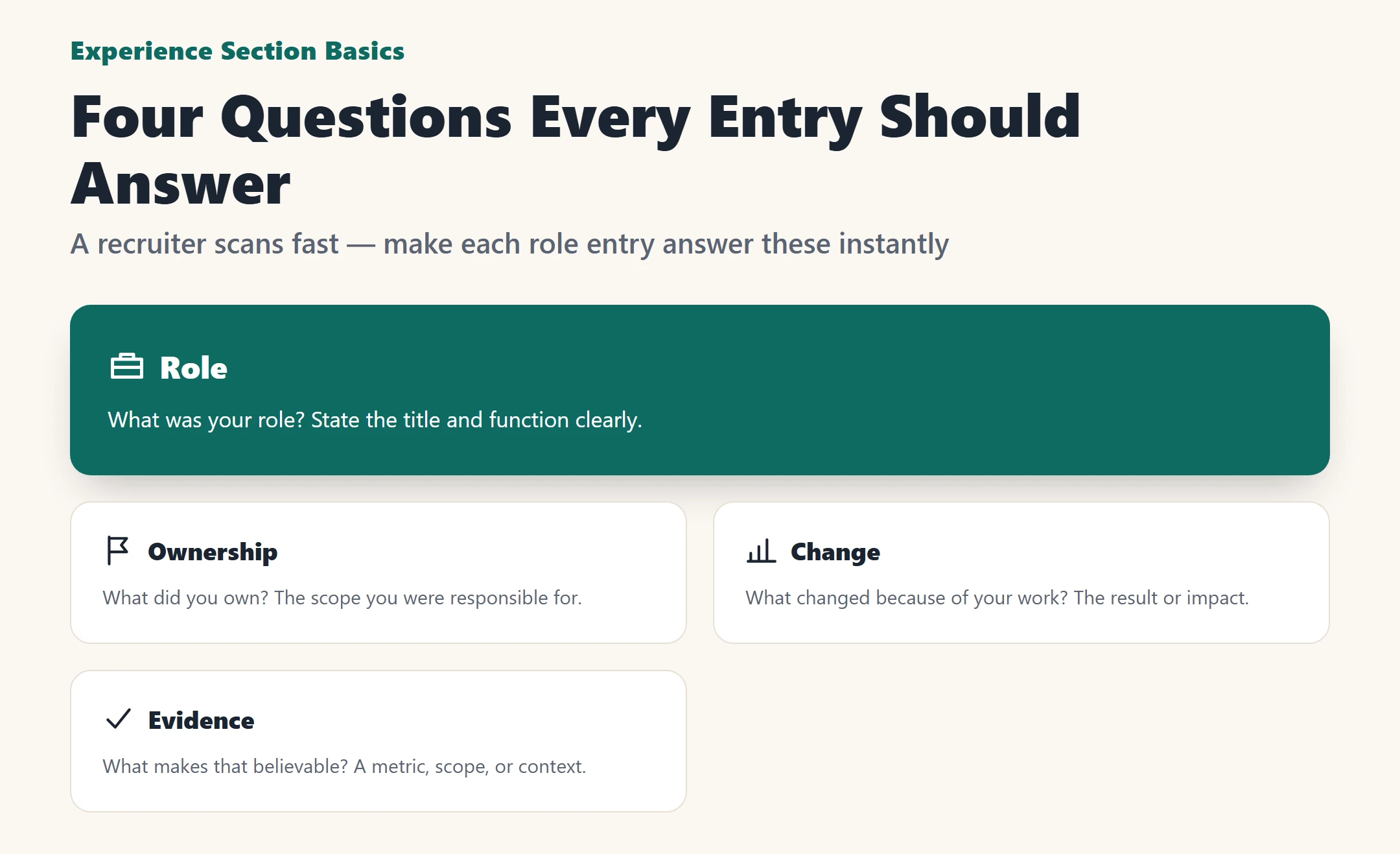
A recruiter may only read your title, company, dates, and the first few lines. So each entry should answer four questions quickly:
- What was your role?
- What did you own?
- What changed because of your work?
- What makes that believable?
A CV can carry more detail. LinkedIn needs tighter phrasing and cleaner scanning. The goal is not to list everything you did. The goal is to show the strongest proof patterns clearly.
If a bullet sounds like a job description, rewrite it. Focus on contribution, change, and evidence. That is the same logic used when you turn tasks into achievements .
Example: Turn CV Bullets Into LinkedIn Bullets
Before
- Responsible for managing digital campaigns across several channels and coordinating with agencies and internal teams to improve lead generation.
After
- Led multi-channel demand generation campaigns across paid search, email, and social, coordinating internal and agency teams to improve lead flow.
- Improved lead quality by refining targeting, landing page messaging, and follow-up process.
- Reported campaign performance weekly using clear conversion and cost metrics for leadership review.
Before and after: paragraph to scannable bullets
If your current role description is one long paragraph, break it into 3 to 5 bullets.
Dense version
- Managed reporting, cross-functional coordination, stakeholder updates, process tracking, and performance reviews for a regional transformation program.
Scannable version
- Coordinated delivery tracking across multiple workstreams in a regional transformation program.
- Built a recurring reporting rhythm for stakeholder updates and issue escalation.
- Improved visibility on progress, blockers, and ownership through structured status reviews.
The second version is easier to scan and easier to trust.
Write a Clear Role Header
Your role header carries more weight than many people realize.
Use this structure clearly:
- Job title
- Company
- Dates
- Location
Avoid ambiguity. If your official title is unclear internally, keep it honest in the header and clarify the function in the description.
Handle title mismatch without sounding misleading
Recruiters usually search with familiar titles. You do not need to change facts, but you do need to reduce confusion.
A safe pattern is:
- Official title in the header
- Market-friendly clarifier in the first line of the description
Example:
- Header: Senior Specialist
- Description opening: Worked as the lead CRM and lifecycle marketing owner for the business unit.
That makes the role easier to understand and supports broader LinkedIn profile SEO without exaggerating your position.
Use a 3-Bullet Proof Pattern
For many experienced professionals, three strong bullets per role are enough.
A simple pattern is:
- Impact — what improved, changed, launched, saved, or grew
- How — what action you took
- Evidence — the metric, scope, stakeholder level, or context
Tight bullet formulas
You can build bullets using patterns like:
- Action + scope + result
- Decision + execution + business outcome
- Ownership + method + evidence
Example
- Redesigned monthly reporting for regional leadership, combining sales and pipeline data into one dashboard to improve decision speed.
- Standardized campaign brief and approval flow across teams, reducing delays and improving launch consistency.
- Partnered with sales, finance, and product stakeholders to prioritize high-value initiatives and track outcomes.
These bullets stay short, but they still show ownership.
Add Metrics and Scope With Context
Numbers help only when the reader understands what they mean.
Good context can include:
- Team size
- Budget size
- Revenue scope
- Number of locations
- Portfolio size
- Customer segment
- Stakeholder level
- Review cadence
Better ways to show scope
Instead of writing:
- Managed budget
- Led team
- Improved reporting
Write:
- Managed annual campaign budget across multiple acquisition channels.
- Led a cross-functional team of marketers, analysts, and agency partners.
- Built a weekly reporting pack for senior leadership covering pipeline, conversion, and channel efficiency.
You do not always need exact figures. If some details are confidential, use accurate scope language such as “regional,” “enterprise,” “multi-site,” or “cross-functional.”
Example: show leadership scope properly
A stronger manager-level role entry might include:
- Team responsibility
- Stakeholder exposure
- Operating rhythm
- One clear result
For example:
- Led a team of recruiters and coordinators supporting high-volume hiring across business functions.
- Established a weekly hiring review cadence with department leaders to unblock approvals and improve visibility.
- Improved consistency in hiring workflow by tightening screening, scheduling, and decision handoffs.
If you want help turning broad experience into a sharper LinkedIn profile or a stronger application-ready CV, we offer paid CV support to rewrite weak content and improve positioning .
Embed Tools and Keywords Naturally
Tools matter, but tool-dumps do not build trust.
Do not list platforms without business context. Mention tools where they were actually used.
Better
- Built a weekly performance dashboard in Power BI to track sales pipeline movement and conversion trends.
- Used Salesforce reports and account segmentation to prioritize outreach and improve follow-up discipline.
Worse
- Tools: Power BI, Salesforce, Excel, HubSpot, Jira, SQL
The better version proves you used the tool in real work.
Show Multiple Roles at the Same Company Clearly
If you were promoted inside one company, show that progression cleanly.
This is a strong trust signal because it shows the business gave you more responsibility over time.
Good structure for promotions
- Company name as the main entry
- Separate role titles underneath, if the platform format allows
- Dates for each title
- Bullets showing what changed at each level
What to highlight at each level
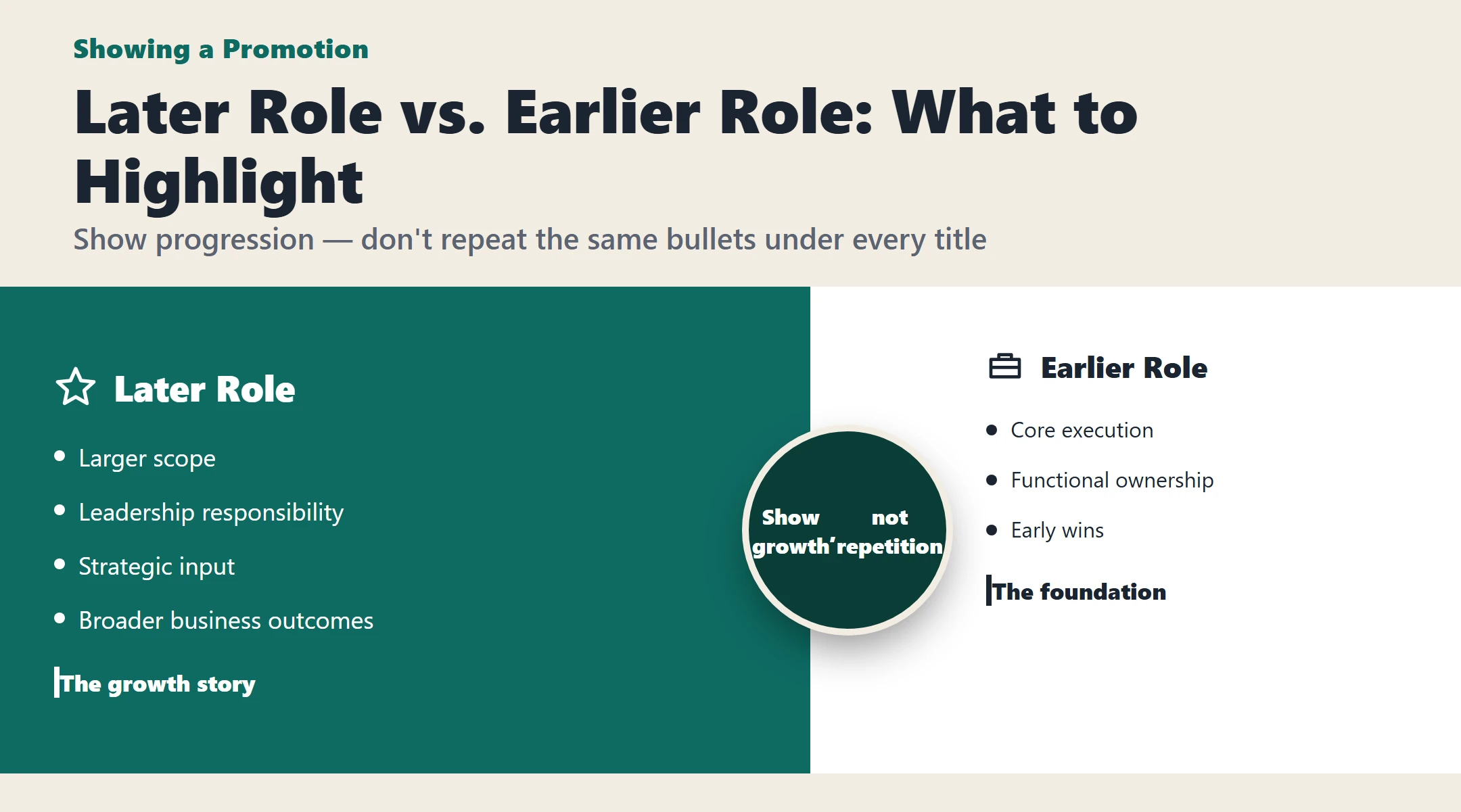
For the earlier role:
- Core execution
- Functional ownership
- Early wins
For the later role:
- Larger scope
- Leadership responsibility
- Strategic input
- Broader business outcomes
Do not repeat the same bullets under every title. Show growth.
Many short stints: how to keep trust
If your experience includes several short roles, keep the presentation calm and structured.
You can:
- Keep titles and dates precise
- Group related freelance or consulting work by theme where appropriate
- Focus each entry on outcomes, not reasons for leaving
- Show continuity through projects, industries, or responsibilities
Short stints look less risky when the profile reads as coherent and professional.
Focus on Projects More Than Responsibilities
Responsibilities matter, but they should not dominate your entry.
Recruiters already know the general duties of a sales manager, finance analyst, HR partner, or operations lead. What they want to see is what you improved, delivered, or solved.
Use this balance
- 20% duties
- 80% outcomes, projects, and improvements
Example: one major project inside a role
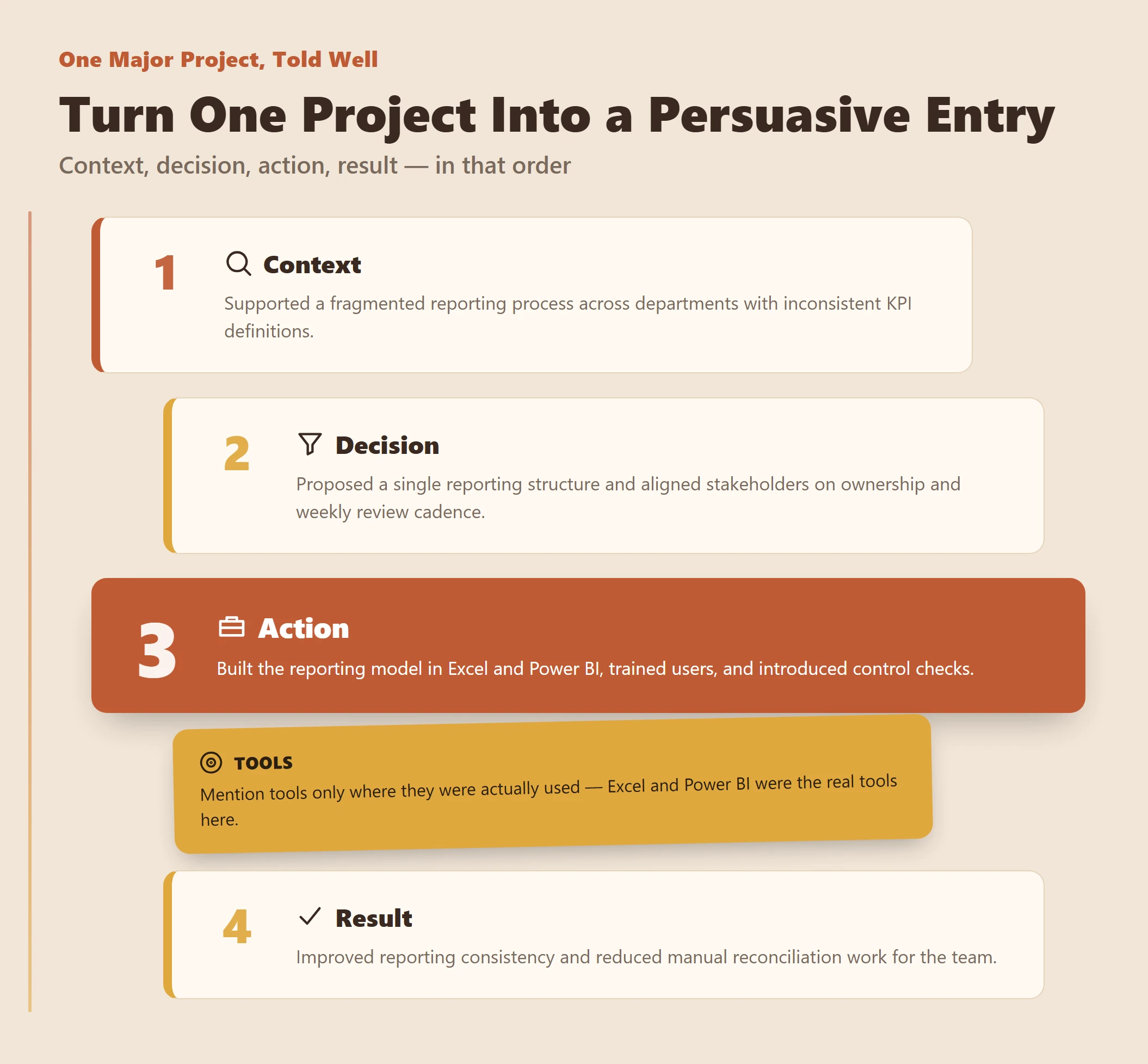
Use this sequence:
- Context
- Decision
- Action
- Result
- Tools, if relevant
Example:
- Supported a fragmented reporting process across departments with inconsistent KPI definitions.
- Proposed a single reporting structure and aligned stakeholders on ownership and weekly review cadence.
- Built the reporting model in Excel and Power BI, trained users, and introduced control checks.
- Improved reporting consistency and reduced manual reconciliation work for the team.
That is more persuasive than writing only “Responsible for reporting.”
Career gaps and freelance work
If you have a gap, keep the explanation brief and neutral. Mention relevant learning, consulting, projects, or professional development if it supports your direction.
For freelance work, create role-like entries with safe descriptions:
- State your function clearly
- Avoid naming confidential clients if needed
- Describe the project scope
- Show outcomes where possible
The aim is continuity and trust, not over-explanation.
Use Featured Media as Proof
LinkedIn gives you ways to attach proof. Use them carefully.
Featured media can strengthen your experience section when it directly supports your claims. Useful examples include:
- Presentation deck
- Dashboard screenshot
- Case summary
- Portfolio sample
- Event speaking clip
- Relevant published article
If confidentiality matters, use:
- Redacted screenshots
- Public-facing materials
- Sanitized case studies
- Anonymous project summaries
Get Better Endorsements by Asking Specifically
Endorsements are weak when they are random.
They become more useful when they match the work shown on your profile. Ask people who have seen your work directly, and guide them toward the right skill.
Simple endorsement request
“Would you mind endorsing me for stakeholder management and project delivery? We worked closely on the systems rollout, so those would reflect the project accurately.”
Why this works
- It ties the request to a real project
- It helps the person choose relevant skills
- It improves consistency across your profile
Ask soon after a launch, migration, hiring cycle, audit, or major delivery phase.
Ask the Right People for Recommendations
Recommendations usually carry more trust than endorsements, but only when the source makes sense.
Strong options include:
- Direct managers
- Senior stakeholders
- Cross-functional peers
- Clients
- Project sponsors
Choose for credibility, not hierarchy alone.
Match the recommender to the proof
Ask:
- A manager to validate leadership and growth
- A peer to validate collaboration and delivery
- A client to validate business value
- A senior stakeholder to validate strategic contribution
Later, you may need to talk about achievements in interviews with the same level of clarity. Good recommendations support that story.
Use a Recommendation Prompt Template
Do not send a vague request.
Make it easy for the other person by giving them context, the project, and the outcomes you would like them to mention.
Template
Hi [Name], I hope you’re well. I’m updating my LinkedIn profile and would really appreciate a recommendation based on our work together on [project or scope].
If helpful, a few points you could mention are:
- the context of the work
- what I owned or led
- how I worked with the team
- the outcome or business value
For example, this could relate to [process improvement / launch / reporting transformation / client delivery]. Thank you either way.
That keeps the request professional and practical.
Choose the Right Items for the Featured Section
Your featured section should support your experience section, not distract from it.
Pin items that prove impact, such as:
- A strong case study
- A relevant portfolio sample
- A useful presentation
- A published insight tied to your specialty
- A project summary with clear business relevance
Avoid:
- Irrelevant reposts
- Personal updates with no professional value
- Old work that no longer fits your target direction
A good test is simple: if a recruiter opens the item, will it strengthen your case?
Experience Bullet Library: Marketing and Growth
Use these templates and replace the brackets:
- Led [channel/campaign] across [market/segment], improving [metric] by [result], supported by [evidence].
- Built [funnel/lifecycle/program] for [audience], increasing [conversion metric] through [action], tracked via [dashboard/report].
- Optimized [campaign element] across [scope], reducing [cost or waste] while improving [result], based on [test/analysis].
- Partnered with [sales/product/agency] on [initiative], helping increase [pipeline/leads] through [specific change], shown in [evidence].
- Launched [new campaign/program] for [product/market], achieving [result] within [timeframe], measured using [tool].
- Improved [retention/engagement] for [customer group] by redesigning [journey/content/process], resulting in [outcome], verified by [metric].
- Managed [budget/channel mix] across [scope], reallocating spend toward [high-performing area] to improve [business result], evidenced by [report].
- Developed [reporting/insight model] for [leadership/team], enabling faster decisions on [priority area], supported by [cadence/KPI].
Experience Bullet Library: Sales
- Managed [territory/account portfolio] across [segment], achieving [result] through [sales action], supported by [evidence].
- Grew [pipeline/revenue/account base] in [market], using [strategy], resulting in [outcome], tracked in [CRM/report].
- Improved conversion from [stage] to [stage] by refining [qualification/demo/follow-up process], leading to [result], shown by [metric].
- Re-engaged [inactive accounts/target segment] through [campaign/outreach plan], generating [outcome], evidenced by [pipeline data].
- Built relationships with [stakeholder type] across [industry/region], helping shorten [sales cycle/onboarding delay], supported by [result].
- Coordinated with [marketing/product/operations] to remove [deal blocker], improving [win rate/forecast quality], verified by [reporting].
- Standardized [sales process/template/playbook] for [team], increasing [consistency/output], measured by [KPI].
- Led [strategic account/renewal effort] for [client type], protecting or expanding [revenue/value], supported by [business outcome].
Experience Bullet Library: Finance
- Built [forecast/budget/reporting model] for [business unit], improving [accuracy/speed/visibility], supported by [evidence].
- Analyzed [cost/revenue/variance area] across [scope], identifying [issue/opportunity] that led to [result], shown in [report].
- Streamlined [month-end/reporting/control] process for [team/function], reducing [manual work/errors/delay], evidenced by [outcome].
- Partnered with [business leaders] on [planning decision], providing [financial insight] that supported [business result], tracked via [review process].
- Improved [cash flow/cost control/spend discipline] by introducing [tool/process], resulting in [outcome], validated by [metric].
- Consolidated [multi-entity/regional] data into [dashboard/model], helping leadership monitor [priority area], supported by [cadence].
- Strengthened [controls/compliance/documentation] for [process], reducing [risk/rework/issues], evidenced by [audit or review outcome].
- Evaluated [investment/project/pricing] scenarios for [business case], enabling [decision], supported by [analysis output].
Experience Bullet Library: Product
- Led [feature/product initiative] for [user segment], improving [adoption/usage/outcome] through [action], measured by [metric].
- Prioritized [roadmap/backlog] across [scope], aligning [stakeholders] around [goal], resulting in [business outcome], shown in [evidence].
- Conducted [user research/analysis] on [problem], identifying [insight] that informed [decision], leading to [result].
- Partnered with [engineering/design/ops] to launch [capability], delivering [value] within [timeframe], tracked by [KPI].
- Reduced friction in [journey/process] by redesigning [step/feature], improving [metric], supported by [usage or feedback data].
- Defined [requirements/success metrics] for [initiative], helping the team deliver [outcome], evidenced by [release result].
- Coordinated cross-functional delivery of [product change] across [markets/teams], improving [consistency/performance], verified by [metric].
- Built reporting around [feature/performance area], enabling better prioritization and stakeholder communication, supported by [cadence/tool].
Experience Bullet Library: Operations
- Improved [process/workflow] across [site/team/function], reducing [delay/error/cost] through [action], supported by [evidence].
- Managed daily operations for [scope], introducing [control/standard] that improved [consistency/output], measured by [KPI].
- Coordinated [vendors/teams/locations] across [operation type], helping maintain [service level/throughput], evidenced by [result].
- Redesigned [handoff/scheduling/tracking] process for [function], reducing [bottleneck] and improving [business outcome], shown by [metric].
- Led [improvement initiative] across [scope], standardizing [practice] and improving [efficiency/visibility], verified by [report].
- Monitored [service quality/capacity/compliance] for [operation], identifying [issue] early and enabling [action], supported by [outcome].
- Partnered with [finance/HR/IT/sales] to improve [cross-functional process], resulting in [faster turnaround/better control], evidenced by [KPI].
- Built [dashboard/checklist/SOP] for [team], helping sustain [performance level] and reduce [rework/escalations], supported by [evidence].
Experience Bullet Library: HR
- Supported hiring across [function/region], improving [speed/quality/experience] by refining [process], evidenced by [metric].
- Partnered with managers on [workforce/talent issue], helping address [need] through [action], resulting in [outcome].
- Improved onboarding for [employee group] by redesigning [step/program], increasing [consistency/engagement], supported by [feedback or KPI].
- Built [report/dashboard] for [HR metric], giving leaders clearer visibility into [hiring/turnover/training], evidenced by [decision impact].
- Coordinated [L&D/performance/recruitment] initiatives across [scope], improving [completion/adoption/alignment], shown in [result].
- Standardized [policy/process/documentation] for [HR area], reducing [errors/delays/questions], supported by [outcome].
- Managed employee relations cases across [scope], ensuring timely resolution and clear stakeholder communication, evidenced by [service level].
- Introduced [tracking/review cadence] for [HR process], helping improve accountability and follow-through, verified by [KPI or feedback].
Experience Bullet Library: Data
- Built [dashboard/model/pipeline] for [team/function], improving [visibility/speed/accuracy], supported by [metric].
- Analyzed [business problem] across [dataset/scope], identifying [insight] that led to [action], evidenced by [result].
- Automated [report/process] using [tool], reducing [manual effort/errors/time], verified by [outcome].
- Defined [metric/logic/data structure] for [use case], improving consistency in [reporting/decision-making], shown by [adoption or result].
- Partnered with [business function] to translate [need] into [analysis/dashboard], enabling [decision], supported by [evidence].
- Improved data quality for [source/process] by introducing [validation/control], reducing [issue], evidenced by [result].
- Created [self-service report/tool] for [stakeholders], helping reduce ad hoc requests and improve access to insights, shown in [usage].
- Monitored [performance/risk/operational] trends through [analysis method], enabling early action on [issue], supported by [outcome].
Experience Bullet Library: PMO
- Led project governance for [program/portfolio], improving [visibility/control/on-time delivery], evidenced by [KPI].
- Built project tracking for [initiative scope], helping stakeholders monitor [risks/dependencies/progress], supported by [cadence/report].
- Coordinated cross-functional delivery across [teams/workstreams], reducing [delay/confusion] through [standard process], shown by [result].
- Managed RAID logs and reporting for [program], enabling faster escalation and decision-making, evidenced by [outcome].
- Standardized templates and stage gates for [project environment], improving [consistency/compliance], verified by [review result].
- Supported leadership reviews for [portfolio], consolidating updates into [dashboard/pack] that improved [decision quality], supported by [feedback].
- Improved resource planning across [projects/workstreams], reducing [conflicts/idle time] and improving [delivery confidence], measured by [metric].
- Helped recover [delayed/at-risk project] by tightening [governance/ownership/tracking], leading to [improvement], shown in [result].
Experience Bullet Library: Customer Success
- Managed [customer portfolio/segment], improving [retention/adoption/renewal] through [action], supported by [metric].
- Led onboarding for [customer type], helping reduce time-to-value and improve [engagement/outcome], evidenced by [result].
- Partnered with [sales/product/support] to resolve [customer issue/theme], improving [experience/retention], shown by [feedback or KPI].
- Built account review cadence for [client group], increasing visibility into [risk/opportunity], supported by [outcome].
- Improved product adoption by guiding customers through [use case/workflow], resulting in [business impact], evidenced by [usage data].
- Identified churn risks across [portfolio], prioritizing outreach and recovery actions that improved [retention outcome], verified by [metric].
- Created [playbook/resource/training] for [customer stage], increasing [consistency/scalability], shown by [result].
- Supported expansion conversations with [accounts/segment] by linking product value to business needs, contributing to [outcome], evidenced by [commercial result].
Experience Bullet Library: Admin
- Coordinated [calendar/travel/meeting support] for [leader/team], improving [efficiency/response time], supported by [outcome].
- Managed documentation and tracking for [process/function], reducing [errors/delays/missed steps], evidenced by [result].
- Organized [events/visits/reviews] across [scope], ensuring smooth execution and clear stakeholder communication, shown by [feedback or outcome].
- Built [filing/reporting/tracking] system for [team], improving [access/control/visibility], supported by [evidence].
- Supported cross-functional coordination for [project/office process], helping maintain [timeline/service quality], evidenced by [result].
- Improved office or team workflow by standardizing [template/checklist/process], reducing [rework/confusion], shown by [outcome].
- Monitored [requests/invoices/records] for [function], helping maintain timely follow-up and better control, supported by [service level].
- Prepared [reports/briefings/materials] for [leadership/team], improving readiness for [meetings/reviews/audits], evidenced by [result].
Final Next Step
A strong LinkedIn experience section helps recruiters understand your value quickly, trust your claims, and see your growth clearly.
Get a professional CV rewrite and LinkedIn-focused positioning support for experienced professionals who want stronger achievement bullets and a clearer application-ready profile—start here .